

Financial Sanctions and Economic Coercion

Financial sanctions and other forms of economic coercion have become policy tools of choice for the US government to deter illegal activity by international actors or to pressure governments into reversing actions that harm US interests. Yet these instruments and their potential pitfalls are often misunderstood. Restrictive economic measures such as financial sanctions, export controls, tariffs, and investment screening can play an important role in advancing certain policy objectives, but they risk being ineffective if misapplied or poorly implemented. Policymakers must also recognize the impact of economic statecraft on the private sector, which bears many of the compliance burdens and operational costs associated with these measures.

Energy Sanctions Dashboard

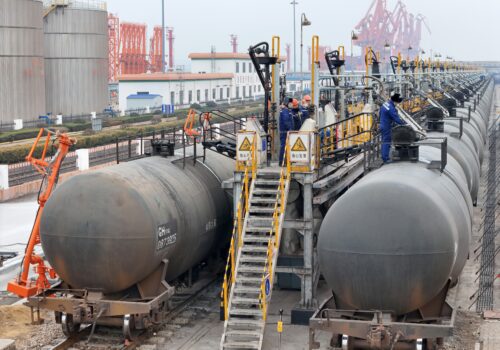
This dashboard focuses on US sanctions and restrictive measures placed on crude oil from Russia, Iran, and Venezuela—including the unintended consequences and the lessons learned.

Econographics

Apr 17, 2025

Russia Sanctions Database

By Kimberly Donovan, Maia Nikoladze, Lize de Kruijf

The Atlantic Council’s Russia Sanctions Database tracks the level of coordination among Western allies in sanctioning Russian entities, individuals, vessels, and aircraft, and shows where gaps still remain.

Eastern Europe Economy & Business

Recent analysis

Programs

At the intersection of economics, finance, and foreign policy, the GeoEconomics Center is a translation hub with the goal of helping shape a better global economic future.

Content

Dispatches

Mar 25, 2026

From drones to rocket fuel, China and Russia are helping Iran through supply chains

By Kimberly Donovan and Emily Ezratty

The US will need to confront China and Russia about their support for the Iranian regime and their schemes to evade sanctions and export controls.

China Conflict

In the News

Mar 20, 2026

Temnycky in Forbes: Hungary creates rift with EU and Ukraine over Russian energy sanctions

By Atlantic Council

Conflict Economy & Business

Issue Brief

Mar 16, 2026

Reconstructing Gaza starts with giving Palestinians financial agency

By Melanie Robbins 

Palestinians are dependent on Israeli banks for cash and access to the financial system, and Jerusalem has floated the possibility of cutting off that access. Any credible reconstruction plan for Gaza has to account for this—otherwise, essential aid organizations can’t pay local staff, and households and businesses can't pay for daily necessities.

Financial Sanctions and Economic Coercion Israel

Dispatches

Mar 5, 2026

Enforce sanctions to prevent Russia from benefitting in a prolonged Iran crisis

By Kimberly Donovan

Russia has millions of barrels of sanctioned oil it is ready to sell—unless the United States and its allies step up sanctions enforcement.

Conflict Energy & Environment

Dispatches

Feb 26, 2026

Lessons from Sudan for US economic engagement with Venezuela

By Lesley Chavkin

Sudan offers important lessons for the United States as it looks to stabilize Venezuela and rebuild its economy following the capture of Nicolás Maduro.

Economy & Business Financial Sanctions and Economic Coercion

Econographics

Feb 24, 2026

In Munich, a reminder that economic security is national security

By Kimberly Donovan, Lize de Kruijf

Policymakers at this year's MSC raised economic security as an issue that they cannot cordon off separately from traditional security issues.

Economy & Business European Union

Dispatches

Feb 5, 2026

When economic warfare meets gunboat diplomacy: What to know about the US seizures of shadow fleet tankers

By Stephanie Connor

The Trump administration’s seizures of “shadow fleet” vessels evading US sanctions raises several crucial legal and logistical questions.

Economy & Business Europe & Eurasia

Balkans Debrief

Jan 16, 2026

Is the U.S. Back in the Western Balkans? A Debrief with Congressman Mike Turner

Rep. Mike Turner sits down with Ilva Tare of the Europe Center to discuss the future of US engagement in the Western Balkans.

Europe & Eurasia Financial Sanctions and Economic Coercion

MENASource

Jan 8, 2026

As Iran protests continue, policymakers should apply these key lessons

By Abram Paley and Nate Swanson

The Iranian people are bravely leading the current protests. It is essential to keep the focus on them.

Civil Society Financial Sanctions and Economic Coercion

UkraineAlert

Dec 18, 2025

Prisoner releases are welcome news but talk of a Belarus thaw is premature

By Hanna Liubakova

The freeing of 123 political prisoners in Belarus last week is encouraging news but should not be interpreted as an indication of more fundamental change, writes Hanna Liubakova.

Belarus Conflict

Experts