Content

Issue Brief

Jul 7, 2020

Emerging technologies: new challenges to global stability

By Robert A. Manning

The world may be fast approaching the perfect storm, with the intersection of two major global trends. At a moment of historic transition, when the post-WWII and post-Cold War international order is eroding amid competing visions of world order and renewed geopolitical rivalries, the world is also in the early stages of an unprecedented technological transformation

China
Cybersecurity

Blog Post

Jun 10, 2020

State of the Order: Assessing May 2020

The State of the Order breaks down the month's most important events impacting the democratic world order.

International Norms
Politics & Diplomacy

Timely Commentary & Analysis

Jun 5, 2020

Artificial intelligence principles: Avoiding catastrophe

By Robert A. Manning

An urgent challenge for the coming decade is to forge a global consensus to operationalize widely-shared ethical principles, standards, and norms to govern the development and use of artificial intelligence.

Americas
China

UkraineAlert

Jun 2, 2020

Trump’s G7 invite for Putin will encourage more war

By Yuliia Popyk

US President Donald Trump wants to invite Vladimir Putin to the next G7 summit, despite the Russian leader's refusal to end the aggression against Ukraine that led to his initial suspension from G8 in 2014.

Conflict
France
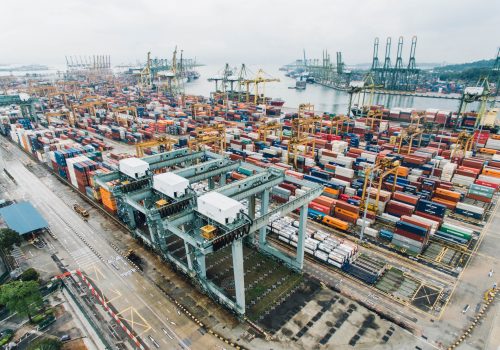
gtc manufacturing supply cahins and different parts

GeoTech Cues

Jun 1, 2020

Expert survey series: Supply chains and the effects of COVID-19, geopolitics, and technological innovation

By Andrea Little Limbago, Stewart Scott

For the fourth installment of the GeoTech Center’s expert survey series, we asked a range of business leaders and tech experts how COVID-19 has impacted their industry’s or enterprise’s supply chains. Significant shortages of personal protective equipment and tests have plagued hospitals, and many countries’ dependence on China quickly became evident in the initial rush to obtain supplies. Food supply chains have also been significantly disrupted--for instance, infection rates at meat packing plants are five-times greater than those in similar geographies.

Coronavirus
Economy & Business

In the News

May 20, 2020

Nawaz joins the Center for Global Policy to discuss his book, “The Battle for Pakistan”

By Atlantic Council

International Norms
Pakistan

In the News

May 12, 2020

Dr. David Bray on leadership in crisis situations

By Atlantic Council

In a recent conversation with the team of OpenExo, Dr. David Bray, Director of the GeoTech Center, spoke on his expertise on government and popular response to crises, to offer guidance on how we as a society might leverage technology to emerge stronger from COVID-19. Citing his years of experience at the heart of teams in charge of anticipating and preventing crises, Dr. Bray explored the way that open societies in particular can take advantage of their strengths and identify threats before they come to fruition, without threatening individual liberties in the process. In order for this effort to succeed, though, Dr. Bray emphasized how intentional steps must be taken now to shape the future of data and society.

Cybersecurity
Digital Policy

Blog Post

May 11, 2020

State of the Order: Assessing April 2020

The State of the Order breaks down the month's most important events impacting the democratic world order.

International Norms
Politics & Diplomacy

In the News

May 7, 2020

Ghori-Ahmad joins the podcast All Encompassing to discuss Harvard University Professor Joseph Nye’s book, “Do morals matter? Presidents and foreign policy from FDR to Trump.”

By Atlantic Council

International Norms
Political Reform

New Atlanticist

May 5, 2020

Democratic solidarity and the road ahead

By Ana Palacio and Daniel Fried

The United States needs to lead in devising both immediate and systemic responses to the coronavirus challenge, but not alone. Leadership means neither diktat nor incantation of old formulas. It means using American convening power to adapt tested principles to new challenges, crystalizing friends and allies—transatlantic, transpacific and not forgetting hemispheric—around a common agenda.

Coronavirus
G20

Experts