Technology & Innovation

The rapid pace of technological change can both provide governments and individuals with new tools to achieve policy goals, while also presenting societies with new economic, political, and social challenges. The harnessing of new technologies can unlock new economic growth, enhance inclusivity and equity, and increase citizens’ quality of life, but their potentially damaging side effects must also be managed. In an era of growing geopolitical and economic competition, governments must also focus on how to ensure their societies retain a technological edge, and produce new innovative products and solutions to drive growth.

The Atlantic Council Technology Programs comprises five existing efforts—the Digital Forensic Research Lab (DFRLab), the GeoTech Center, the Cyber Statecraft Initiative, the Democracy + Tech Initiative, and the Capacity Building Initiative. These operations work together to address the geopolitical implications of technology and provide policymakers and global stakeholders necessary research, insights, and convenings to address challenges around global technology and ensure its responsible advancement.


Content

Report

Nov 10, 2025

The geopolitical trends shaping the EU’s policies on China

By Zoltán Fehér, Valbona Zeneli

European policies on China are shaped by four major geopolitical trends: intensifying US-China competition, uncertainty about sustained US engagement in Europe and globally, China’s support for Russia’s war on Ukraine, and Beijing’s growing economic and technological challenge to the EU.

China Economy & Business

Report

Nov 10, 2025

France’s policy on China: Strategic autonomy and less naïveté

By Zoltán Fehér

Over the last decade, France’s long-standing engagement with China has transformed into a more nuanced and cautious dynamic, reflecting a growing emphasis on balancing. This shift is guided by France’s pursuit of strategic autonomy, its effort to “de-risk” economic and security ties, and the broader geopolitical realities unfolding in the Indo-Pacific.

China Economy & Business

Report

Nov 10, 2025

Poland’s policy on China: From partnership to skepticism

By Zoltán Fehér

Despite its traditionally transatlantic orientation, Poland pursued an engagement policy toward China until the late 2010s. However, unmet economic promises and Beijing’s alignment with Moscow following Russia’s invasion of Ukraine shifted Warsaw’s view of China from economic partner to systemic challenger.

China Economy & Business

Report

Nov 10, 2025

Is Europe waking up to the China challenge? How geopolitics are reshaping EU and transatlantic strategy

By Zoltán Fehér, Valbona Zeneli

China’s rising global ambitions challenge both US and European interests. By examining the EU’s gradual shift toward “de-risking” and gaps in transatlantic policy, this report offers insights for developing a more coherent and coordinated strategy to address Beijing’s economic and security challenges.

China Europe & Eurasia

Report

Nov 10, 2025

Convergence and divergence in US and EU policies on China

By Zoltán Fehér

Where have US and EU polices on China drifted apart—and where do they converge? Identifying areas of conflict and alignment can help decision-makers on both sides of the Atlantic develop strategies to strengthen cooperation and more effectively counter China’s political and economic influence.

China Economy & Business

Report

Nov 10, 2025

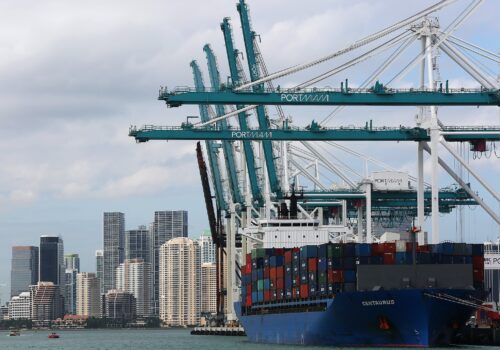
How Europe deals with China in trade, technology, and security

By Valbona Zeneli

The EU’s approach to China is increasingly converging around “de-risking,” though progress remains uneven. While powerful member states set the overall direction, smaller ones drive change—and outliers slow collective action. Whether the EU can turn this patchwork into a unified strategy will define its China policy in the years ahead.

China Economy & Business

UkraineAlert

Nov 10, 2025

Angelina Jolie highlights the horrors of Russia’s ‘human safari’ in Ukraine

By Peter Dickinson

Hollywood star Angelina Jolie paid a surprise visit to Ukraine in early November to help raise international awareness about Russia's 'human safari' campaign of drone killings targeting Ukrainian civilians, writes Peter Dickinson.

Conflict Drones

UkraineAlert

Nov 6, 2025

Vladimir Putin’s endless nuclear threats are a sign of Russian weakness

By Stephen Blank

Since 2022, Russian President Vladimir Putin has repeatedly used nuclear threats to deter Western support for Ukraine, but this scare tactic risks exposing Russia's inability to project strength via more conventional means, writes Stephen Blank.

Conflict Disinformation

UkraineAlert

Nov 6, 2025

Learning the lessons from Ukraine’s fight against Russian cyber warfare

By Oleksandr Bakalynskyi, Maggie McDonough

The Russian invasion of Ukraine is among the most technologically advanced wars the world has seen. But while rapid developments in drone warfare tend to attract most attention, the cyber front also offers important lessons for international audiences, write Oleksandr Bakalynskyi and Maggie McDonough.

Conflict Cybersecurity

New Atlanticist

Nov 6, 2025

How South Korea advanced its trade and technology agenda at the APEC summit

By Kayla T. Orta

South Korea leveraged its diplomatic influence to strengthen Seoul’s standing within the multilateral economic framework and secure trade deals with the United States.

Economy & Business Indo-Pacific

Experts

Events