After Israel’s recognition of Somaliland, what comes next?
In a historic move, Israel has officially recognized the Republic of Somaliland as an independent and sovereign state. Preceded only by Taiwan, Israel is the first United Nations member to recognize Somaliland after more than three decades of international impasse. Announced on December 26, the recognition was formalized through a joint declaration signed by Prime Minister Benjamin Netanyahu and Somaliland President Abdirahman Mohamed Abdallah. In parallel, Somaliland pledged to join the Abraham Accords, aligning itself with Washington’s regional normalization framework.
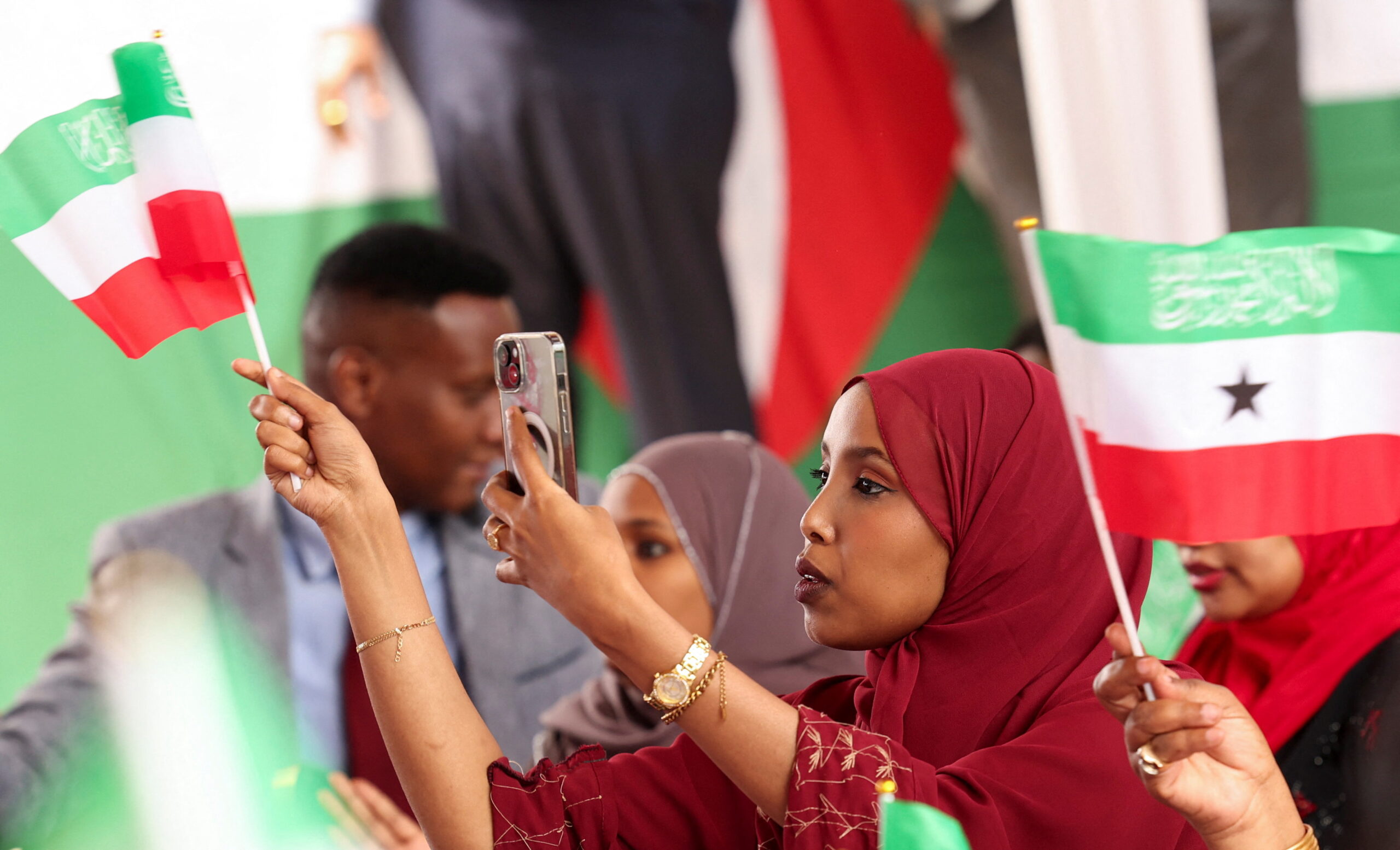
Somaliland’s leaders hailed Israel’s decision as “historic,” celebrating it as long-awaited validation of de facto statehood, with the Israeli flag projected in Somaliland’s capital, Hargeisa. The decision builds on Somaliland’s record of relative stability and functioning democratic institutions, factors that have long differentiated it within a volatile region. However, beyond its symbolism, the significance of recognition will be shaped by its implementation. How Israel translates this decision into security, economic, and diplomatic engagement, while managing regional sensitivities and coordinating with key partners, particularly the United States and the United Arab Emirates (UAE), will determine whether recognition evolves into a durable framework for regional cooperation.
SIGN UP FOR THIS WEEK IN THE MIDEAST NEWSLETTER
Recognition and its limits
Israel’s recognition of Somaliland reshapes the scope of bilateral engagement but does not eliminate the diplomatic and political constraints tied to Somaliland’s contested status. In practical terms, recognition elevates Israel–Somaliland relations from informal coordination to institutionalized state-to-state ties, enabling formal bilateral channels for security dialogue, economic cooperation, and diplomatic presence. The Israeli statement has already signaled an intention to expand cooperation in areas such as agriculture, health, technology, and economic development with Somaliland.
The security implications are most pronounced in the Red Sea context. Israeli officials have confirmed that the recognition is linked to countering Iran and its regional proxies, particularly the Houthi rebels in Yemen. Somaliland’s leadership has, according to regional reporting, been open to hosting an Israeli security presence in exchange for recognition. Formal ties now allow for open discussions on intelligence sharing, port security, and, over time, potential logistical or monitoring arrangements aimed at Red Sea threats.
Economically, recognition reduces political risk for investment and long-term cooperation. Israeli engagement in sectors such as water management, agriculture, health technology, and logistics now rests on a formal diplomatic foundation, creating pathways for trade relations and tangible economic outcomes.
At the same time, recognition does not resolve Somaliland’s contested international status. The Somali Federal Government considers Somaliland part of its territory and opposes any foreign engagement implying recognition. Israel remains the sole United Nations member to have taken this step. The United States, European Union, African Union (AU) members, and even Somaliland’s closest regional partner, the United Arab Emirates, have thus far refrained from recognition. The AU has rejected Israel’s move, reaffirming its commitment to Somalia’s territorial integrity and limiting Somaliland’s access to international institutions in the near term.
Nor does recognition eliminate regional resistance. Somalia’s federal government and several regional actors view Israel’s move as divisive rather than a stabilizing development. In a joint statement, Somalia, Egypt, Turkey, and Djibouti condemned Israel’s decision and reaffirmed their support for Somalia’s territorial integrity. The recognition raises concerns about regional fragmentation and risks inflaming nationalist sentiment in Somalia, while straining Israel’s relations in Africa.
Taken together, recognition expands what can be done while narrowing the margin for error. It enables cooperation but also raises expectations and diplomatic costs that must now be actively managed.
Why this decision came now
Israel’s unprecedented recognition of Somaliland reflects a convergence of strategic and political calculations. Domestically, Netanyahu is under intense pressure from the “Qatargate” scandal: allegations that his top aides accepted Qatari funds to influence policy. With Netanyahu facing calls to resign and looking ahead to a 2026 election year, the move offers an opportunity to shift the narrative with a diplomatic win. Netanyahu explicitly framed the decision “in the spirit of the Abraham Accords,” aligning it with US President Donald Trump’s revived normalization framework. This alignment allows Netanyahu to tout a foreign-policy success at a time when both Saudi Arabia and Indonesia appear reluctant to normalize relations with Israel in the near term, largely due to sustained political sensitivities around the war in Gaza.
Security dynamics further help explain the timing. As Israel emerges from a multifront war in which it has significantly degraded Hamas in Gaza, Hezbollah in Lebanon, and Iranian assets in Syria, one front remains unresolved: the Houthis in Yemen. Despite extensive US and Israeli military action, including more than 1,100 US strikes and repeated Israeli operations, the Iranian-backed group continues to strike Israel and disrupt international shipping in the Red Sea, exposing enduring intelligence and operational constraints for both Washington and Jerusalem.
In this context, Somaliland’s geography takes on heightened relevance. Located across from Yemen near the Bab el-Mandeb chokepoint, Somaliland offers a stable platform for intelligence cooperation, maritime monitoring, and contingency planning against a shared Houthi threat that neither Israel nor the United States has been able to decisively neutralize. The recognition, therefore, is not merely diplomatic; it reflects a recalibration toward long-term Israeli positioning in a theater where the conflict is not over.
Washington’s calculus
Trump responded to Israel’s recognition by making clear that Washington is not prepared to follow Jerusalem’s lead, reiterating that the matter remains under review. This caution comes despite growing bipartisan pressure in Congress toward recognition. In August, Republican Senator Ted Cruz (R-TX) publicly urged the administration to consider recognition, framing Somaliland as a reliable security partner and a strategically aligned actor in the region. At the time, Trump acknowledged that the administration was “looking into” the question of recognition, signaling openness without committing to a policy shift.
The hesitation reflects competing strategic calculations. On one hand, US defense planners have long recognized Somaliland’s value. Senior US Africa Command officials have recently visited Hargeisa, and Somaliland has reportedly offered military basing that could enhance US capabilities to counter Houthi maritime disruption and limit Chinese influence along the Horn of Africa. On the other hand, formal recognition carries diplomatic costs. A unilateral shift risks undermining US relations and counterterrorism coordination with Somalia’s federal government while also straining ties with regional partners.
Therefore, Washington will continue to face pressure from Mogadishu and the AU to preserve the status quo. Still, the strategic consequences of Israel’s move, combined with US interests in the region, make eventual US recognition increasingly plausible.
Abu Dhabi’s balancing act
The UAE takes a more nuanced position. Abu Dhabi has been Somaliland’s most significant partner for nearly a decade, investing heavily through DP World’s development of Berbera port and maintaining a diplomatic liaison office in Hargeisa. These ties reflect a strategic interest that predates Israel’s recognition and position the UAE as a central economic and security actor in Somaliland.
Notably, while the Gulf Cooperation Council (GCC) issued a collective statement condemning Israel’s recognition, the UAE has not issued a standalone national condemnation. This distinction matters. Abu Dhabi’s posture signals its careful balancing of Somaliland engagement against broader Gulf dynamics, particularly Saudi Arabia’s firm response. Riyadh’s stance, aligned with Somalia and reinforced through the GCC and Organisation of Islamic Cooperation, constrains the UAE’s room for maneuver, even as intra-Gulf competition in the Horn of Africa continues to shape Emirati strategy.
In practice, the UAE is unlikely to scale back its presence in Somaliland. Instead, Abu Dhabi is expected to deepen engagement quietly, continuing port and infrastructure projects while avoiding a high-profile diplomatic break. Formal recognition remains possible over time, but would likely be pursued in coordination with Washington and in consultation with the AU.
Turning recognition into strategy
With Israel and Somaliland now formal partners, the priority should be to consolidate this diplomatic opening without inflaming regional tensions. What follows should be guided by coordination, restraint, and sequencing, particularly with the United States.
For Israel, close coordination with Washington is essential. Acting in parallel with the United States, rather than ahead of it, will reduce friction with regional partners and avoid working at cross purposes. At the same time, Israel should quietly engage key Arab and African partners, including the UAE, Ethiopia, and Kenya, to explain its move, encourage pragmatic cooperation, and mitigate long-term fallout.
Israel should prioritize a phased rollout of cooperation with Somaliland. Rushing into highly visible steps, such as military facilities or overt security deployments, risks provoking backlash from Somalia and its allies. In the near term, Israel would be better served by avoiding provocations and emphasizing civilian and developmental cooperation, signaling good faith and framing recognition as stabilizing rather than militarizing. Security cooperation, while clearly part of Israel’s calculus, should initially remain low-profile, focused on intelligence-sharing and counterterrorism rather than overt operations.
Finally, Israel should embed its engagement with Somaliland within a multilateral framework. Coordinating security and economic initiatives with the United States and the UAE, leveraging the UAE’s established military and logistical presence in Somaliland and existing US Africa Command infrastructure, would anchor cooperation within broader regional architectures, enhancing legitimacy and durability.
The United States, even if not prepared to recognize Somaliland at this stage, remains central to shaping outcomes through its regional security presence and diplomatic influence on both African and Arab actors. The Trump administration has stated that the issue remains under review; this window should be used to conduct a structured interagency assessment of US policy toward Somaliland and its implications for Red Sea security, counterterrorism, and regional diplomacy.
Short of recognition, Washington can deepen engagement incrementally. Options include upgrading its diplomatic presence in Hargeisa to a liaison office, expanding security cooperation and training, and increasing investment; steps that advance US interests while preserving strategic flexibility.
At the same time, Washington should leverage its influence with Mogadishu to discourage escalation with Somaliland. A US-facilitated confidence-building process, building on this administration’s successful mediation track record, could help preserve space for dialogue.
Ultimately, Israel’s unprecedented recognition of Somaliland reflects confidence in a stable partner and a belief that engagement can strengthen security in the Red Sea. If implemented in alignment with Washington, this move has the potential to reshape regional dynamics beyond the Horn of Africa.
Amit Yarom is a graduate student at the Elliott School of International Affairs at George Washington University. He is a foreign policy researcher, specializing in the Arabian Gulf.
Related Reading
Image: Delegates wave the flags of Somaliland as they attend the unveiling of the Somaliland Mission premises in Nairobi, Kenya, May 29, 2025. REUTERS/Monicah Mwangi
