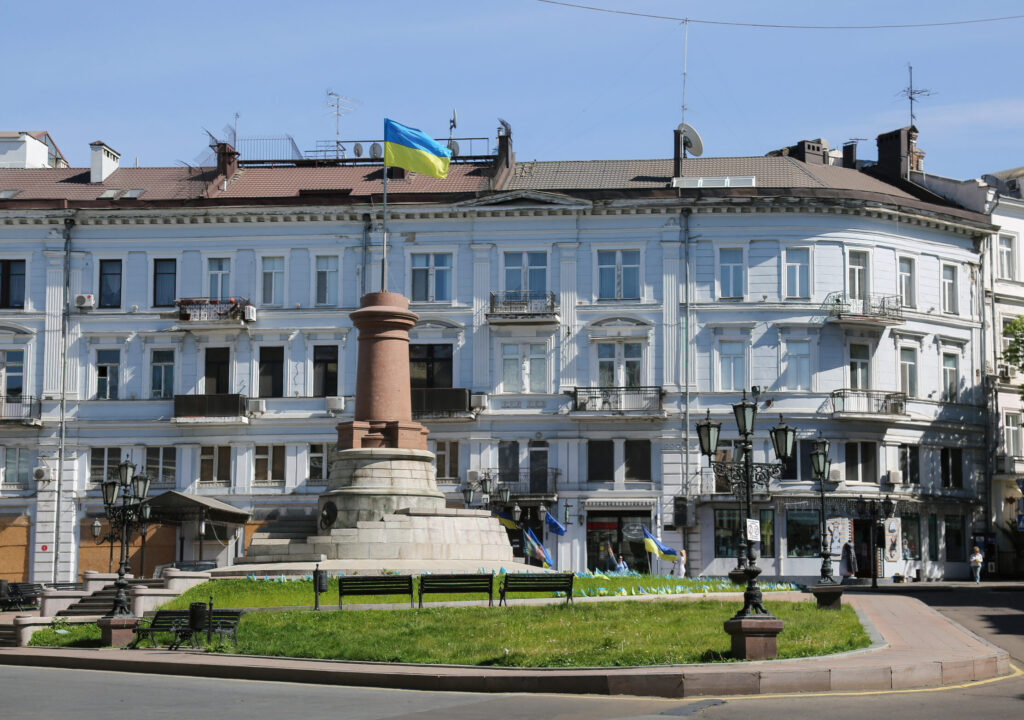
When Ukraine renames a city or tears down a Soviet-era monument, international media coverage tends to treat it as an understandable act of symbolic housekeeping by a nation at war. But this framing badly undersells what is actually happening.
Ukraine’s campaign to strip Soviet and Russian imperial place names from the country’s towns and cities is not a reaction to the current war so much as the leading edge of a region-wide rejection of Moscow’s cartography. From the Caucasus to Central Asia, former Soviet states are shedding the names and symbols imposed on them as they seek to assert their own national identities.
Ukraine’s decommunization and derussification drives began long before the full-scale invasion of February 2022. Initial renaming efforts started in the early 1990s, with streets across the country stripped of overtly Soviet names. This was accompanied by the removal of many but not all Communist monuments. Indeed, a giant Soviet hammer and sickle loomed over Independence Square in central Kyiv until the early 2000s.
A second major wave began in the wake of Ukraine’s 2014 Revolution of Dignity. Two years later, the city of Dnipropetrovsk became Dnipro, shedding a name that honored Bolshevik functionary Grigory Petrovsky, a man associated with the machinery of Soviet rule during the artificial famine of the early 1930s that killed millions of Ukrainians. Nearby Dniprodzerzhynsk reverted to its historic Kamianske, erasing the name of Felix Dzerzhinsky, founder of the Soviet secret police. Ordzhonikidze became Pokrov, dropping a Soviet revolutionary’s name entirely.
Following the onset of Russia’s full-scale invasion in 2022, Ukrainian decolonization efforts moved beyond Soviet-linked place names and went after Russian imperial identity directly. In 2024, Novomoskovsk (“New Moscow”) was renamed Samar, retiring one of the more brazen colonial names on the Ukrainian map. Meanwhile, Kyiv stripped Russian and Soviet names from roughly a hundred streets in a single batch.
In parallel to these steps, Ukraine has also appealed to the international community to abandon Russified place names and adopt spellings based on the Ukrainian language. This has led to small but symbolically important changes in international usage, such as the widely adopted switch from “Kiev” to “Kyiv.”
Stay updated
As the world watches the Russian invasion of Ukraine unfold, UkraineAlert delivers the best Atlantic Council expert insight and analysis on Ukraine twice a week directly to your inbox.
The Ukrainian case is the loudest, but it is far from unique. Russian and Soviet officials routinely renamed places to assert dominance and tie areas geographically to the imperial center. In Georgia, the town of Stepantsminda (“Saint Stephen”) had been renamed Kazbegi during the Soviet era in a bid to scrub the religious connotation. In 2006, Tbilisi restored the original name.
The Soviet name Kazbegi carried a particularly fitting irony. It honored nineteenth century Georgian writer Alexander Kazbegi, whose novel The Patricide features a bandit hero named Koba, the very character a young Iosif Dzhugashvili admired so much that he took “Koba” as his revolutionary alias before later settling on Stalin. The man who would industrialize the erasure of national identities across the USSR drew his earliest self image from the Georgian literature his own state later worked to bury.
In Central Asia, Kazakhstan offers some of the clearest examples of cartography as decolonization. For a country with a long Russian border, a large Russian-speaking population, and a national language weakened by Soviet rule, reclaiming the map is inseparable from reclaiming national identity. Following the fall of the USSR, the map of Kazakhstan soon began to change. Ust-Kamenogorsk became Oskemen and Uralsk became Oral.
Kazakh capital Astana is a fascinating case study. The city was originally known as Aqmola (“white tomb”) before being rechristened Tselinograd (“Virgin Lands City”) during the Soviet era, a name that cast Kazakhstan as empty territory to be settled by Russians. Following independence, this was changed to Akmola and then Astana, which simply means “capital city” in Kazakh.
The contested Nagorno-Karabakh region in the Southern Caucasus reflects the political significance of Soviet place names. “Karabakh” is a Turkic-Persian compound attested by historians as far back as the thirteenth century. The Russian language prefix “Nagorno” (“mountainous”) was bolted on in the early 1920s as Soviet planners reorganized the Caucasus, diluting an indigenous name with an imperial qualifier.
Eurasia Center events
Russia’s hostile response to the post-Soviet trend of decolonizing place names underlines the continued importance of imperially imposed geography. The Kremlin has condemned renaming practices in independent Ukraine as “forced derussification,” and has attacked it as an attempt to “break the historical unity” of the two nations.
This framing is drawn straight from Russian President Vladimir Putin’s July 2021 essay on the historical ties between Russia and Ukraine. Putin argued that the two neighboring countries were actually “one people” and complained that Bolshevik era efforts to define the borders separating Russians and Ukrainians meant “Russia was robbed.” This laid the ideological foundations for Russia’s full-scale invasion, which began months later.
Russia’s tone elsewhere is softer, but the worldview it reflects is more or less identical. Kremlin officials portray the post-Soviet space as a shared civilizational inheritance and lament any drift away from the Russian language, historical memory, or place names. While visiting a war memorial in Samarkand in 2025, Russian Foreign Minister Sergei Lavrov pointedly noted the absence of a Russian-language inscription alongside Uzbek and English texts. This was poorly received in Uzbekistan, with many viewing it as a former colonial power attempting to dictate language policy.
The Kremlin rhetoric toward Kazakhstan has been harder still. Putin claimed in 2014 that “the Kazakhs never had statehood” before the Soviet collapse. He later called Kazakhstan “a Russian-speaking country in the full sense of the word.” Astana’s reply was its own act of anti-imperial defiance: A national celebration to mark the five hundred and fiftieth anniversary of the Kazakh Khanate.
One of the most revealing reactions was also among the most recent. When Ukrainian President Volodymyr Zelenskyy and Armenian Prime Minister Nikol Pashinyan met during the European Political Community summit in Yerevan in May 2026 and spoke in English to each other, former Russian president Dmitry Medvedev derided them as “two brainless Russophobes” who despite being fluent in Russian, stumbled through their conversation in English “out of their own sense of inferiority.” The contempt is the point: For Moscow, choosing not to default to Russian is itself a hostile act.
The renaming of places throughout the former USSR reveals something more fundamental than geopolitical alignment. It reflects a determined assertion of independence and national identity by countries that spent generations having both defined for them. That is why the place names used by the international community also matter.
Every time a foreign official, media outlet, or map maker defaults to Lvov instead of Lviv, Uralsk instead of Oral, or Nagorno-Karabakh instead of Karabakh, it does more than repeat a Soviet-era convention. Such choices strip the countries of the former Soviet Union of the agency they are seeking to assert and re-files them in Russia’s backyard, endorsing Moscow’s claim that they are not truly sovereign peoples but rather provinces of a shared Russian space.
The corrective costs nothing. Using the names these countries choose for themselves is not a favor or a reward for good behavior; it is recognition that they have the right to name their own places and assert an independent identity of their own. The alternative is to keep validating an imperial map that the entire region is working to redraw.
Joseph Epstein is director of the Turan Research Center.
Further reading


The views expressed in UkraineAlert are solely those of the authors and do not necessarily reflect the views of the Atlantic Council, its staff, or its supporters.

The Eurasia Center’s mission is to enhance transatlantic cooperation in promoting stability, democratic values, and prosperity in Eurasia, from Eastern Europe and Turkey in the West to the Caucasus, Russia, and Central Asia in the East.
Follow us on social media
and support our work
Image: View of European Square (Formerly Catherine Square) in Odesa. The imperial name of the square was changed to the European name. The decision to change the name of the square and street was made by the Historical and Toponymic Commission of Odesa at its regular meeting. The decision was also supported by the residents of Odesa during the survey. (Credit Image: © Viacheslav Onyshchenko/SOPA Images via ZUMA Press Wire)
