The proverbial ink is barely dry on the digital draft of an interim deal to reopen the Strait of Hormuz. The news is welcome for an economy like Turkey’s that imports most of its energy needs. Still, the fifteen-week war has also provided another clear illustration of how such structural disadvantages outweigh advantages that could be derived from geography and nimble geopolitics.
Without much oil or gas available domestically, Turkey’s current account is highly sensitive to energy prices given the country’s still-high energy import dependency. While Ankara could muffle the pass-through to domestic inflation by scaling back energy taxation and subsidizing consumer prices, not much could be done about the effects on the balance of payments. Combined with domestic political uncertainties, the negative shock to the current account once again forced the Turkish Central Bank to defend the Lira exchange rate in March and late May. At just under thirty billion dollars, reserves net of loans and swaps haven’t yet entered negative territory, but this is only because the value of Turkey’s gold holdings has increased with global prices. The same phenomenon has also contributed to a rise in Turkish households’ and firms’ perceptions of their own wealth, as many invested in gold to protect themselves against depreciation. This is another complicating factor as Ankara tries to stamp out inflation.
The war brought a more novel set of challenges as well. The first is the risk of relying on corridors as a development strategy. The seventeen-billion-dollar Development Road project with Iraq was meant to connect the Gulf to Turkey’s own infrastructure, but the planned Grand Faw Port sits on the Gulf and would depend on the strait remaining open, which is still far from guaranteed. On the other hand, the Middle Corridor through the Caucasus does provide Ankara with some power to attract investment into rail infrastructure.
The second new challenge stemming from Hormuz is financial. Domestic swaps and gold have sufficed to get Turkey through the recent financial storm, and it hasn’t had to activate its unique swap lines to the Gulf. These show up as holdings in the Central Bank’s balance sheet, but Ankara must seek consent before converting its Emirati riyal and Qatari dirham balances into dollars. This may not even have been available at the height of the crisis as Gulf countries faced their own currency mismatch challenges, and new swap lines were set up for them with the US Treasury. Turkey also relies on loans and investment from the Gulf to fund infrastructure improvements but repairs to energy infrastructure could make them less reliable providers of cash for the foreseeable future.
The rate debate
Still, the fact Turkey has withstood the latest challenging episode shows the country’s turn to orthodoxy since 2023 is yielding benefits to financial stability.
The sharp interest rate hike in 2024—initially from 8.5 percent to 50 percent—has delivered the hoped-for cooling of real growth, which fell from 5.1 percent in 2023 to a still very respectable 3.6 percent in 2025. Subdued consumer demand tends to help Turkey’s current account, but it will also depress growth further this year. High bond yields have attracted foreign investors, but these tend to take fright whenever domestic political risk is perceived to be growing—not only in reaction to gradual rate cuts, which seasoned observers viewed as premature. The policy rate has stayed at 37 percent since January, and three successive Monetary Policy Committee meetings have decided to stay put. The government and the Central Bank argue this makes for a high real policy rate given the latest inflation figure of 32 percent. Inflation expectations are indeed falling, but the war in Iran also provided a good excuse in May for the Central Bank to revise the end-of-year inflation target upwards from 16 percent to 24 percent.
Progress in the management of Turkey’s external position won’t be enough to sustain a transition to higher incomes, however. A more holistic investment plan favoring productive sectors in manufacturing over construction and real estate is needed. Gross fixed capital formation hit a record high in the fourth quarter of 2025, but this was still driven by state-led reconstruction and the social housing pipeline. Foreign direct investment has remained subdued and even deteriorated on a net basis in early 2026. Launched in July 2024, the HIT-30 incentive program was designed to transform the country into a global manufacturing powerhouse by 2030. The choice of sectors, ranging from electric vehicles (EVs) to batteries and semiconductors, is a little too broad and could be better concentrated on the needs of export-oriented service sectors, be they defense, tourism, medicine, or construction.
Customs union controversies
Turkey does have a unique advantage in the willingness of Turkey’s firms to enter markets risk-averse peers won’t touch—Syria today and Ukraine tomorrow. This won’t carry the day, however. Trade with Russia and China is heavily skewed towards imports, which Ankara has tried to stem with tariffs on a growing number of Chinese metals, EVs, and other manufactured goods. Turkey’s trade deficit with the US (likely to grow following the landmark deal with Boeing) has not spared it Section 301 investigations, which will lead to new tariffs. As global trade fragments, the need for a reliable market for Turkish goods will keep leading back to the thorny topic of Turkey’s customs union with the European Union.
Sadly, despite the revival of the High-Level Dialogues on Economics and Trade in April 2024, eight meetings have yielded little progress on removing barriers to trade. There are longstanding irritants like visa liberalization, which Ankara treats as a precondition for deeper talks but remains undeliverable for the EU. A new, structural problem is how global challenges are forcing the EU to accelerate on industrial policy (quite literally though the Industrial Accelerator Act), free trade agreements with partners it trusts, and targeted protectionism against others. Despite the many assets Turkey has to offer for the continent’s economic resilience, starting with its manufacturing base, the knock-on implications for the Turkish economy from these policies aren’t always front of mind in Brussels.
Two examples come to mind. Under the customs union, when Brussels signs a deal with India or the Mercosur trade bloc, Turkey must open its market to their goods on the same terms—yet neither is obliged to open theirs to Turkish exports in return. Ankara will struggle to leverage its geography to force a partner like India to give it better terms: the “Middle Corridor” doesn’t quite lead to India and the Development Road will only become a throughfare for EU-India trade if traffic through Hormuz returns to normal. The second is the Industrial Accelerator Act and its “Made in Europe” proposals, which should in principle include carve-ins for Turkey through the customs union. Turkey has also been doing its homework with its new Emissions Trading Scheme, which should make it reduce or zero out what most Turkish sectors will need to pay to the EU’s Carbon Border Adjustment Mechanism when certificate purchases begin next year. But the EU is considering a very specific carve-out for batteries and EVs. This has already led Chinese carmaker BYD to slow-walk its promised investment in Turkey, privileging its new plant in Hungary instead.

An Atlantic Council report last autumn argued that geopolitical positioning won’t make things fall into Turkey’s lap economically. That assessment holds. Whatever modest leverage the Hormuz crisis handed Ankara as a “land bridge” to Asian markets was more than offset by the damage high energy prices have done to the current account, the lira, and inflation. One revision is warranted to the report’s call for Turkey to keep courting Chinese investment. The imbalances it described, and the speed at which Chinese EVs are being adopted, are now driving a policy shift in Europe. Turkey should still welcome the capital, but it must avoid being cast as a platform for Chinese-owned manufacturing. The EU cannot hit Turkey with Section 301–style tariffs the way it might China—but the perception alone could slow the much-vaunted modernization of the customs union. Although, at this rate, one wonders whether that is still a threat.
Charles Lichfield is the director of economic foresight and analysis and the C. Boyden Gray senior fellow at the Atlantic Council’s GeoEconomics Center.
The views expressed in TURKEYSource are solely those of the authors and do not necessarily reflect the views of the Atlantic Council, its staff, or its supporters.
Related Reading


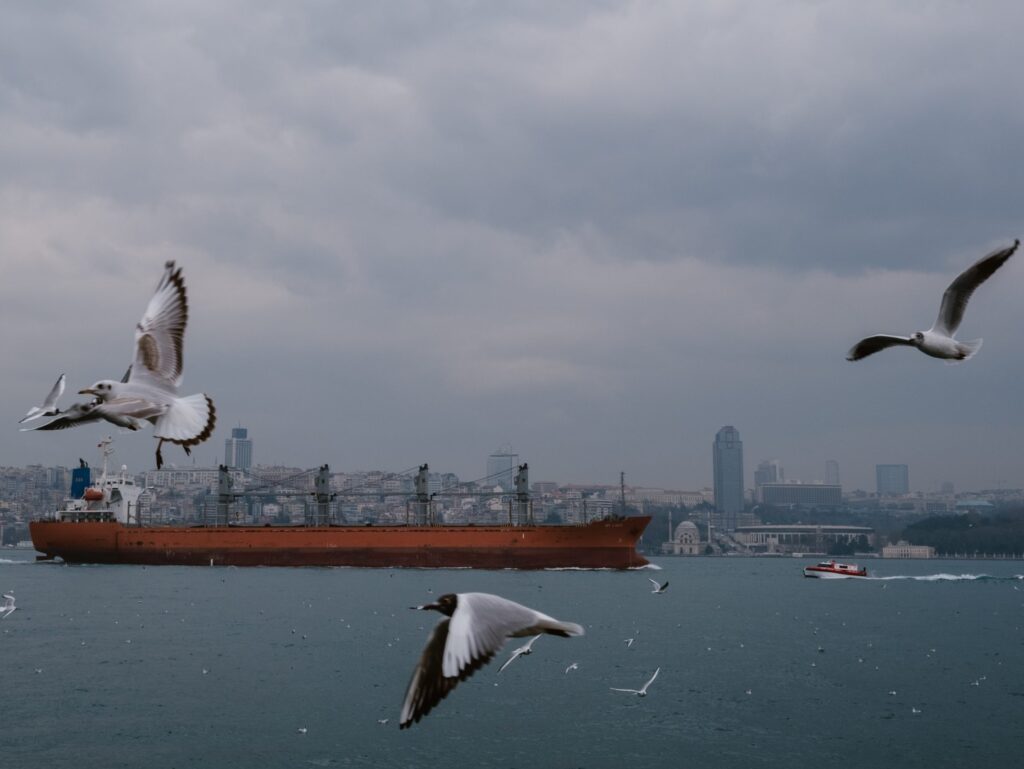
Image: A tanker in the Bosphorus Strait, in Istanbul. (Filipp Romanovski, Unsplash, Unsplash License) https://unsplash.com/license