
The Kremlin-appointed authorities in Russian-occupied Crimea have halted fuel sales to the public in recent days and imposed sweeping restrictions on everything from tourist activities to street lighting as a Ukrainian drone strike campaign to cut off the strategically vital region continues to gain momentum. These latest measures come weeks after Ukraine’s Defense Minister Mykhailo Fedorov launched a “logistics lockdown” and vowed to turn the occupied Ukrainian peninsula into an island.
Ukraine’s recent success in Crimea reflects the country’s growing ability to target Russian logistics far beyond the front lines of the war with a new generation of mid-range drones. These mid-range strikes against military hubs, fuel transports, command posts, air defenses, bridges, ferries, and other high-value logistical targets are hampering Russian operations throughout occupied Ukraine. The low cost of Ukraine’s mid-range drone fleet makes large-scale bombing operations possible.
The current mid-range drone campaign did not emerge overnight. It relies heavily on technological innovations that have been under development for an extended period, and has also been facilitated by sustained Ukrainian efforts to degrade Russian air defenses in and around Crimea. By methodically weakening Russia’s air defense network over the past year, Ukraine has opened up pathways to conduct strikes throughout areas of southern Ukraine currently under Kremlin control and across occupied Crimea.
Stay updated
As the world watches the Russian invasion of Ukraine unfold, UkraineAlert delivers the best Atlantic Council expert insight and analysis on Ukraine twice a week directly to your inbox.
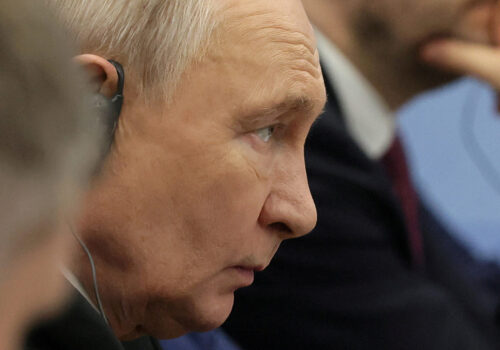
Crimea plays a crucial practical role in Russia’s war against Ukraine. Since 2022, Moscow has used the Black Sea peninsula as a military hub for the invasion of southern Ukraine, and as a launch pad for the bombardment of Ukrainian cities. It is also personally important to Putin as a symbol of his quest to reverse the humiliation of the Soviet collapse and revive Russia’s superpower status. The invasion of Ukraine began in 2014 with the blitzkrieg seizure of Crimea, an event that is widely viewed in Russia as Putin’s greatest triumph.
It is still too early to speak of a total Ukrainian blockade of Crimea. While Ukraine’s mid-range drone campaign is clearly causing significant disruption to supply lines, many routes into the peninsula remain open, while Russia is improvising solutions such as pontoon bridges. There are also reports of plans to import fuel via sea to counter losses caused by Ukrainian bombardment.
The impact of Ukraine’s bombing campaign is not merely military or economic. Recent waves of drone strikes are also having a significant psychological effect on the Russian population, who have been shocked by reports of mounting hardships in traditional tourist haven Crimea. For those living on the occupied peninsula or visiting for summer vacations, it is becoming extremely difficult to find gasoline amid growing fears of more widespread shortages.
Eurasia Center events

Crimea is only one of multiple fronts in Ukraine’s mid-range bombing campaign. Ukrainian drones recently struck the port in Mariupol, the largest city captured by Russian forces since the start of the full-scale invasion in 2022 and a key logistics gateway located on the Sea of Azov that is used to export grain, metals, and other goods taken from Ukraine. Meanwhile, highways across southern Ukraine have come under intense attack from Ukrainian mid-range drones, threatening the so-called “land bridge” linking Russia to occupied Crimea.
Ukraine’s mid-range strike campaign is unlikely to become a war-winning strategy on its own, but the escalating attacks of recent months have succeeded in making it more difficult for Russia to sustain military operations across occupied southern Ukraine and Crimea. Ukraine’s ability to destroy bridges, fuel depots, and supply trucks in large quantities poses serious questions for the Russian military that they have so far been unable to answer.
In a war that has been defined by competing technological innovations, it is reasonable to assume that Moscow will eventually find ways to counter the threat posed by Kyiv’s mid-range drone strike capabilities. However, at present Ukraine clearly enjoys the upper hand and is making good use of this advantage.
For more than a decade, the capture of Crimea has symbolised Russia’s resurgence on the international stage. Ukraine’s drone blockade is now transforming the occupied peninsula into a liability that highlights the gap between Putin’s imperial ambitions and his army’s limitations.
Maksym Beznosiuk is a strategic policy analyst whose work focuses on Russia, Ukraine, and international security. He is an associate fellow at GLOBSEC. William Dixon is a senior associate fellow of the Royal United Services Institute and an associate fellow at GLOBSEC. He specializes in cyber and international security issues.
Further reading


The views expressed in UkraineAlert are solely those of the authors and do not necessarily reflect the views of the Atlantic Council, its staff, or its supporters.

The Eurasia Center’s mission is to enhance transatlantic cooperation in promoting stability, democratic values, and prosperity in Eurasia, from Eastern Europe and Turkey in the West to the Caucasus, Russia, and Central Asia in the East.
Follow us on social media
and support our work
Image: Drone footage shows fire and smoke rising from a bridge, which Ukraine's military says was destroyed by them, near Rozdolne, Crimea, in this screengrab from a handout video released on June 23, 2026. Special Operations Forces Of Armed Forces Of Ukraine/Handout via REUTERS