
For the past two years, my daily stroll down to the Black Sea shore in Odesa has taken me through the city’s splendid Shevchenko Park and past the great curved bulk of Chornomorets Stadium, with the name of the stadium spelled out in giant letters that you can see from afar. I have no particular interest in soccer. What I liked was what the building said: Odesa was still a city confident enough to keep a stadium that size fully operational, a few hundred meters from a working seaport that itself had become a high-value target for Russian drones and missiles.
Then the airstrikes came closer. In early August, a Russian drone carrying deadly shrapnel slammed into my street, damaging a historic apartment building, a cultural center, and a pharmacy I use. This was a corner of the city center that had previously come through more than four years of war virtually untouched. On August 7, the stadium itself was hit and badly damaged. Days later, two trains were struck in the Odesa region.
As a longtime foreign resident of Odesa, I interpreted the recent strike on the stadium as a signal to take a break. For the around a million people in Odesa who cannot leave so easily, it was one more reminder of their terrifying new reality. Looking out across the Black Sea used to offer a visual escape from the destruction of the city, but with port operations now suspended, this pleasant view has been marred by the sight of immobilized merchant ships that were destined for the outside world. A graveyard of hulls, one of them burned out and another lying on the seabed.
Until very recently, this maritime corridor had connected Ukrainian farmers in Uman to bread vendors in Cairo’s Tahrir Square. Not anymore. Odesa officials have now counted more than seventy attacks on port infrastructure along with over sixty strikes on merchant vessels. A number of sailors have been killed during recent bombings. Ships will no longer sail to Odesa region ports, leaving Ukraine’s main gateway to global markets firmly shut.
From Langeron to Otrada and Arcadia, the famous beaches of Odesa are not yet empty. The sunbathers and holidaymakers are still there, thinner in number, timing their dips in the sea between air raid alerts. What beach club owners fear is that one of the disabled ships fully loaded with grain and fuel will be targeted, causing an ecological disaster and bringing the summer season to an abrupt end.
Stay updated
As the world watches the Russian invasion of Ukraine unfold, UkraineAlert delivers the best Atlantic Council expert insight and analysis on Ukraine twice a week directly to your inbox.
Russia’s apparent strategy is not simply to punish Odesa. Moscow aims to make Ukraine’s largest Black Sea port city functionally landlocked. While the systematic bombardment of the city and nearby shipping lanes destroys port infrastructure and prevents cargo vessels from loading, Russia is also attacking the roads, railways, and bridges that connect the Odesa region to the rest of Europe.
The cost of all this is almost impossible to calculate, but the empty marine colleges and many shuttered freight forwarding companies around downtown Odesa hint at the economic dislocation. As one longtime Odesa local and business owner tearfully put it to me in early August, “It feels like the sidewalks have been drained of energy.” As the sound of explosions rang over the harbor and ricocheted into European Square, she added, “Nowhere in Ukraine feels safe anymore.”
The timing of Russia’s Black Sea bombing campaign compounds the costs. Harvest season is when Ukraine’s grain moves, and Odesa together with two neighboring ports normally handle roughly 60 percent of monthly exports worth around $3.5 billion. Instead, millions of tons are now at risk of sitting in silos or sunken hulls rather than reaching buyers, according to the New York Times.
The impact on Ukraine’s industrial exports in sectors such as metallurgy is equally disastrous. Alternative land routes cannot come close to matching the volumes processed by Odesa’s main ports. Sending goods via train or truck through neighboring EU countries is also politically complicated and could strain bilateral relations.
The Ukrainian Agri Council is already warning of a bankruptcy wave and asking Kyiv for emergency loans and state guarantees. Past experience indicates that the impact is likely to extend far beyond Ukraine’s borders. In 2022, a Russian blockade of Ukraine’s Black Sea ports drove global food prices up and put around 70 million people at heightened risk of acute food insecurity by UN estimates. Odesa’s beach season is a local cost. The bill for the blockade will be global.
Eurasia Center events

The Kremlin has demonstrated its ability to sustain mass drone and missile attacks while drawing on Iranian technology, North Korean troops and ballistic missiles, and Chinese dual-use components. Meanwhile, Ukraine is asking its own soldiers to help fund the war they are fighting.
One senior Ukrainian soldier from Odesa told me he’s crowd funding online for his own men’s supplies.“The motherland only provides us with 60 percent of what we need. My side has to raise the other 40 percent.” The majority of the Ukrainian state budget is now directed toward the country’s defense, with international donor funds helping to cover gaps in civilian spending. Even that leaves a serving Ukrainian officer passing the hat on Facebook.
Ukraine’s well-publicized air defense shortages and the current global deficit in Patriot interceptors mean Odesa is highly unlikely to receive the protection the port so desperately needs anytime soon. It is therefore understandable that many people fear the coming winter season. Recent United Nations data indicated that July was the deadliest month for Ukrainian civilians since April 2022. Nearly everyone I’ve spoken to recently in Odesa expects this winter to be even worse than last year, when power, heating, and water outages created dire living conditions.
Many Odesa residents are already making contingency plans to leave. If Russian strikes on critical civilian infrastructure lead to the same seasonal hardships in the coming months, and if the port-based local economy continues to shrink, this could fuel another large-scale migration wave into the EU. At that point, Russia’s bombing campaign against Odesa becomes Europe’s problem in the most literal sense.
There are no easy solutions. The Trump administration is reluctant or unable to give Ukraine sufficient Patriot interceptors. Ukrainian President Volodymyr Zelenskyy recently told CNN that five percent of the current US stockpile would get his country through the winter, while ten percent would neutralize Russia’s ballistic missile threat. Instead, Ukraine is relying on allies digging into their own limited air defense reserves. However, few realistically expect Germany or other European partners to hand over absolutely everything they can spare. This will inevitably mean more destruction in Odesa and across Ukraine, providing further confirmation that NATO lacks the production capacity to keep pace with Russia’s rapidly expanding ballistic missile output.
Across the Black Sea, Turkey may have a role to play in diplomatic efforts to ease the pressure on Odesa and restart the stalled peace process. Ankara has a huge stake in regional security, while enjoying close ties with both Moscow and Kyiv. Turkish officials helped broker a grain corridor deal in summer 2022, and are now pushing Russia for a new moratorium on strikes targeting Black Sea merchant shipping. No other NATO country retains such channels of communication with the Kremlin. Turkish President Recep Tayyip Erdoğan would like nothing better than to be the statesman who delivers a settlement to end the war.
Since the start of Russia’s full-scale invasion, many Odesa residents have told me they miss the everyday sounds of the port most of all: Cranes moving, locomotives shunting along the rails, and new ships announcing themselves from all around the world. On my last walk through Shevchenko Park and past the damaged stadium, there was none of this background noise. Instead, silhouettes of ships stood silently on the horizon, going nowhere.
Odesa’s current plight raises obvious questions about the city’s prospects and Ukraine’s future. With the Russian bombardment increasing in intensity and allies unable or unwilling to provide Ukraine with the weapons systems it needs to defend itself, at what point does a country with a coastline become landlocked in every way that matters?
Michael Bociurkiw is a senior nonresident fellow at the Atlantic Council and founder of the World Briefing report on Substack.
Further reading


The views expressed in UkraineAlert are solely those of the authors and do not necessarily reflect the views of the Atlantic Council, its staff, or its supporters.

The Eurasia Center’s mission is to enhance transatlantic cooperation in promoting stability, democratic values, and prosperity in Eurasia, from Eastern Europe and Turkey in the West to the Caucasus, Russia, and Central Asia in the East.
Follow us on social media
and support our work
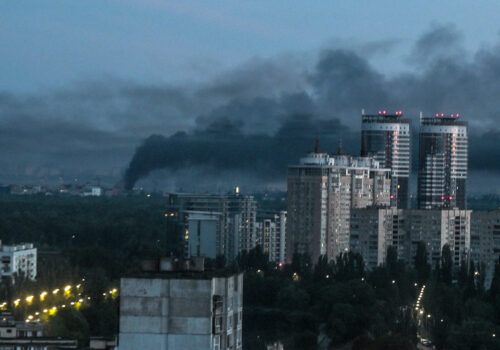
Image: Black smoke rises from a vessel damaged by a Russian attack in the Black Sea, Odesa region, Ukraine, July 28, 2026. The Russian army struck a civilian ship flying the Liberian flag for the third time while it was anchored near the approaches to the Odesa port without crew or cargo. Where: Odesa region, Ukraine When: 28 Jul 2026 (Credit: Nina Liashonok/Ukrinform/Cover Images)