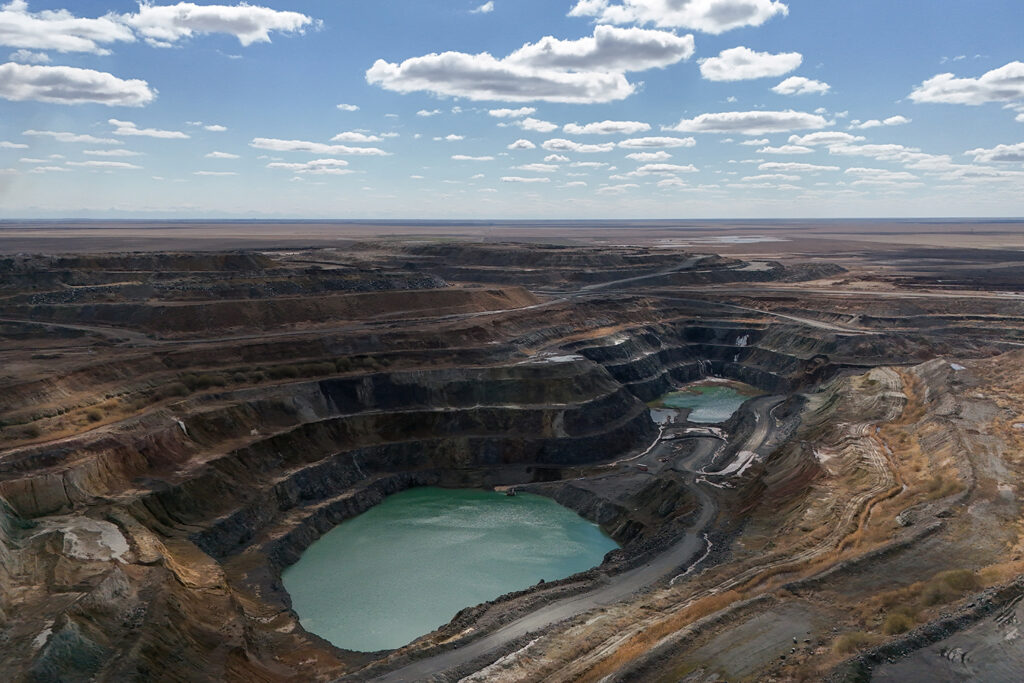
Central Asia is facing a paradox: Vast energy and mineral reserves promise economic growth, yet climate change and water shortages constrain the region’s ability to realize that potential.
Led by Kazakhstan and Uzbekistan, the five Central Asian states—which also include Kyrgyzstan, Tajikistan, and Turkmenistan—are eager to develop their wealth of critical minerals and rare earths. But without careful management, this push risks further straining already dwindling water reserves, particularly as temperatures in the region rise twice as fast as the global average.
Undoubtedly, new mining projects will initially add more pressure to Central Asia’s stressed water systems. However, with smart policies, states in the region can capture a net “water dividend”: By reinvesting mining revenues in water-saving infrastructure and technologies, they can ensure that the water conserved or newly secured ultimately exceeds the amount consumed by mining itself.
Resource wealth meets climate pressure
To avoid further exacerbating water shortages, the Central Asian states will need to navigate two public policy challenges. First, they must attract high-quality foreign investment in mining partnerships, ensuring firms from all countries can compete on a level playing field. Second, they must use mining revenues to modernize aging infrastructure, experiment with cutting-edge precipitation enhancement technologies, and fund a long-term strategy for regional water security cooperation.
Central Asia’s critical minerals and rare earths have drawn major commercial and geopolitical interest from the United States, China, Russia, and the European Union. Companies and governments alike view access to these resources—key to the production of complex electronics, renewable power sources, high-grade defense systems, and more—as essential to competing economically and militarily in the decades ahead. Kazakhstan and Uzbekistan, in particular, are rich in rare earths as well as critical minerals such as uranium, copper, and tungsten.
At the same time, the region appears to be careening toward a water crisis. Central Asia uses approximately 127 billion cubic meters of water per year. Of that, 100 billion cubic meters flow into the region’s highly inefficient agricultural sector, which loses half of this water supply before it even reaches the fields.
As many as twenty-two million of the roughly eighty million people living in Central Asia already lack secure access to safe water—and the region’s total population may increase to 110 million by 2050, intensifying demographic pressure on scarce water resources. Rising temperatures are rapidly melting the glaciers in Kyrgyzstan and Tajikistan that provide much of the fresh water for downstream countries such as Uzbekistan and Turkmenistan. Meanwhile, water levels in the Caspian Sea are projected to drop by up to 60 feet by 2100, exposing dry land roughly the size of Portugal.
Critical minerals could power the region’s growth
Mining operations are notoriously capital-intensive to launch and water-intensive to run, but the industry can still become a net revenue and resource boon to Central Asia. Western firms have begun investing in new critical mineral projects across the region. These firms have proven much more eager to do so when they are backed by their governments. In November, US-Australian firm Cove Capital agreed to a $1.1 billion deal with Kazakhstan’s state mining company to develop the Upper Kairakty and North Katpar tungsten deposits in central Kazakhstan—among the largest known tungsten deposits in the world. Cove Capital’s feasibility studies suggest the project could produce eighty billion dollars’ worth of the resource over the mine’s lifespan.
Crucially, the project is set to be backed by $900 million in financing from the US Export-Import Bank (EXIM), making it the most high-profile example to date of concrete Western government and private-sector engagement in Central Asian critical minerals development.
Water intensity varies widely across metals mining depending on ore grade, depth, dispersion, recycling rate, and management, but tungsten and other rare earth elements may be among the more water-efficient metals to extract. Almonty Industries’ Sangdong tungsten mine in South Korea—a much smaller operation in terms of annual output—uses roughly 500,000 cubic meters of fresh water per year, a drop in the proverbial bucket compared to Central Asia’s agricultural water consumption. Cove Capital believes ore grades at Upper Kairakty and North Katpar may exceed those at Sangdong, potentially further reducing water requirements for tungsten processing.
If early exploration proves accurate, Kazakhstan could hold the third-largest rare earth reserves globally. The Kazakh government has signaled that it aims not only to mine rare earths but also to move up the minerals value chain. Studies estimate that developing rare earth processing capacity alone could add up to 7.1 percent of gross domestic product (GDP), on top of revenues from raw mineral production. Such investments could ultimately make mining more valuable than Kazakhstan’s oil and gas sector, which currently accounts for about 16 percent of GDP, compared to roughly 12 percent (around thirty billion dollars) from mining today. This additional revenue would be especially valuable for a country whose real GDP growth is expected to slow beginning in 2026.
Uzbekistan has also signed agreements with the US government to partner on mining investments with significant potential, particularly in tungsten and other rare earths. While the country’s mineral wealth has not been surveyed as extensively as Kazakhstan’s, Tashkent is investing billions of dollars in exploration it believes could unlock as much as three trillion dollars in total economic value. Achieving this ambitious target will depend on maximizing transparency during exploration and reducing investor risk through continued rule-of-law reforms—turning memoranda of understanding into bankable projects.
Turning mining revenues into modern water infrastructure
Both Kazakhstan and Uzbekistan should therefore pass favorable subsoil and export-tax legislation to attract investment. Astana and Tashkent should also work with EXIM and the US Development Finance Corporation to support investments in processing capacity tied to projects involving US investors. Given China’s dominance in critical mineral and rare earth processing, the US government has a strategic interest in facilitating regional processing capabilities alongside US mining investments.
Kyrgyzstan and Tajikistan also possess economically viable mineral resources, but uncertain regulatory environments and Chinese dominance in their mining sectors make large-scale Western investment unlikely in the medium term. Among the five Central Asian states, Turkmenistan may stand to gain the most from a water dividend—and could leverage its substantial natural gas revenues to fund smarter water conservation practices.
Most importantly, governments must reinvest new revenue streams in technologies that directly mitigate water insecurity.
First, agricultural irrigation infrastructure across the region is largely outdated and inefficient and should be replaced by modern systems to reduce water loss to seepage and evaporation. Efficiently collecting mining revenues and procuring water-saving technologies will require greater governmental agility and technical capacity.
Second, Central Asian states should explore increasingly efficient cloud-seeding technologies, pioneered in the United States and the Gulf, as a means of increasing precipitation in agricultural zones—particularly in steppe and mountain valley regions. Early studies suggest that localized cloud-seeding programs can increase precipitation by up to 15 percent per year. While some have raised questions about cloud seeding’s environmental impact, communities and local governments that employ cloud seeding have empirically found negligible risks.
Third, a region-wide water security strategy, backed by interstate conservation and infrastructure projects, is essential for long-term stability. For decades, competition over water and strained neighborly relations created a vicious cycle of mistrust and tension in Central Asia. That dynamic can be gradually reversed through people-to-people engagement and shared infrastructure projects designed to conserve and distribute water more effectively in service of regional welfare and stability—rather than narrow domestic interests.
Modernizing irrigation infrastructure is expensive but can be made affordable by diverting a modest share of future mining revenues. Experts estimate that Kazakhstan will spend $515 million on irrigation upgrades between 2026 and 2030. The proposed Cove Capital tungsten mine alone could eventually generate around $125 million in annual tax revenue, assuming production and price targets are met over its fifty-year lifespan. Cloud seeding in the west of the United States has repeatedly proven more cost-effective than water metering and other indirect conservation measures, and costs could fall further as companies such as California-based Rainmaker deploy drones to seed clouds more precisely.
Central Asia should leverage its vast mineral wealth to secure a net water dividend and reduce risks to regional security and stability. Trusted partnerships, high-quality investment, good governance, private-sector dynamism, and creative diplomacy will all be crucial to addressing the region’s escalating climate and water challenges. By maximizing shared benefits from mineral development, Central Asian states can transform mining revenues into long-term water security.
Andrew D’Anieri is associate director of the Atlantic Council’s Eurasia Center. Find him on X at @andrew_danieri.
Further reading
Tue, Oct 28, 2025
Dispatch from Uzbekistan: Regional peace progress and economic growth reveal opportunities for US engagement
New Atlanticist By Andrew D’Anieri
The advances toward peace in the Fergana Valley and Uzbekistan’s economic growth should encourage deeper US engagement in the region.
Tue, Oct 28, 2025
Working within a ‘Central Asia Quartet’ can strengthen US ties in the region. The foundations for it have already been laid.
TURKEYSource By
To strengthen their ties to Central Asia, the United States, Turkey, Japan, and South Korea should work together on their engagement with the region.

Tue, Oct 21, 2025
How the US should partner with Central Asian states to avoid Russia-China dominance
New Atlanticist By Tatiana Gfoeller
By acting now, Washington can capitalize on the desire among some Central Asian states to reduce their dependence on Moscow and Beijing.
Image: A drone view shows Varvarinskoye gold deposits in the Kostanay region in Kazakhstan on April 15, 2025. Photo via REUTERS/Pavel Mikheyev.