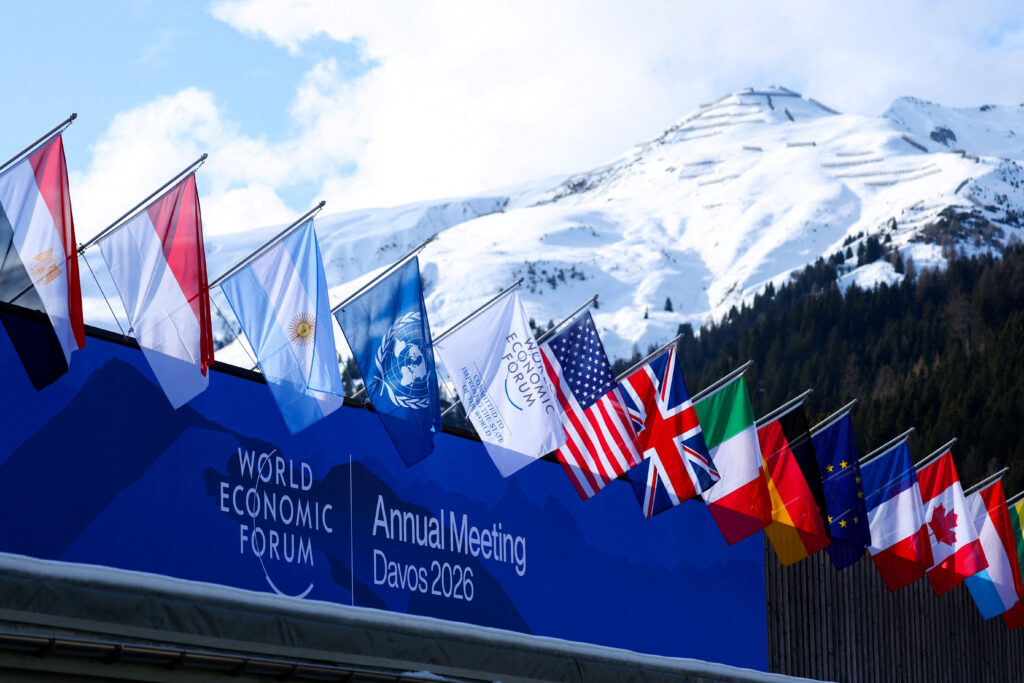
Under the theme “A Spirit of Dialogue,” the 2026 World Economic Forum (WEF) annual meeting once again brought world leaders, CEOs, policymakers and civil society representatives to Davos, Switzerland, to confront some of the most pressing challenges facing the global order.
At the heart of this dialogue was the global energy agenda. Delegates from around the world debated how to reconcile energy security, market stability, climate objectives, and economic competitiveness—all while navigating intensifying geopolitical pressures, divergent national strategies, and the risks and opportunities posed by new technologies.
What is the path forward for global energy security? Our experts weigh in with key takeaways from the energy conversations at Davos.
Click to jump to an expert analysis:
Lisa Basquel: The transatlantic energy fault line at Davos 2026
Alexis Harmon: At Davos, global leaders treated critical mineral cooperation as economic realism
The transatlantic energy fault line at Davos 2026
Against the backdrop of US-EU tensions over Greenland and trade, Davos 2026 revealed that the transatlantic energy divide is as much about trust as it is about climate targets or fuel choices. Energy policy emerged as a proxy for deeper disagreements over how each side strengthens economic competitiveness, safeguards strategic autonomy, and asserts their authority in an increasingly fractured global order.
From Washington’s perspective, energy was framed as a source of economic strength and geopolitical influence. US officials emphasized market scale, energy abundance, and affordability. US President Donald Trump pointed to surging oil and gas production and a renewed embrace of nuclear power as evidence of America’s energy dominance, while criticizing Biden-era climate policies as the “Green New Scam.” He singled out wind power as inefficient and expensive, reflecting a broader concern that Europe’s reliance on renewables had weakened its competitiveness. US Energy Secretary Chris Wright echoed these concerns, arguing that global investment in renewables is underdelivering on growth and affordability, calling for a doubling of global oil production and warning that European environmental regulations risk discouraging US exports and limiting market access for American producers.
Europe, by contrast, spoke the language of strategic autonomy. European Commission President Ursula von der Leyen was explicit that geopolitical shocks should be used to build “a new form of European independence.” Her emphasis on energy security, nuclear power, and homegrown renewables was not just about resilience and climate objectives, but about limiting exposure to external volatility. Her reference to ending “manipulation” in energy markets was a pointed signal: autonomy is no longer aspirational—it is a direct response to Europe’s diminishing trust in transatlantic energy cooperation.
What emerged most clearly from Davos’ energy debates was that this divide is no longer about hydrocarbons versus renewables. The United States sees energy as leverage; Europe sees it as sovereignty. Energy was just one thread in Davos’ crowded agenda, but it laid bare a deeper recalibration in the transatlantic relationship, with Europe preparing for a future less anchored in US leadership.
—Lisa Basquel is a program assistant with the Atlantic Council Global Energy Center.
Under an energy security imperative, global leaders find common ground in nuclear energy expansion
Set against shifting geopolitical tensions and diverging geoeconomic priorities, this year’s WEF annual meeting concluded with a unifying consensus among several world leaders: nuclear energy will play a crucial role in bolstering a diverse and resilient global energy system.
In his address last Wednesday, Trump praised nuclear energy’s safety and affordability, reiterating the administration’s staunch support of nuclear energy and its role in expanding America’s energy dominance agenda. Trump’s sentiments build on significant actions taken by the administration over the last year to reinvigorate the US nuclear energy industry, including four executive orders to build out the US nuclear fuel supply chain, enhance nuclear reactor testing, streamline reactor licensing, and enable the use of advanced nuclear technologies to support national security objectives.
Trump’s address marks the latest step in the administration’s strategy to reinvigorate US competitiveness in the nuclear export market while establishing energy independence. Earlier this month, the US Department of Energy announced a $2.7 billion investment to strengthen domestic uranium enrichment, another significant step toward meeting anticipated demand from new nuclear projects and shifting away from US reliance on imported Russian uranium.
Support for deploying nuclear reactors to secure energy independence was echoed by leaders from across Europe as the region urgently seeks to establish affordable, resilient energy systems. Price volatility and supply shocks continued to play a central role in energy discussions and were key drivers in remarks by von der Leyen, who highlighted nuclear energy’s role in lowering prices and cutting dependencies. Sweden’s energy minister Ebba Busch emphasized Sweden’s plans to orchestrate a “nuclear renaissance” to meet the country’s need for reliable, dispatchable energy, while Romania’s Minister of Energy Bogdan Ivan cited economic competitiveness as a driving factor behind Romania’s planned nuclear energy expansion.
In addition to government figures, international business leaders shared commonalities in their projections of the future nuclear energy landscape, attributing the success of prospective projects to “coalitions of the willing.” Progress in deploying nuclear reactors to strengthen nations’ energy independence will likely occur through regional and bilateral alliances, such as the EU nuclear alliance, Nordic-Baltic cooperation, renewed Japanese investment, and civil nuclear cooperation between the United States and Canada.
While the promises and pitfalls of artificial intelligence (AI) were at the center of this year’s WEF agenda, AI’s need for reliable, 24/7 power dominated energy conversations. Meta is the latest of several tech companies that have signed historic partnerships with US nuclear reactor developers to meet data centers’ exponential energy demand. Last March, major tech companies joined a pledge to support the goal of at least tripling global nuclear capacity by 2050. As the global race for AI leadership intensifies, industry leaders acknowledged a key convergence in nuclear technology’s potential to provide secure, baseload power and to establish AI competitiveness.
This year, Davos hosted its first panel focused on nuclear energy in Africa, exemplifying the global momentum surrounding the sector and its potential to meet rising electrification demands. Leaders from countries considering new nuclear energy projects, such as Paraguay and India, expressed intentions to pursue domestic civil nuclear programs, displaying a shared recognition of nuclear energy’s role in catalyzing sustained economic growth and competitiveness in emerging markets.
The conversations at Davos reveal a growing consensus and a clear market signal—nuclear energy has emerged as an imperative across national energy agendas as nations’ shared visions materialized on the global stage. The successful deployment of nuclear energy technologies at scale rests on dedicated policies, investments, and cooperation to ensure a secure and sustainable energy system.
—Amy Drake is an assistant director with the Atlantic Council Global Energy Center.
Carney positions Canada as a reliable, middle power partner with vast energy resources to offer
Amid a series of remarks from global leaders at Davos 2026, Canadian Prime Minister Mark Carney’s address captured international attention. Carney’s speech, “Principled and pragmatic: Canada’s path,” outlined a new course forward for Canada and other middle power countries, pointing to energy as a critical enabler for strengthening emerging bilateral and multilateral partnerships.
Carney’s address offered a striking assessment of the current rules-based international order, positing that the conventional group of great power countries have taken advantage of their influence over financial mechanisms and global supply chains to coerce their smaller and more vulnerable counterparts into zero-sum relationships. In response, to other middle power countries, Carney offers collaboration with Canada as an alternative to the current global framework. In line with the theme, “A Spirit of Dialogue,” Carney marketed Canada as a stable partner that is looking to redefine its foreign partnerships and establish a new standard for international cooperation. Carney outlines a new strategy of “variable geometry”—creating different coalitions for distinct issue sets—that aims to reduce the economic and security exposure of middle power countries.
Energy, it appears, will play a key role in Canada’s diversification process. Carney pointed to Canada’s status as a self-proclaimed energy superpower and outlined its ambition to fast track over a billion dollars of domestic investment in critical minerals, AI, and energy development. With vastcritical mineral reserves and energy resources, partnerships with Canada offer a multitude of opportunities for new foreign partners to build on their own domestic energy security initiatives. New agreements already formed with China and Qatar on electric vehicle imports and energy infrastructure projects underscore that Carney’s rhetoric is backed by action.
As we move forward from Davos, Canada’s prospective realignment away from great power allies raises questions about the future of its traditional trade partnerships. This pivot could play a critical role in the upcoming review of the US-Mexico-Canada Agreement and will shape the future of US-Canada trade and energy cooperation.
—Elina Carpen is an associate director with the Atlantic Council Global Energy Center.
At Davos, global leaders treated critical mineral cooperation as economic realism
At Davos 2026, minerals and materials were a common thread underpinning conversations ranging from the expansion of AI to the deployment of additional energy capacity. Overall, discussion clustered around two intertwined themes: scale and cooperation.
First, there was a recognition of the sheer material scale required to build the future energy and digital economy. Conversations around AI, electrification, and clean energy deployment repeatedly circled back to the physical reality underpinning these ambitions. While policy debates often fixate on niche critical minerals, Davos speakers emphasized that the challenge is far broader, encompassing massive, sustained demand for foundational materials like copper. It was clear that leaders increasingly see the energy transition and AI boom not just as technological revolutions, but industrial ones—and that they recognize current mining and processing pipelines are nowhere near aligned with projected demand.
Second, and more unexpectedly, Davos 2026 leaned heavily into cooperation on minerals, reflecting the Forum’s theme, “The Spirit of Dialogue.” Despite familiar rhetoric around strategic competition and US–China tensions, many leaders framed collaboration as pragmatic rather than idealistic. Carney pointed to discussions around a G7 critical minerals buyers’ club to reduce volatility and coordinate demand, while Saudi Minister of Industry and Mineral Resources Bandar Alkhorayef described international collaboration on mineral supply as simply the “rational thing” to do.
Together, these discussions suggest a subtle but important shift from viewing minerals exclusively as a zero-sum geopolitical asset toward seeing them as a shared constraint on global economic growth. With the Trump administration’s inaugural Critical Minerals Ministerial set for February 4, this emphasis on collaboration appears poised to deepen.
—Alexis Harmon is an assistant director with the Atlantic Council Global Energy Center.
About the Authors




Stay connected
Sign up for PowerPlay, the Atlantic Council’s bimonthly newsletter keeping you up to date on all facets of the energy transition:
related content

our work

The Global Energy Center develops and promotes pragmatic and nonpartisan policy solutions designed to advance global energy security, enhance economic opportunity, and accelerate pathways to net-zero emissions.
Image: FILE PHOTO: Flags flutter during the 56th annual World Economic Forum (WEF) meeting, in Davos, Switzerland, January 19, 2026. REUTERS/Denis Balibouse/File Photo