As Iran protests continue, policymakers should apply these key lessons
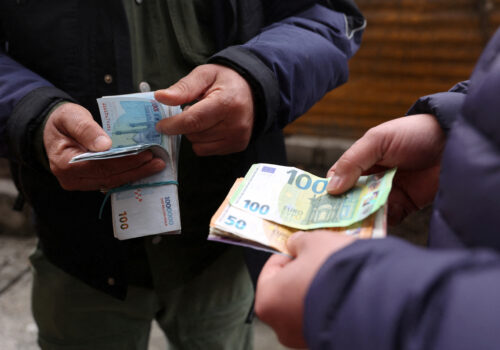
Since December 28, protests have erupted across all thirty-one of Iran’s provinces, as the Iranian people have once again demonstrated their courage and desire for change from the regime. The demonstrations were initially sparked by currency devaluation and economic hardship, but quickly morphed into a broader cause calling for systemic change in Iran. According to rights groups, conservative estimates indicate the Iranian government has responded by killing at least thirty-eight protestors and arresting more than two thousand more. Those numbers are likely to grow as protests continue.
Although the protests are inspiring and potentially historic, some of the developments are being overshadowed by the United States. On January 2 (and again two days later), US President Donald Trump issued an unspecified threat to the regime not to use further violence against its citizens. It is admirable that the Trump administration is focusing attention on the Iranian people, but it is also inconsistent with the administration’s past decisions to cut funds for vital internet circumvention services in Iran and avoid speaking out against the regime’s human rights violations.
The United States should not miss this opportunity to reaffirm support for the Iranian people as a centerpiece of a more comprehensive approach to its Iran policy. With this context in mind, and drawing on our past experiences serving in various capacities for the US government working on Iran—including during the Mahsa Amini protests—we authors suggest a few key policy recommendations.
Recommendations for the United States and its partners
- Pause all major non-protest-related policy initiatives. Now is not the time for renewed nuclear negotiations or military strikes. The Biden administration famously paused negotiations about resuming the Joint Comprehensive Plan of Action during the protests in response Mahsa Amini’s death. This does not mean diplomacy is dead, but any hypothetical nuclear talks between Washington and Tehran need to be postponed indefinitely. This is also not the time for Israel (or the United States) to restart military attacks. The Iranian people deserve the time and space to see these protests through. In June, the Iranian government benefited from an ill-conceived Israeli strike on Evin prison that attempted to liberate, but ended up killing, a number of prisoners. It is vital to not give the government a similar propaganda victory.
- The US government should designate a new Iran envoy. The Trump administration should immediately name or designate an envoy or senior official to engage with the Iranian diaspora and to more broadly focus on all aspects of Iran policy full-time. Regular engagement with this community and other Iran-focused government and nongovernment contacts is important to emphasize that the administration is serious about the Iranian people. This individual would not replace US Special Envoy to the Middle East Steve Witkoff but would report to him and other senior officials who remain focused on wider-ranging issues. Full-time attention on the portfolio would also help provide an internal advocate within an administration focused on budget cuts for low-cost, high-reward spending to advance a broader Iran policy, such as internet circumvention funding.
- Partner governments should fund Iran initiatives that the administration ended. At the height of the Mahsa Amini protests, thirty million Iranians used US-funded circumvention services. Some of these services are being temporarily funded by private enterprises. Over the long-term, they require consistent support from a government entity. The same is also true of the Iran human rights programs that the current administration proposed cutting in its entirety in the Congressional Budget Justification. If the administration does not reconsider its cuts, other foreign governments would have an opportunity to pick up the technical and moral leadership that the United States has relinquished.
- The international community should unite in backing the Iranian people. We authors have heard directly from Iranians who participated in past protests that a unified signal from the international community not only helped buoy sentiment within the movement but also served as a deterrent against human rights abuses by the regime. For instance, Iran significantly decreased its executions of drug offenders following sustained international pressure. Joint statements, including those issued by the Group of Seven and United Nations, have the best chance of impacting Iranian behavior.
- Create a nimble emergency funding mechanism. During the Mahsa Amini protests, several Iranian advocacy groups suggested to us that there was need for urgent funding, and they proposed possible emergency initiatives such as setting up funds to help pay striking workers living wages. Although we supported these ideas, the Biden administration was not nimble enough to fully evaluate and fund them in a timely manner. The United States or other partner nations should consider establishing a fund or program to explicitly facilitate crisis response operations. If the United States is unable or unwilling to fund it, the Treasury Department should, at a minimum, issue (or reissue) guidance to allow private individuals and organizations quick and legal ways to send money to protestors.
- Increase human rights sanctions. The United States and partner governments should move quickly to issue targeted sanctions against human rights abusers and those involved in the crackdown against protestors. The 2024 bipartisan MAHSA Act provides the Treasury and State Department with new sanction authorities. To date, not a single designation has been imposed under this authority. Implementing MAHSA sanctions now—ideally in coordination with actions from our foreign partners—would send a symbolic, but powerful, message that the international community condemns Iran’s crackdown on protestors.
Recommendations for nongovernmental actors
- Minimize partisan politics. Iran policy has long been a victim of brutal partisan politics in Washington. Support for the Iranian people should be an approach that both parties should be able to get behind, as it aligns with US interests and values.
- More constructive engagement with the diaspora. As admittedly non-Iranian Americans involved in Iran policy, we authors will never fully understand the intricacies of the diaspora. From our past experiences, the online and in-person abuse directed at other members of the diaspora and at proposed policies limited government-diaspora engagement, and hindered the diaspora’s ability to effectively advocate for policy changes.
- Provide clear and tangible recommendations. During the Biden administration, then-Vice President Kamala Harris led efforts to support the Iranian people’s call for the regime to be removed from the UN Commission on the Status of Women. This was a direct result of lobbying by civil society. Once the Harris team had a clear recommendation and knew it aligned with US policy priorities and values, the United States successfully led the campaign to remove Iran from the Commission.
A final recommendation for everyone: Keep the focus on Iran
The Iranian people themselves are bravely leading the current protests. It is essential to keep the focus on them, rather than on Washington politics and social media, to ensure the Iranian people get the support they need at this critical juncture.
Abram Paley is an incoming nonresident senior fellow at the Atlantic Council. He most recently served as acting special envoy for Iran from 2023 to 2025 and, before that, Middle East advisor to Vice President Kamala Harris.
Nate Swanson is a resident senior fellow and director of the Iran Strategy Project at the Atlantic Council. He most recently served as director for Iran at the National Security Council in the Biden White House and a member of the Trump administration’s Iran negotiating team.
Further reading
Fri, Oct 24, 2025
‘Snapback’ sanctions are deepening the Iran-Russia alignment
MENASource By
United by a desire to counter US influence, Iran and Russia are poised to deepen their bilateral and multilateral cooperation.

Tue, Dec 9, 2025
Western policy must include Iran’s neglected peripheries
MENASource By
Now is the time for Western and regional policymakers to form a clear-eyed view of how they should engage with Iran’s minorities.
Tue, Dec 16, 2025
What will 2026 bring for the Middle East and North Africa?
MENASource By
As 2025 comes to a close, our senior analysts unpack the most prominent trends and topics they are tracking for the new year.
Image: An Iranian woman shops in a local market as protests erupt over the collapse of the currency's value in Tehran, Iran, January 5, 2026. Majid Asgaripour/WANA (West Asia News Agency) via REUTERS ATTENTION EDITORS - THIS PICTURE WAS PROVIDED BY A THIRD PARTY