
Egypt’s foreign minister: One cannot secure waterways ‘while ignoring the political order of the states’ along the shore
The crisis in the Strait of Hormuz has captured international attention in recent weeks. Now, concern is rising about the other major trade waterway in the region: the Red Sea. Instability on its shores—both to the east in Yemen and to the west in the Horn of Africa—threatens to further disrupt global shipping.
The Horn of Africa only tends to get Washington’s attention in bursts—following piracy crises, famines, and terrorist attacks—and then loses it again. That cycle of engagement and neglect could have serious costs for global trade.
Egypt is watching closely. Positioned just north of the Horn of Africa and dependent on Suez Canal revenues, Cairo has more at stake in Red Sea stability than almost any other capital. For a sense of how Cairo is approaching this turbulent moment, Maisoon H. Kafafy—a senior advisor to the Atlantic Council’s Middle East programs—reached out to Egyptian Foreign Minister Badr Abdelatty for his thoughts.
Expert insights by Maisoon Kafafy
Several themes from the foreign minister’s responses offer lessons for US policymakers.
First, his responses highlight a connection between Red Sea security and political stability in the Horn of Africa—arguing, in effect, that one cannot protect the shipping lanes without ensuring stability in the states that border them. This is not a novel argument, but it is one that Washington has historically struggled to operationalize, preferring to more narrowly tackle maritime crises in a way that that addresses symptoms rather than larger structures.
Second, the foreign minister expressed concern about Somaliland recognition because of its potential impacts beyond the region. As shown through Abdelatty’s responses, Egypt argues that the recognition of Somaliland poses a systemic risk, based on the belief that if norms such as sovereignty and territorial integrity erode in the Horn, the reverberation across the continent—where several borders are contested—will be significant.
Finally, the foreign minister’s responses highlight Egypt’s concerns about what would happen if the United States disengaged. Abdelatty argued that US abandonment would create a vacuum that other actors would fill—and that the United States has more to lose from such a scenario than it currently appreciates. He notes that the Horn of Africa is looking for partners to be proactive and consistent in supporting the region.
KAFAFY: The Red Sea corridor carries roughly 15 percent of global trade. Yet the Horn of Africa still gets treated in Washington as a humanitarian theater rather than a strategic one. Why?
ABDELATTY: The strategic importance of the Horn of Africa is not a matter of opinion, but a geographic and economic fact. The Bab el-Mandeb Strait is one of the most consequential chokepoints in the world. Instability at that southern gate transmits directly through the Red Sea to the Suez Canal, and from there into the global trading system. What disrupts navigation in the Horn does not stay in the Horn. It affects energy markets, shipping costs, and the movement of goods between Asia, Africa, and Europe. We trust that Washington understands the strategic significance of this waterway and that its stability is where its own interests lie.
For Egypt, the connection is not theoretical. Our economy depends in substantial part on the revenues of the Suez Canal. Every disruption in the Red Sea is felt directly by Egypt. The losses of the Suez Canal revenues since October 2023 and the Israeli aggression on Gaza are estimated to be around twelve billion dollars. What I am referring to here is not felt as geopolitical abstraction, but as an economic and security reality. That is why Egypt has long argued that all responsible nations have a vested interest in stability in the Horn of Africa and the Red Sea, and why we have committed ourselves to contributing to that stability through sustained engagement.
KAFAFY: Recent escalation across the broader Middle East, including the closure of the Strait of Hormuz and mounting disruptions to Red Sea shipping, has exposed just how quickly regional conflict transmits into global economic shock. What do these experiences reveal about the Red Sea’s structural vulnerabilities, and how does Egypt think about the compounding risk when multiple chokepoints face stress simultaneously?
ABDELATTY: What the simultaneous pressure on the Strait of Hormuz and the Red Sea corridor has made undeniable is something Egypt has long argued: These strategic corridors do not function in isolation. They are nodes in a single interconnected system, and when more than one faces stress at the same time, the consequences for global trade are not additive; they are exponential. For Egypt, this is not an abstraction. Disruptions at the southern gate of the Red Sea are felt directly along the Suez Canal, and disruptions in the Gulf compound that pressure further. The global economy experienced, in a very short period, what it looks like when that system is stressed at multiple points concurrently.
The structural vulnerabilities that enable this are well understood but inadequately addressed. State fragility across parts of the Horn creates the permissive environment in which instability can take root and project outward. When sovereignty erodes—whether through internal collapse or external interference—the vacuum that follows does not remain empty. And when external actors exploit that fragility to advance unilateral agendas, they are not only destabilizing individual states; they are introducing risk into a maritime system on which the entire global economy depends. Egypt’s engagement in the Horn is grounded in the conviction that you cannot secure the waterway while ignoring the political order of the states along its shores. That connection is foundational to our approach and not incidental.
KAFAFY: Egypt has expanded its presence across the Horn—in Somalia, Djibouti, Eritrea, and through a multitude of initiatives. One could say this looks more like competition for regional influence than a policy based on principles. How do you answer that?
ABDELATTY: The distinction that matters is not between engagement and nonengagement, but between engagement that strengthens state sovereignty and engagement that undermines it. Egypt’s approach is grounded in a consistent set of principles: respect for the sovereignty and territorial integrity of the states we engage, support for their national institutions rather than substitution for them, and cooperation that is embedded in international law and African Union norms. Other actors chose to disregard the unity and sovereignty of the region’s states, undermine international law, and impose their will—rather than cooperate—in order to pursue national interests.
In Somalia, our engagement is broad and long-standing—humanitarian and medical assistance, educational missions to build local capacity, the reestablishment of our permanent diplomatic presence in Mogadishu, the planned inauguration of an Egyptian bank to support Somalia’s financial infrastructure, and our participation in the African Union Support and Stabilization Mission. These are contributions to Somalia’s own resilience and self-sufficiency. In Djibouti, we have invested in logistics, energy infrastructure, and port capacity. Our relations with Eritrea are also in an excellent place. EgyptAir now connects all Horn countries to Egypt and to the broader network regularly, reinforcing people-to-people ties. And through the StREAM initiative, launched at the Aswan Forum in October 2025, Egypt is working to build a comprehensive framework for maritime economic integration and sustainable development across Red Sea states.
I would invite those who wish to assess Egypt’s role to measure it by one criterion: Does our engagement make the states of the Horn stronger, more unified, and more capable of governing themselves? That is the standard we apply to ourselves, and it is the standard by which we ask to be judged.
KAFAFY: There are people who argue in good faith that Somaliland functions better as an autonomous entity than it would as part of a failing central state—that functional governance, not territorial lines, is what stability actually requires. What is Egypt’s position?
ABDELATTY: Somalia’s federal structure already accommodates significant autonomy for its constituent regions—that is built into Somalia’s constitutional framework. Inclusive political dialogue about the terms of that federal arrangement is entirely legitimate, and Egypt supports it. What Egypt does not support, and what is categorically different, is unilateral external recognition of a secessionist entity. Those are not the same thing.
The argument that functional governance justifies external recognition of separatist entities carries consequences that go far beyond Somalia. It establishes a principle that external actors can override territorial integrity when they judge it convenient. That, if accepted, would destabilize much of the African continent. Africa has many states where there is live tension between federal arrangement and separatist aspiration. The norms of sovereignty and territorial integrity are the foundation on which the post-colonial African order was built, and their erosion would carry consequences that dwarf any short-term governance benefit in a single territory.
Egypt’s position is therefore not merely about Somalia. It is about what kind of international order we are willing to defend.
KAFAFY: If the Somaliland recognition gains broader traction, what does Egypt assess as the realistic downstream risk? For Africa, and beyond?
ABDELATTY: Egypt’s assessment is that the risks are severe and systemic. The unilateral recognition of the so-called “Somaliland” region violates international law, the United Nations Charter, and the Constitutive Act of the African Union. It contravenes the long-standing consensus—within Africa and internationally—on the preservation of state sovereignty and territorial integrity. That consensus did not emerge by accident. It emerged because the alternative—a world in which borders can be redrawn unilaterally, in which external powers can recognize separatist entities for strategic or commercial reasons—was understood to carry catastrophic risks for the stability of African states.
If recognition gains traction, the precedent it sets will not be confined to Somalia. It will embolden separatist movements across the continent. It will invite other external actors to make similar moves wherever they calculate strategic advantage. It will reopen border disputes that African consensus has, with great effort, held in place. And it will signal to fragile states everywhere that their territorial integrity is contingent on the goodwill of outside powers, not on the protections of international law. That is a world less stable, less predictable, and less governed by the norms that have, however imperfectly, constrained the worst impulses of international competition.
Some have compared the situation of the so-called “Somaliland” with South Sudan, asking why Egypt was among the first countries to recognize the latter yet stands against the former. To that, I emphasize that in the case of South Sudan, the process of its secession from Sudan was an orderly one, conducted within an internationally recognized agreement between the sovereign government of Sudan and separatist groups. This is by no means the case in Somalia. The entire international community never recognized the unilateral declaration of independence by the so-called “Somaliland” in 1991. The question that needs to be addressed is why certain players chose to recognize the region’s independence at this point in history, marked by rampant regional conflict on the Red Sea and the Arabian Gulf. Since January 2024, we have been faced with one unsuccessful bid by Ethiopia to recognize the independence of the region, followed in December 2025 by the Israeli recognition of the region. Our categorical rejection of both cases is a principled one. We refuse any attempt to meddle with the unity and territorial integrity of any states—especially fragile ones—to pursue national interests.
KAFAFY: Some will argue that Washington returns focus to the Horn of Africa during crises, only to soon lose interest. What does the United States fail to understand about this region, and where is the partnership opportunity most concrete?
ABDELATTY: I cannot say the United States is losing interest in the Horn of Africa and the Red Sea. On the contrary, the United States has a significant and appreciated role in the region. It runs Operation Octave Shield to combat terrorism in Somalia, it is part of Operation Prosperity Guardians and Operation Poseidon Archer, and it has a naval base in Djibouti.
The United States does not underestimate the degree to which the Horn of Africa is not a regional issue but a test of the global order, and it realizes that it has an interest in sustaining peace in the region. Maritime security in the Red Sea, the integrity of international trade routes, the containment of terrorism and extremism, and the maintenance of sovereignty norms are all issues that we continuously discuss with our American partners. They are core interests of the United States, and they are all under pressure in the Horn right now.
Also, we do not underestimate the cost of Washington’s absence. If the United States disengages, the vacuum does not remain empty. Other actors try to fill it—not always in ways that align with American interests or values. That is why we talk with the US government about reconsidering its current position on financing peacekeeping efforts in Somalia. Naturally, we understand the need for more cost-effective practices in the United Nations and the African Union; however, the world is at a critical stage where many conflicts overlap and have spillover effects that impact us all, especially the ongoing conflicts around the Arabian Gulf and the Red Sea. We cannot afford to have new conflicts emerging in the region.
I see the partnership opportunity is most concrete in maritime security frameworks in the Red Sea, support for Somali state-building and counterterrorism capacity, investment in infrastructure and connectivity that reduces the fragility external actors exploit, and sustained diplomatic engagement that reinforces the norms of sovereignty and territorial integrity. Egypt and the United States share genuine interests across all of these areas.
KAFAFY: Ten years from now, what does a stable Horn of Africa actually look like—and what would have to happen to get there?
ABDELATTY: We are in continuous pursuit of peace and stability in the Horn of Africa. Success looks like a region of sovereign, unified states that are capable of governing their territories, providing for their populations, and participating constructively in regional and international institutions. It looks like maritime corridors that are secure and open. It looks like a regional architecture built on African solutions to African problems—in which external engagement serves rather than supplants African agency.
Concretely, it looks like a Somalia that has consolidated its institutions and resolved its federal arrangements through inclusive political dialogue; a Somalia that is an active member of a regional economic framework, through the Council for Arab and African States Littoral to the Red Sea and the Gulf of Aden, and that integrates Red Sea states through shared infrastructure and mutual economic interest; a Horn of Africa in which the norms of sovereignty and territorial integrity have been affirmed rather than eroded, and in which the international community has demonstrated that those norms carry real consequences when violated.
What would have to change is the level of sustained, consistent commitment from the international community. It has to evolve from crisis-driven engagement to the kind of long-term investment in institutions, political processes, and economic development that addresses structural fragility rather than its symptoms. The Horn does not need sympathy. It needs partners who show up before the emergency, not only after it—partners who have a vested interest in pursuing peace, security, stability, and prosperity, through achieving common interests and win-win solutions.
Further reading

Tue, Mar 17, 2026
A crisis in Egypt could be a warning sign for the global economy
MENASource By Khalid Azim
Market watchers should keep an eye on Egypt as an oil shock could cause financial turmoil.

Thu, Jan 15, 2026
After Israel’s recognition of Somaliland, what comes next?
MENASource By
Recognition reshapes the scope of bilateral engagement but does not eliminate the constraints tied to Somaliland’s contested status.
Thu, Apr 17, 2025
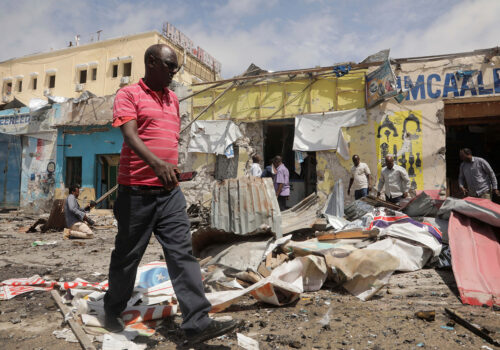
The US must sustain counterterrorism operations in Somalia—the costs of retreat are too high
New Atlanticist By
To maintain a foothold in East Africa’s security architecture, the US must prioritize continuity, including keeping the US embassy in Mogadishu open.
Image: Badr Abdelatty, foreign minister of Egypt, speaks with the German Foreign Minister during a meeting. Photo by Hannes P. Albert/dpa via Reuters Connect.