Will the Houthis join the Iran war?
One week into the Iran war, the Houthis have not yet come to Iran’s defense but have warned in official communications that their “fingers are on the trigger.” The Houthis’ apparent reticence has been a surprise for those who view them as simply an Iranian proxy or a trigger-happy militia. Both of these descriptors are reductive—the Houthis are a highly adaptive group with both grand regional goals and unresolved domestic objectives.
Getting involved in the Iran war will not yield the same domestic and international benefits for the Houthis that attacking Israel and Red Sea shipping during the Gaza war did, and fighting in the Iran conflict could pose greater risks. The Houthis’ involvement in the Gaza war elevated them on the international stage and allowed them to capitalize on broad support among Yemenis for Palestinians at a time when their population was growing restless. But Yemenis are much more reticent about supporting Iran—a state with ample resources that many Yemenis see as yet another foreign power meddling in their country. On top of this, Saudi Arabia’s involvement in the current war means that Houthi involvement could disrupt the Saudi-Houthi détente that has been in place since 2022, potentially plunging Yemen back into an active war with Riyadh.
If the Houthis do decide to insert themselves into the Iran war, it could be because they have decided that détente is no longer in their interests. Therefore, Houthi involvement in the Iran war could reignite the Yemen war after four years of relative calm, with significant implications for Yemen and the region.
SIGN UP FOR THIS WEEK IN THE MIDEAST NEWSLETTER
Three scenarios for Houthi involvement in the Iran war
The lowest-risk option for the Houthis would be to resume attacks on Israel. While the vast majority of Houthi missile and drone attacks against Israel during the Gaza war were intercepted or failed to reach their target, the group has demonstrated that it can penetrate Israeli airspace. Indeed, Houthi strikes on Israel have inflicted dozens of casualties and damaged Ben Gurion Airport. This scenario would invite renewed Israeli airstrikes on Yemen, which were militarily and economically costly for the Houthis but also help rally popular domestic support. Israeli strikes against Hudaydah Port were particularly damaging for the Houthis, as the port is an essential lifeline for the import-dependent country and a source for illicit Houthi oil revenues. At the same time, the Houthis have demonstrated considerable resilience to air strikes, having now withstood heavy air campaigns for most of the past decade. While an Israeli strike killed some political leadership in Sanaa, Houthi military leadership and the true power brokers within the movement remain untouched.
The second option would be for the Houthis to resume attacks against commercial shipping in the Red Sea, which could potentially threaten their détente with Saudi Arabia. Disrupting commercial shipping is far easier for the Houthis than striking Israel, given their strategic location along the Bab el-Mandeb maritime chokepoint. The Houthis sank multiple commercial ships during the Gaza war using a combination of drones, missiles, and manned and unmanned boats. And the risks posed by their attacks nearly halted passage through the Red Sea and Suez Canal in 2023. Attacking the Red Sea would be both more impactful and far riskier for the Houthis in 2026. With the Strait of Hormuz effectively closed because of the Iran war, Saudi Arabia is relying on its facilities along the Red Sea to maintain some oil exports—most of which are going to Asia and would typically transit south toward Yemen. Absent the Red Sea route, Gulf oil flows could grind to a halt after a couple more weeks of war. Given this, Saudi Arabia is likely communicating to the Houthis that attacks on Red Sea shipping are now a red line and could invite a Saudi military response. The Houthis have a tendency to test red lines, so they could conduct minor Red Sea attacks and then pull back if they determine doing so would break their détente with Saudi Arabia. Alternatively, the Houthis could seek to exploit heightened Saudi fears over disruptions in the Red Sea to extract new concessions from Riyadh.
The third and most consequential option would be for the Houthis to resume attacks on Saudi Arabia and/or the United Arab Emirates (UAE). This could potentially unfold in combination with attacks in the Red Sea and ground offensives inside of Yemen aimed at seizing control of Yemen’s oil and gas resources and weakening the internationally recognized Yemen government. In doing so, the Houthis would effectively reignite the Yemen war. If Saudi Arabia or the UAE decides to respond militarily to Iran’s attacks on civilian and economic infrastructure in both countries, the Houthis could use that retaliation to argue that it was the Gulf countries that broke the détente, not the Houthis. If the Houthis decide to go this route, they will have been driven primarily by their calculations over the situation inside of Yemen, not the war in Iran.
Shifting sands inside Yemen
The Houthis agreed to a United Nations-mediated truce with the Yemeni government in April 2022 after a series of costly Houthi offensives failed to gain control of the oil and gas resources in Yemen’s Marib governorate. While approximately 75 percent of Yemen’s roughly 35 million people live under Houthi control, the Houthis do not control any of Yemen’s oil and gas resources. The Houthis have used illicit oil sales, aggressive taxation, and a stranglehold on economic activity to fund the movement’s military buildup, but northern Yemen faces a perpetual economic crisis that threatens the viability of Houthi control over the long term. That crisis has grown more acute as Houthi detentions of aid workers and other harassment forced the World Food Programme to stop food distributions in the northern part of the country in January, leaving Houthi-controlled Yemen increasingly isolated.
The April 2022 truce and the Saudi-Houthi backchannel talks that grew out of it signaled a shift in the Houthis’ approach. After failing to secure a sustainable revenue source and cement their control over Yemen through military means, they sought instead to do so through negotiations. The Houthis remained hopeful that Saudi Arabia would force the internationally recognized Yemeni government to accept a deal that gave the Houthis control over most of the country’s resources, even after the Houthis started their Red Sea campaign and were re-designated as a Foreign Terrorist Organization by the United States in March 2025. Fears over such a deal may have been one factor motivating the UAE-backed Southern Transitional Council (STC) to seize territory from other government-affiliated factions in December.
Following the STC operations and amid escalating tensions between Saudi Arabia and the UAE, Saudi leadership decided to redouble its support to the internationally recognized Yemeni government, giving it hundreds of millions of dollars in new economic support and centralizing its military command. This could signal a shift in the Saudi approach: When the Presidential Leadership Council (PLC), the Yemeni government’s executive body, was formed in 2022, Riyadh seemed to view it as a negotiating body for future peace talks with the Houthis. Now, the Saudis are bolstering the PLC as an effective governing body in a manner that—if successful—could present a direct threat to the Houthis.
If the Houthis assess that the Saudi approach has shifted and that a deal is no longer viable, this could lead them to resume the war. The Houthis could determine that, with the Yemeni government still reconstituting and Saudi Arabia distracted by Iranian attacks, now is the time to launch a military offensive to seize Yemen’s oil and gas resources. Some Yemen analysts have begun warning that the Houthis appear to be mobilizing for a ground war, including via mass recruitment campaigns.
The consequences of reigniting the Yemen war
While Yemen remains a persistent source of regional instability, the civil war and Houthi cross-border attacks against Saudi Arabia and the UAE have been on pause for the past four years. Even before the April 2022 truce, the Saudi-led coalition had significantly scaled back its operations inside the country. Not since 2018 has Yemen witnessed large-scale conflict and coalition campaigns attempting to unseat the Houthis. If the Yemen war reignites, it would open another major front at a time when the Middle East is already reeling from war. For Yemenis, this would deepen the country’s humanitarian crisis, which would be even further exacerbated by the lack of food aid. Renewed Houthi attacks would also present a serious tactical challenge for Saudi Arabia, as Riyadh would be forced to direct already limited air defenses against attacks from both its south and the east.
By expanding the number of actors involved in intertwined conflicts across the Gulf, an active war inside Yemen could also make it significantly harder to find off-ramps and broaden the consequences of a war that is already certain to change the region for years to come.
Allison Minor is the director of the Project for Middle East Integration with the Atlantic Council’s Rafik Hariri Center & Middle East programs. She previously served as US deputy special envoy for Yemen and as director for Arabian Peninsula affairs at the National Security Council.
Related Reading

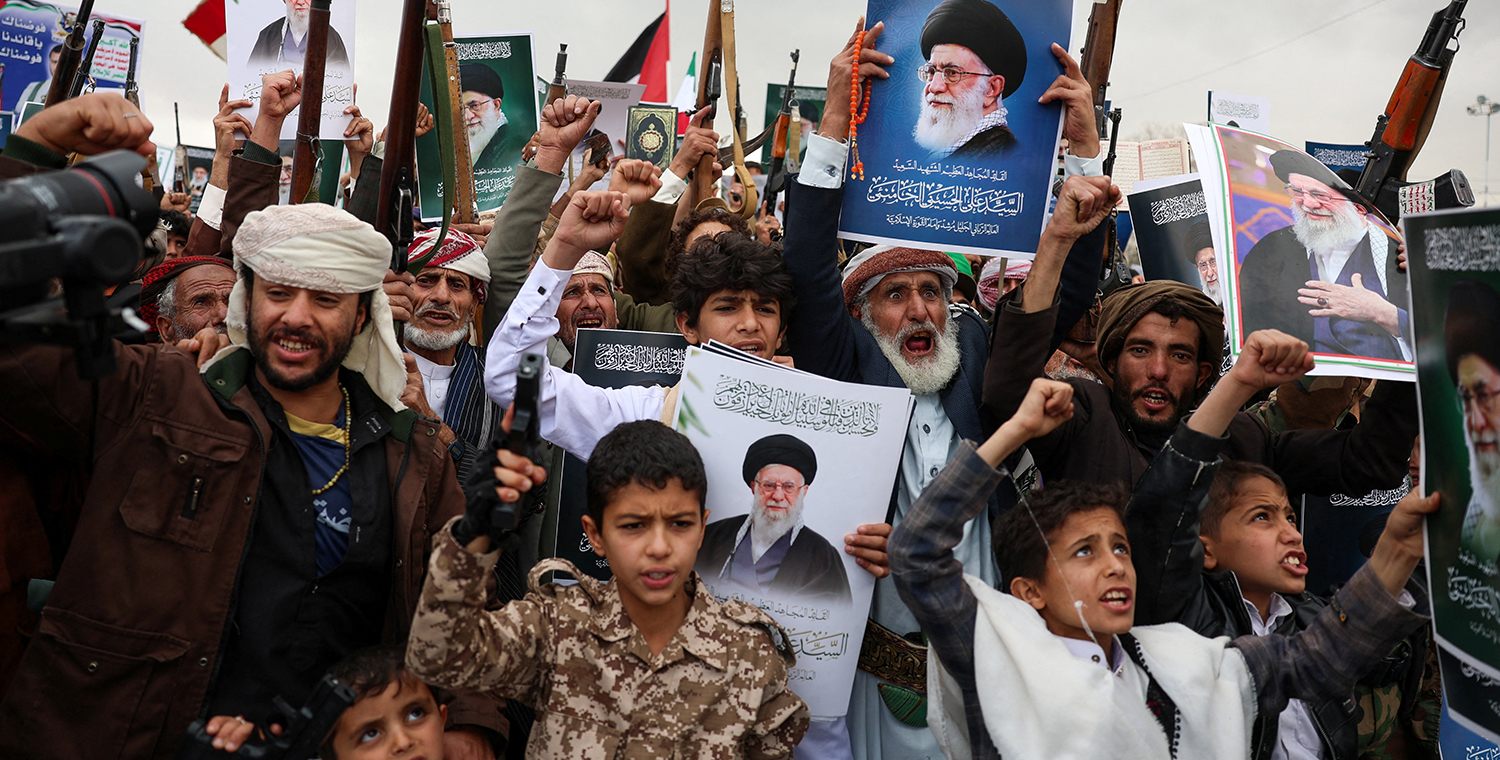
Image: Houthi supporters hold placards picturing late Iranian Supreme Leader Ayatollah Ali Khamenei as they demonstrate in solidarity with Iran and Lebanon in Sanaa, Yemen on March 6, 2026. Photo via REUTERS/Khaled Abdullah.