Russia’s full-scale invasion of Ukraine is now entering a fifth year and has already lasted longer than the entire conflict between Nazi Germany and the Soviet Union during World War II.
It was not supposed to be like this. When Russian President Vladimir Putin first gave the order to invade four years ago, he was anticipating a brief and victorious campaign to decapitate the Ukrainian state and extinguish Ukrainian independence. This over-confidence was reflected in the initial Russian invasion plan, with vast armored columns approaching cities along major highways while showing little consideration for the possibility of any serious Ukrainian resistance.
Putin did not seek to mobilize or recruit additional troops for this ambitious undertaking. Instead, he believed an invasion force of approximately two hundred thousand professional soldiers would be more than enough to achieve his objectives. There were even reports of invading Russian units bringing their parade uniforms along, ready for the inevitable victory celebrations. However, it soon became apparent that the Kremlin dictator had fundamentally misread the situation.
Russia’s blitzkrieg attack failed because it was based on a series of false political and military assumptions. In the political realm, Russia’s leaders had long dismissed Ukraine as an artificial state with no unifying national identity. As a result, they seem to have been genuinely shocked by the scale of popular resistance in spring 2022 as millions of Ukrainians rose up to defend their nation.
On the battlefield, the initial stage of the invasion exposed the underwhelming reality behind Russia’s military superpower pretensions. The Russian army may look impressive when marching unopposed across Red Square, but Putin’s commanders struggled to conduct combined arms operations in Ukraine and demonstrated a distinct lack of imagination. Likewise, the Russian air force was unable to establish control of the skies over Ukraine.
Putin’s plans unraveled because he underestimated Ukraine. After years of dismissing Ukrainian statehood as an accident of history and insisting Ukrainians were really Russians (“one people“), he seems to have convinced himself that Ukraine could not possibly demonstrate the national cohesion necessary for a sustained defense. His commanders appear to have been similarly dismissive, and clearly did not think the Ukrainian military was capable of waging a modern war.
These assumptions were largely the product of wishful thinking. They conveniently ignored Ukraine’s significant nation-building progress during the post-Soviet era, and failed to anticipate the impact of the comprehensive military reforms undertaken in the country following the onset of Russian aggression in 2014.
Putin and his Kremlin colleagues were not the only ones to fall into the trap of underestimating Ukraine. On the eve of the full-scale invasion, military and political leaders throughout the West were also queuing up to write off the country.
While individual forecasts differed, there was a broad consensus that Ukraine had no real chance of resisting the might of the Russian military and would be completely overrun by the Kremlin war machine in a matter of days. Instead, Ukraine won the Battle of Kyiv and stunned the watching world.
This remarkable success set the tone for all that has followed. By the end of 2022, Ukraine had liberated around half of the land seized by Russia during the initial stage of the invasion. Since then, Kyiv has managed to decimate the Russian Black Sea Fleet and has forced Putin to withdraw the bulk of his remaining warships from occupied Crimea. Ukraine is also now increasingly bringing Putin’s invasion home to Russia with long-range drone and missile strikes deep inside the Russian Federation.
Stay updated
As the world watches the Russian invasion of Ukraine unfold, UkraineAlert delivers the best Atlantic Council expert insight and analysis on Ukraine twice a week directly to your inbox.
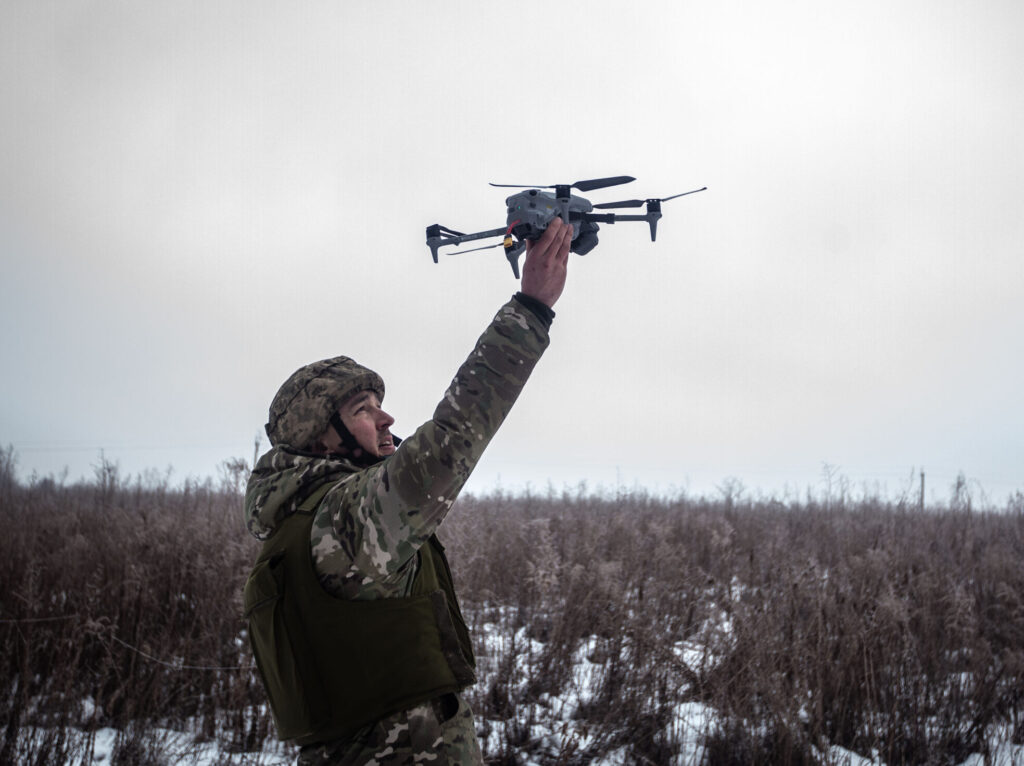
Over the past four years, Russia’s invasion has become the biggest European war since World War II, with a series of game-changing technological advances transforming military doctrine. In 2022, the battlefield was dominated by tanks, armor, and artillery, much as it had been since the early twentieth century. Today, the war is being shaped primarily by drones and small groups of infantry.
The proliferation of these technologies has turned what began as a war of movement into a war of attrition, with a kill zone stretching at least ten kilometers from ground zero on both sides of the front line. Robotic systems can now strike enemy targets on land, in the air, and at sea, and are also being deployed to evacuate the wounded, perform logistics roles, and serve as front line sentries.
Ukraine has proved highly adept at this innovative form of warfare. In many cases, Ukrainian military commanders have sought high tech solutions in order to counter Russia’s overwhelming advantages in manpower and conventional firepower.
Kyiv has also viewed defense tech innovations as an economically viable way to compensate for often unpredictable flows of military supplies from the country’s Western partners. This approach has helped to minimize any negative consequences following the reduction in direct US aid to Ukraine since the return of Donald Trump to the White House last year.
As a result, Ukraine now boasts a large and sophisticated domestic drone industry, with developers constantly upgrading existing models based of real-time combat feedback. Ukraine’s remarkable defense tech progress since 2022 has positioned the country at the cutting edge of drone technologies. Partner countries increasingly acknowledge this status and are seeking to benefit from Ukraine’s expertise, with Ukrainian soldiers training their NATO counterparts in drone warfare.
As the Trump presidency leads to dramatic shifts in the international security landscape, Kyiv is more generally in the geopolitical ascendancy. With America looking to downgrade its transatlantic commitments, the Ukrainian army is recognized as a key contributor to Europe’s future security. A country once seen as militarily insignificant is now regarded as indispensable for the defense of the continent.
Eurasia Center events

Ukraine’s emergence as the largest and most innovative military in Europe has enabled the country to stem the tide of Russia’s invasion and prevent any major breakthroughs. While Moscow has consistently held the battlefield initiative since late 2023, the Russian army has only managed to seize around one percent of additional Ukrainian territory while suffering hundreds of thousands of casualties.
Faced with a bloody quagmire on the front lines, Putin has resorted to exaggerating his army’s advances as he seeks to maintain the myth of inevitable Russian victory and discourage further support for Ukraine. This tactic was brutally exposed in late 2025 when Putin repeatedly claimed to have captured Kupyansk in northeastern Ukraine, only for Ukrainian President Volodymyr Zelenskyy to visit the city personally and record a selfie video revealing the Kremlin dictator’s lies.
Despite Ukraine’s strong record of military innovation and battlefield success since 2022, there are indications that both Russia and some of Kyiv’s Western partners continue to underestimate the country. Putin’s recent public statements reaffirming his determination to fight on, together with Russia’s increasingly open rejection of a compromise peace, suggest that Moscow still expects the Ukrainian army to collapse.
Meanwhile, US President Donald Trump has repeatedly stated that Ukraine has “no cards” and should therefore agree to a Kremlin-friendly peace deal. Others in Europe continue to argue that unfavorable military realities make painful Ukrainian concessions unavoidable in order to end the war.
These pessimistic perspectives ignore the lessons of the past four years. The Russian army is clearly not the irresistible force of Kremlin propaganda, while Ukraine is no longer a military minnow and has multiple trump cards in its possession. The most important conclusion of all is that the human dimension still ultimately determines outcomes on the battlefield. It is here that Ukraine truly excels, with an army of skilled, inventive, and highly motivated personnel defending their homes and families.
The grassroots ingenuity of Ukraine’s military and the country’s readiness to embrace defense sector innovation have undoubtedly been instrumental in sustaining the Ukrainian war effort. But while impressive new weapons systems have often grabbed the headlines, it would be shortsighted to attribute Ukraine’s military strength to technological advances alone.
As the war enters a fifth year, the Ukrainian nation as a whole deserves the respect of the world for defying Russia so emphatically and transforming their country into a formidable military power. Nobody knows this better than Putin, who is paying a very high price for making the mistake of underestimating Ukraine.
Mykola Bielieskov is a research fellow at the National Institute for Strategic Studies and a senior analyst at Ukrainian NGO “Come Back Alive.” The views expressed in this article are the author’s personal position and do not reflect the opinions or views of NISS or Come Back Alive.
Further reading
The views expressed in UkraineAlert are solely those of the authors and do not necessarily reflect the views of the Atlantic Council, its staff, or its supporters.

The Eurasia Center’s mission is to enhance transatlantic cooperation in promoting stability, democratic values, and prosperity in Eurasia, from Eastern Europe and Turkey in the West to the Caucasus, Russia, and Central Asia in the East.
Follow us on social media
and support our work
Image: Ukrainian army soldiers hold a reconnaissance drone before they launch it on the Sumy front, in Sumy, Ukraine, on January 28, 2026. (Photo by Francisco Richart Barbeira/NurPhoto)