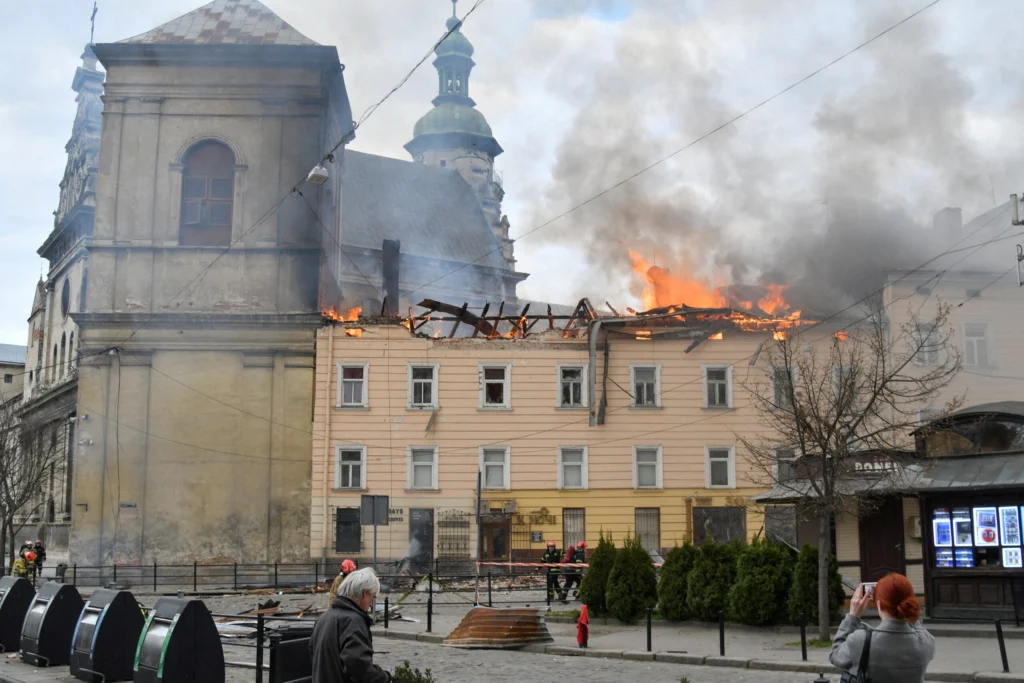
Russia bombed a UNESCO World Heritage site in the historic heart of west Ukrainian city Lviv on March 24 as Kremlin efforts to target Ukraine’s civilian population continue to escalate. The rare daytime drone strike hit a residential building close to the Bernardine monastery complex, causing extensive damage and leaving two people seriously injured. The area has featured on the UNESCO World Heritage Site List since 1998 as part of Lviv’s historic architectural ensemble.
Ukrainian officials condemned Tuesday’s attack on the bustling downtown district of Lviv and called on the international community to react. “Russia brutally struck the center of Lviv, a city of exceptional cultural value and a UNESCO World Heritage Site. I urge the UNESCO Director General to immediately respond to this crime in the strongest terms,” commented Ukrainian Foreign Minister Andrii Sybiha. “Russia is doing exactly what the Iranian regime is doing in the Middle East, but in the middle of Europe.”
Video footage of the bombing appears to show a Russian drone flying unimpeded into the building in central Lviv, indicating a targeted airstrike. This was the latest in a series of similar Russian attacks on Ukrainian heritage sites that have fueled accusations of a deliberate campaign to erase the symbols of Ukrainian culture and national identity. In response to these repeated Russian attacks, UNESCO’s World Heritage Committee has already added three Ukrainian sites located in Kyiv, Lviv, and Odesa to the UN agency’s official List of World Heritage in Danger.
Stay updated
As the world watches the Russian invasion of Ukraine unfold, UkraineAlert delivers the best Atlantic Council expert insight and analysis on Ukraine twice a week directly to your inbox.
Many Ukrainians saw Tuesday’s attention-grabbing airstrike on a non-military target in central Lviv as part of Kremlin efforts to terrorize the civilian population and break Ukrainian society’s will to resist the ongoing Russian invasion. “This is how Russia tries to make normal life impossible,” commented Ukrainian member of parliament Inna Sovsun.
Over the past year, Russian attacks of civilian targets have risen sharply. According to United Nations data, 2025 was the deadliest period for Ukrainian civilians since the initial months of the full-scale invasion, with the number of deaths rising by 31 percent compared to the previous year.
Many of these civilian deaths came as a result of an escalating bombing campaign made possible by the dramatic expansion of Russia’s domestic drone production capacity. Whereas aerial attacks in 2023 and 2024 typically involved dozens of drones, it is now common for Russia to launch hundreds of unmanned bomber drones at targets across Ukraine in a single night. The sheer scale of these attacks means that Ukrainian air defenses are often overwhelmed.
The recent winter season saw Russia’s most extensive bombing campaign against the Ukrainian civilian population of the entire war, with a coordinated air offensive targeting critical heating and power infrastructure amid Arctic temperatures. This apparent attempt to freeze millions of Ukrainians into submission in their own homes ultimately failed, but it did serve to underline Kremlin dictator Vladimir Putin’s readiness to employ terror tactics as he seeks to subjugate Ukraine.
Eurasia Center events

Moscow’s mounting attacks on Ukrainian civilians have come against a backdrop of growing battlefield frustration for the Kremlin. Despite enjoying the military initiative throughout 2025, Russia managed to seize less than one percent of additional Ukrainian territory while suffering catastrophic losses.
This underwhelming military performance has continued in recent months. For the first time in more than two years, Ukraine actually liberated more land during February 2026 than Russia was able to occupy. The Russian army’s inability to achieve a decisive breakthrough is now causing rumblings of discontent on the home front, including among Russia’s vocal pro-war blogger community.
Despite Russia’s lack of progress on the battlefield, Putin shows no signs of a willingness to compromise on the maximalist goals of his invasion. Instead, he continues to insist on peace terms that would leave postwar Ukraine isolated, defenseless, and completely at his mercy. The Russian ruler knows he cannot afford to settle for anything less. After all the sacrifices of the past four years, a negotiated peace that left 80 percent of Ukraine beyond Kremlin control and firmly anchored in the Western world would be viewed in Moscow as a defeat of historic proportions.
With no obvious route to military victory in Ukraine, Putin now finds himself trapped in a war he cannot win but dare not end. He has responded to this dilemma by increasing attacks on Ukraine’s civilian population. So far, there is little evidence to suggest this approach is working. On the contrary, polls indicate that the targeting of civilians has hardened Ukraine’s resolve to fight on rather than accept peace terms dictated by the Kremlin. Nevertheless, Russian attacks on civilians look set to continue.
Tuesday’s airstrike targeting an historic district of a major Ukrainian city in broad daylight has left many shocked, but it is entirely in keeping with Russia’s overall strategy. Indeed, this Lviv attack may mark the start of a new phase in Putin’s escalating bombing campaign as he seeks to force Ukraine’s surrender.
Peter Dickinson is editor of the Atlantic Council’s UkraineAlert service.
Further reading

The views expressed in UkraineAlert are solely those of the authors and do not necessarily reflect the views of the Atlantic Council, its staff, or its supporters.

The Eurasia Center’s mission is to enhance transatlantic cooperation in promoting stability, democratic values, and prosperity in Eurasia, from Eastern Europe and Turkey in the West to the Caucasus, Russia, and Central Asia in the East.
Follow us on social media
and support our work
Image: Residents look at firefighters who work at the site of a building which was hit by a Russian drone strike, amid Russia's attack on Ukraine, in the downtown of Lviv, Ukraine, March 24, 2026. (REUTERS/Stringer)