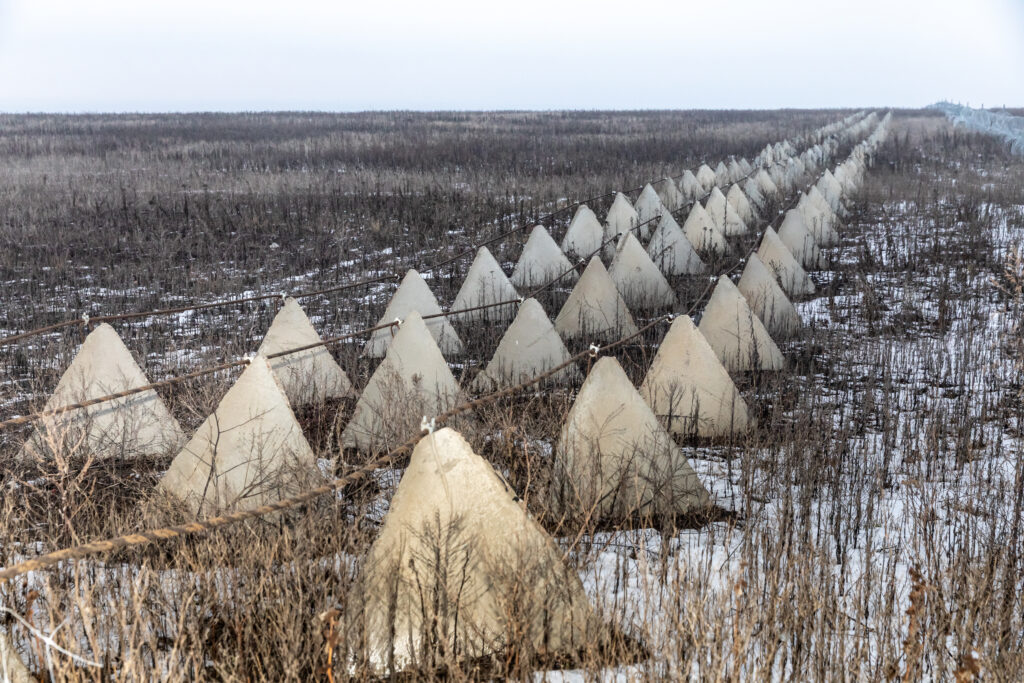
Russian forces continued to gradually advance in Ukraine during 2025, but suffered huge losses in exchange for minimal gains. This unfavorable ratio reflects the increasing effectiveness of Ukraine’s defensive lines, which now feature a combination of layered fortifications backed by deadly drone coverage. Together, these elements have turned much of the front line into a controlled kill zone that makes large-scale offensive operations extremely challenging while dramatically raising the cost of each new assault.
As Ukraine focuses on preventing further Russian advances and solidifying the front lines of the war, Kyiv has invested consideration resources in a major upgrade of the country’s defenses. This has resulted in what Britain’s The Economist recently described as a “massive fortification system” up to two hundred meters in depth covering much of the Ukrainian battlefield. “Ukraine now has the fortress belt it wishes it had in 2022,” the publication reported in early January.
Physical obstacles play an important role in this approach. Anti-tank ditches, razor wire, and concrete obstacles are layered to slow Russian advances. Defensive lines are often spaced within mortar range of one another, allowing Ukrainian units to trade space for time and counterattack against exposed enemy assault groups before they have had an opportunity to consolidate. The emphasis is on attrition and disruption rather than rigid territorial defense.
Stay updated
As the world watches the Russian invasion of Ukraine unfold, UkraineAlert delivers the best Atlantic Council expert insight and analysis on Ukraine twice a week directly to your inbox.
Ukraine’s defensive strategy goes far beyond a reliance on traditional static barriers. Over the past year, there has also been a growing emphasis on dispersed, concealed, and flexible defensive networks. These small-scale fortified positions are often located underground or embedded in tree lines at strategic locations, and are supported by remote fires and decoys. Each individual node in these networks is designed to shape enemy movement rather than stop it outright, channeling attackers into deliberately prepared kill pockets without exposing defenders. By creating choke points for Russian troops, Ukraine aims to maximize Kremlin casualties and capitalize on its in-built advantages as the defending party in a war of attrition.
There are growing signs that this approach is working. Ukraine’s top military commander Oleksandr Syrskyi commented recently that the current strategy has proved particularly effective on the Pokrovsk front, which has witnessed some of the heaviest fighting of the entire war over the past year. According to Syrskyi, “timely and high-quality fortifications and engineering obstacles” enabled Ukrainian forces to inflict maximum losses on Russian units close to Pokrovsk and disrupt their plans, even when facing numerical superiority.
Where Ukrainian defenses have failed, the reasons are instructive. In areas such as Toretsk and parts of the Kharkiv front, troop rotations occurred without sufficient time or equipment to construct proper fortifications, leading to Russian gains. Constant Russian drone surveillance made the use of heavy engineering machinery dangerous, leaving units unprepared when assaults followed. These cases serve as confirmation that fortifications are not optional enhancements but foundational to battlefield survival under drone saturated conditions.
Eurasia Center events

Drones are at the heart of Ukraine’s defensive strategy, serving as a ubiquitous presence over kill zones and preventing localized Russian advances from consolidating into more substantial breakthroughs. Meanwhile, in some sectors of the front such as Pokrovsk, ground robotic systems are now being used to deliver the vast majority of supplies to troops. With this in mind, Ukrainian commanders argue that all future defensive lines should be optimized for both aerial and ground drones.
These technological advances do not eliminate the need for manpower. Even the most sophisticated fortifications require soldiers to react to emerging threats. When Russian units manage to infiltrate defensive lines or push into urban areas, infantry forces remain essential in order to clear and secure ground. While Ukraine’s improved fortifications are an encouraging development for the war-weary nation, no physical barrier can realistically stop Russia unless it is supported by sufficient quantities of well-trained troops.
Strengthening Ukraine’s fortifications and addressing manpower shortages will be among the top priorities for incoming Ukrainian Defense Minister Mykhailo Fedorov, who took up his post this week. Fedorov made his name in government as Minister of Digital Transformation. Since 2022, he has been one of the driving forces behind Ukraine’s rapidly expanding drone warfare capabilities.
Fedorov’s extensive defense tech background, along with his reputation as a modernizer who has countered institutional corruption through the digitalization of state services, has led to considerable optimism over his appointment. He is now faced with the twin challenges of improving Ukraine’s front line defenses while addressing the mobilization and desertion problems hindering the Ukrainian war effort. If he is able to make progress on these two fronts, Ukraine’s prospects for 2026 and beyond will begin to look a lot better.
David Kirichenko is an associate research fellow at the Henry Jackson Society.
Further reading

The views expressed in UkraineAlert are solely those of the authors and do not necessarily reflect the views of the Atlantic Council, its staff, or its supporters.


The Eurasia Center’s mission is to enhance transatlantic cooperation in promoting stability, democratic values, and prosperity in Eurasia, from Eastern Europe and Turkey in the West to the Caucasus, Russia, and Central Asia in the East.
Follow us on social media
and support our work
Image: Mykhaylo Palinchak / SOPA Images via Reuters Connect