
As the full-scale invasion of Ukraine enters a fifth year with no end in sight, Kremlin officials continue to push the idea of inevitable Russian victory. By convincing the outside world that Ukraine cannot win, Moscow hopes to persuade Kyiv and its partners that further resistance is futile and force them to accept a punitive peace on Russian terms. However, these efforts are now being steadily undermined by Ukrainian military successes on the battlefield and deep inside Russia itself.
There are currently growing signs along the front lines of Russia’s invasion that the tide may finally be turning in Ukraine’s favor. For the first time in more than two years, Ukraine regained more territory than it lost in February 2026, the New York Times reports.
This Ukrainian progress followed months of glacial Russian advances that came at a terrible cost for the Kremlin in terms of casualties. While the Russian military held the battlefield initiative throughout 2025, Vladimir Putin’s invading army was unable to achieve any major breakthroughs and managed to secure less than one percent of additional Ukrainian territory.
By early 2026, many Western officials estimated that monthly Russian military losses in Ukraine were now exceeding Moscow’s capacity to replenish its forces. This high casualty rate is creating mounting pressure on Russia’s manpower reserves despite the country’s large population and continued recruitment efforts. With Putin deeply reluctant to risk another mobilization drive inside Russia, Moscow is turning increasingly to Africa and other regions for mercenary troops.
Stay updated
As the world watches the Russian invasion of Ukraine unfold, UkraineAlert delivers the best Atlantic Council expert insight and analysis on Ukraine twice a week directly to your inbox.
Ukraine is also bringing Putin’s invasion home to Russia with increasing effectiveness. Since 2022, Kyiv has prioritized the development of missiles and long-range drones. This is now making it possible to regularly strike military and industrial targets located over one thousand kilometers from the Ukrainian border.
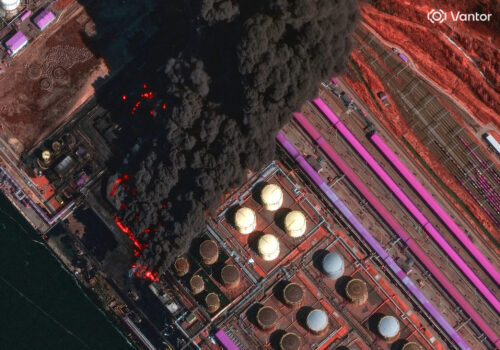
Ukraine’s enhanced long-range capability has produced spectacular results. In February, Ukrainian forces used domestically produced Flamingo cruise missiles to hit a major Russian industrial site that plays a critical role in Moscow’s own missile program. Satellite imagery and video footage appeared to confirm significant damage to the strategically important facility.
More recently, a series of large-scale Ukrainian drone strikes on ports and energy infrastructure temporarily cut Russia’s oil export capacity by at least 40 percent, according to Reuters calculations. The shutdown was “the most severe oil supply disruption in the modern history of Russia,” the news agency reported. With more Ukrainian missiles currently in the pipeline, a further expansion in Kyiv’s long-range strikes is widely anticipated.
Ukraine has been able to achieve similar success at sea. Despite not having a conventional fleet of its own, the Ukrainian military has used marine drones to sink or damage dozens of Russian warships. This has allowed Ukraine to break the blockade of the country’s Black Sea ports and force Putin to withdraw the bulk of his remaining fleet from its traditional base in occupied Crimea. In recent months, long-range Ukrainian strikes have intensified against the Russian navy and oil export terminals in the eastern Black Sea, causing significant damage and disruption.
Eurasia Center events

Amid mounting military setbacks, Putin continues to project confidence while insisting that the goals of Russia’s invasion will be met “unconditionally.” The Kremlin dictator has long been a leading advocate of efforts to portray Russian victory in Ukraine as a foregone conclusion. He often suggests that Ukraine’s defenses are on the verge of collapse, and bolsters these claims by exaggerating the difficulties that Kyiv faces from issues such as manpower shortages and desertion. The main message is clear: Russian victory is only a matter of time.
Kremlin officials routinely echo Putin’s swagger. During bilateral peace talks in 2025, members of the Russian delegation warned their Ukrainian counterparts that Moscow was ready to fight for as long as it takes to achieve their objectives. “We fought Sweden for 21 years. How long are you ready to fight?” stated lead negotiator Vladimir Medinsky in reference to the Great Northern War of the early eighteenth century.
Despite this bravado, it is becoming increasingly difficult for the Kremlin to disguise the Russian army’s lack of progress in Ukraine. In some cases, Putin’s commanders have been reduced to making exaggerated or entirely fictional claims of battlefield success in order to maintain the myth of relentless Russian advances.
This habit of inventing imaginary victories was highlighted in late 2025 when Putin repeatedly claimed to have captured Kupyansk in eastern Ukraine, only for Ukrainian President Volodymyr Zelenskyy to personally visit the city and record a selfie video revealing the Russian ruler’s lies. “We must keep exposing every single Russian falsehood because truth restores justice,” commented Zelenskyy.
Moscow’s messaging campaign appears to have won over some international leaders. US President Donald Trump has repeatedly indicated that he believes Russia will inevitably win and has called on Ukraine to make painful concessions. In Europe, pro-Putin politicians such as Hungarian Prime Minister Viktor Orban have repeatedly stated that Ukraine has no hope of success while pushing for a Kremlin-friendly settlement.
These pessimistic assessments closely mirror Putin’s own propaganda but are not supported by an objective analysis of Russia’s invasion. In reality, the idea that Moscow will inevitably win relies on outdated assumptions of Russian strength and Ukrainian weakness that have been comprehensively debunked over the past four years.
The false narrative of inevitable Russian victory is designed to demoralize Kyiv’s allies and undermine support for the Ukrainian war effort. Countering this defeatist disinformation is vital in order to ensure that diplomatic decisions are based on facts rather than the Kremlin’s carefully constructed illusions.
Kateryna Odarchenko is a partner at SIC Group USA and president of the PolitA Institute for Democracy and Development.
Further reading

The views expressed in UkraineAlert are solely those of the authors and do not necessarily reflect the views of the Atlantic Council, its staff, or its supporters.


The Eurasia Center’s mission is to enhance transatlantic cooperation in promoting stability, democratic values, and prosperity in Eurasia, from Eastern Europe and Turkey in the West to the Caucasus, Russia, and Central Asia in the East.
Follow us on social media
and support our work
Image: A service member of Ukraine's 422nd Unmanned Systems Regiment walks next to a heavy strike drone at a training ground, amid Russia's attack on Ukraine, in Zaporizhzhia region. March 23, 2026. (REUTERS/Stringer)