
For centuries, Russia’s colossal size has been widely regarded as the country’s greatest asset. From Charles XII of Sweden to Napoleon Bonaparte and Adolf Hitler, a long line of would-be conquerors have invaded Russia only for their armies to swallowed up by the vastness of the country. Ukraine is now attempting to turn this military logic on its head with a strategic bombing campaign that aims to exploit Russia’s immensity and transform it from a key strength into a fatal weakness.
Kyiv’s current deep strike strategy reflects the changing technological possibilities of modern warfare. Russia’s sheer size once made it virtually impossible to conquer, but in an era where long-range precision weapons are increasingly accessible, the Putin regime is now discovering that this same attribute makes the country extremely difficult to defend.
Stay updated
As the world watches the Russian invasion of Ukraine unfold, UkraineAlert delivers the best Atlantic Council expert insight and analysis on Ukraine twice a week directly to your inbox.
Since the onset of Russia’s full-scale invasion in February 2022, Ukrainian policymakers have recognized the importance of bringing the war home to Russia. At the same time, they have been under no illusions regarding the deep reluctance of Ukraine’s allies to authorize strikes against targets inside the Russian Federation using Western weapons. This has left Kyiv with little choice but to prioritize the development of domestically produced long-range drones and missiles capable of penetrating deep into Russia.
During the first two years of the full-scale war, Ukraine’s long-range weapons program produced only modest results. While attacks were sporadically carried out, these early strikes were mostly symbolic in nature, with video footage of isolated explosions boosting Ukrainian morale without doing any real damage to the Kremlin war machine. More recently, however, Ukraine’s long-range strikes have become far bigger and more consequential.
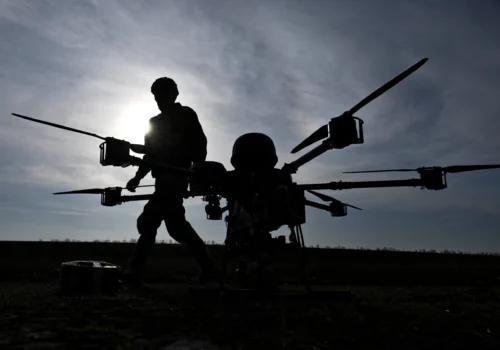
The mounting impact of Ukraine’s strategic bombing campaign is due to an upgraded long-range arsenal that now contains a large number of drone models along with a growing quantity of domestically developed cruise missiles. In recent months, Kyiv has used this enhanced firepower to conduct large-scale attacks on Russian military production sites and energy infrastructure, including multiple targets located more than a thousand kilometers from the Ukrainian border. This extended range means that around a quarter of Russia’s entire landmass and more than 70 percent of the Russian population are now within reach, according to Bloomberg.
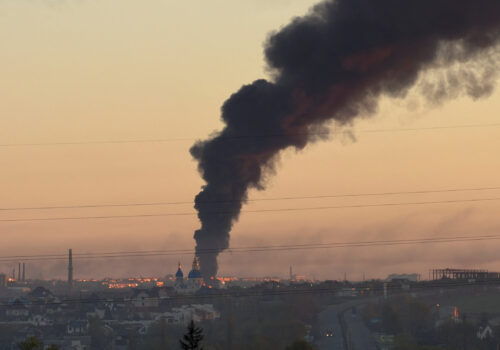
Ukraine’s bombing tactics are also evolving. While the initial stages of Ukraine’s deep strike campaign featured a wide range of targets, recent attacks appear to be more methodical in nature and often involve the repeated bombardment of key logistics hubs. This approach was evident during a series of recent attacks on the oil terminal facility at Russian Black Sea port Tuapse, which was hit on four separate occasions in late April and early May.
Ukrainian attacks on Russia’s oil industry have proved particularly effective. During spring 2026, a series of spectacular drone strikes against port terminals succeeded in disrupting Russian exports, while attacks on refineries led to reports of significantly reduced capacity. Ukrainian officials believe that by targeting Russia’s energy industry, they can deprive the Kremlin of a vital economic lifeline that funds the ongoing invasion.
Ukraine has ambitious plans in place to escalate its strategic bombing campaign. This includes the development of ballistic missiles, which would represent an important addition to Kyiv’s strike capabilities. While reports of advances in Ukraine’s ballistic missile program have yet to be independently confirmed, the country’s progress in developing other long-range weapons and long history of missile production mean that talk of an impending ballistic breakthrough should be taken seriously.
Eurasia Center events

Ukraine’s growing arsenal creates enormous dilemmas for the Kremlin. Russian officials have long known that their country is susceptible to long-range precision weapons and have worked hard to deny Ukraine such capabilities. On multiple occasions since 2022 when Kyiv’s partners have appeared close to supplying Ukraine with long-range missiles, Putin has intervened with thinly veiled threats and warnings of dire consequences. Likewise, during talks over a possible peace deal, Russian negotiators have repeatedly pushed for limits on the range of weapons Ukraine is allowed to possess.
Russia’s vulnerability is all too clear. Even in the most favorable circumstances, the Kremlin would find it extremely challenging to organize a truly effective nationwide air defense network. The invasion of Ukraine has exacerbated this problem. Since 2022, a large portion of Russia’s air defense systems have been deployed to the front lines to protect troops and logistics hubs. Meanwhile, Ukrainian drone operators have prioritized the destruction of air defenses, further adding to the Kremlin’s supply problems.
On the home front, the mounting threat of Ukrainian airstrikes against targets inside Russia has forced the Kremlin to concentrate the country’s limited remaining air defense resources around high-value locations such as Moscow and Saint Petersburg, while also protecting the palatial residences of Putin and his cronies. This is inevitably creating gaps elsewhere in Russia’s air defense infrastructure for Ukraine to exploit.
Even if the Kremlin was somehow able to drastically increase the quantity of air defense systems at its disposal, it is doubtful this would be sufficient to protect the country’s many military production sites and sprawling energy industry infrastructure from aerial attack. With an airspace that spans eleven time zones and is almost thirty times larger than Ukraine’s, Russia is simply too big to be covered comprehensively.
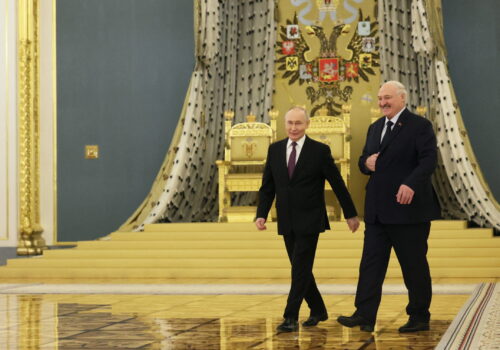
Putin clearly understands the scale of the threat and signaled his mounting alarm in early May by downgrading Russia’s annual Victory Day parade in Moscow amid fears of possible Ukrainian drone strikes. The Kremlin dictator’s decision to scale back a parade that has long served as a symbol of his personal power was widely seen as proof that Russia is struggling to cope with Ukraine’s escalating air offensive.
This trajectory is unlikely to change any time soon. On the contrary, as Ukraine’s long-range arsenal expands further and Putin’s air defenses are stretched thinner, the Russian colossus will become even more vulnerable to attack from above.
Peter Dickinson is editor of the Atlantic Council’s UkraineAlert service.
Further reading
The views expressed in UkraineAlert are solely those of the authors and do not necessarily reflect the views of the Atlantic Council, its staff, or its supporters.


The Eurasia Center’s mission is to enhance transatlantic cooperation in promoting stability, democratic values, and prosperity in Eurasia, from Eastern Europe and Turkey in the West to the Caucasus, Russia, and Central Asia in the East.
Follow us on social media
and support our work
Image: Smoke rises from the site following a Ukrainian drone attack that caused a fire at an oil refinery, amid the Russia-Ukraine conflict, in Tuapse, Krasnodar Krai, Russia. April 28, 2026. (2026 Planet Labs PBC/Handout via REUTERS)