

Featured analysis

Latest analysis

EconoGraphics

Mar 13, 2023

Silicon Valley Bank failed: What happens next?

By Hung Tran

Even if the contagion effects are contained, risks to the financial stability of the US and the world have increased significantly. The Fed can no longer focus only on bringing down inflation, but must also avoid exacerbating financial stability risks.

Economy & Business
Financial Regulation

Econographics

Jan 26, 2023

Global Sanctions Dashboard: How sanctions will further squeeze the Russian economy in 2023

By Charles Lichfield, Maia Nikoladze, and Castellum.AI

The effects of sanctions on the Russian economy; Venezuela’s pursuit of lifting energy sanctions; the plans for screening EU-US outbound investment going into China.

China
Economic Sanctions

Econographics

Jan 23, 2023

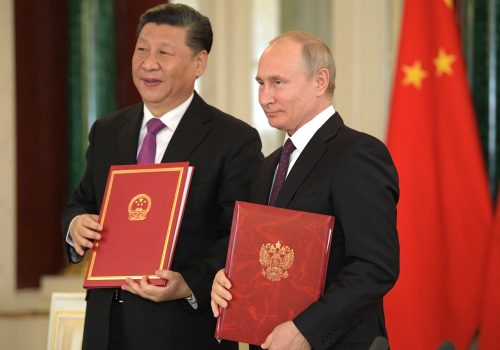
Russian finance pivots east

By Niels Graham

Starting in 2014 and accelerating after Russia’s invasion of Ukraine, Moscow launched a financial pivot toward China. While it initially worked for both countries, economic stress in China as well as the risk of overreliance on Beijing may hinder its future success

China
Economic Sanctions

EconoGraphics

Jan 14, 2023

Global Economic Events Calendar

By GeoEconomics Center

The Global Economic Events Calendar tracks key central bank meetings, major data releases, and significant international economic and political events

Economy & Business

Econographics

Jan 9, 2023

Fed reverse repos hit a new record: An unhealthy development

By Hung Tran

The Fed’s large footprint in private short-term financial transactions will have largely negative implications for the US financial system and economy.

Economy & Business
Macroeconomics

Econographics

Dec 15, 2022

A different monetary policy path in 2023

By Ole Moehr

Decisions and statements this week from the Fed, ECB, and the BOE tell us how they will each deploy tools at their disposal differently in 2023.

Economy & Business
Europe & Eurasia

Econographics

Dec 8, 2022

The numbers that drove China’s Zero-COVID policy

By Niels Graham

China’s adherence to zero-COVID was primarily driven by poor vaccination rates among seniors and weak health care infrastructure. As the country opens, both factors remain key health risks.

China
Coronavirus

Econographics

Nov 23, 2022

US-China competition after the US midterms and the CCP 20th Congress

By Hung Tran

For the first time since becoming President, Joe Biden met face-to-face with Secretary General Xi Jinping on November 14, 2022, at the outset of the G20 Summit in Bali, Indonesia. Against the backdrop of rising tensions between the two countries, the United States hoped it would “put a floor under the relationship.” But the recent […]

China
Economy & Business

Econographics

Nov 17, 2022

Global Sanctions Dashboard: What’s coming in 2023?

By Charles Lichfield, Maia Nikoladze, and Castellum.AI

Fall sanctions against Russia and Iran; implications of US semiconductor export controls against China; projected sanctions trends in 2023.

China
Economic Sanctions

Econographics

Nov 11, 2022

The target of limiting global warming to less than 1.5 degrees is practically dead. Why do emissions per capita matter?

By Amin Mohseni-Cheraghlou

Achieving the target to limit global warming to below 2, preferably 1.5 degrees Celsius, by the end of the century seems more unfeasible than ever. The reason is simple. The most critical of greenhouse gases have continuously risen in the past decade and CO2 emissions are only expected to grow more in 2022 and for the foreseeable future. COP27 needs to pave the path for a renewed international cooperative and enforceable framework to reduce global greenhouse gas emissions by the world’s top emitters both in absolute terms and in per capita terms.

Climate Change & Climate Action
Economy & Business

Content

EconoGraphics

Jun 20, 2017

Balancing Act

By Samuel Weitzman

On June 12, in US President Donald J. Trump’s first full cabinet meeting, the new US Trade Representative Robert Lighthizer briefly encapsulated the young administration’s philosophy on international trade: “Deficits do matter, and ours are coming down.” This is not a particularly partisan view; Trump’s opponent in the 2016 presidential election, former Secretary of State Hillary Clinton, spoke out against the Trans-Pacific Partnership (TPP) during her campaign despite supporting it previously.

Economy & Business
Trade and tariffs

EconoGraphics

Jun 9, 2017

A Vital Foreign Policy Tool

By Ole Moehr

This is the first EconoGraphic as part of our recently launched Economic Sanctions Initiative. The initiative aims to promote dialogue between the public and the private sector to investigate how to improve the design and implementation process of economic sanctions.

Economic Sanctions
Economy & Business

EconoGraphics

Apr 19, 2017

The European Stability Mechanism

By Lu Ding & Ole Moehr

The global economic and financial crisis, which originated in the United States in 2008, ultimately triggered a sovereign debt crisis in Europe in 2010. As a result of sky high debts, economies lacking in competitiveness, and over lenient banking regulations, the credit ratings of the Eurozone members Cyprus, Greece, Ireland, Portugal, and Spain plummeted. These countries began facing prohibitively high interest rates when they attempted to borrow from international credit markets.

Economy & Business
European Union

EconoGraphics

Mar 17, 2017

The United States Needs Europe And Vice Versa (Pt. 3)

By Lu Ding & Ole Moehr

This EconoGraphic is the final edition of a three-part series on why the United States and Europe need each other. The series highlights excerpts from the EuroGrowth Task Force’s inaugural report on European economic growth and why it matters for US prosperity.

Economy & Business
Europe & Eurasia

EconoGraphics

Mar 7, 2017

The United States Needs Europe And Vice Versa (Pt. 2)

By Lu Ding & Ole Moehr

US economic ties with the European Union (27) generate the largest global bilateral trade flows, worth an estimated $2.4 billion per day. The massive volume of US-EU (27) bilateral trade promotes prosperity on both sides of the Atlantic.

Economy & Business
Europe & Eurasia

EconoGraphics

Feb 22, 2017

The United States Needs Europe and Vice-Versa

By Lu Ding & Ole Moehr

The United States is the world’s largest recipient of global foreign direct investment (FDI). On a current-cost basis, the US FDI stock was more than three times larger than that of the second largest destination country in 2014, the most recent year from which statistics are available. Despite the current fragile global economy and great political uncertainty, foreign investment in the United States remains strong.

Economy & Business
European Union

EconoGraphics

Dec 12, 2016

Refer-Ending Renzi’s Government

By Filippos Letsas

On December 4, Italian voters rejected former Prime Minister Renzi’s constitutional reform referendum. The result of the referendum renewed concerns about the economic recovery in Italy, stability of the Euro, broader European economic integration, and rising populism across Europe. In the week following the referendum, global markets have focused their attention on the ailing Italian banking sector.

Economy & Business
Europe & Eurasia

EconoGraphics

Nov 29, 2016

The United States Needs China and Vice-Versa

By Filippos Letsas

Over the last decade, China’s large holdings of US debt have helped the Bank of China keep the value of the renminbi artificially low. This strengthened China’s competitive position in the global markets, allowing for cheaper Chinese exports and contributed significantly to China’s large trade surplus, which now accounts for about half of the total US trade deficit.

China
Economy & Business

EconoGraphics

Oct 25, 2016

CETA: Why “Comprehensive” Matters

By Filippos Letsas

On October 14th, the regional parliament of Wallonia, a French-speaking region of 3.6 million people in Belgium, voted to block the Comprehensive Economic and Trade Agreement (CETA), a proposed trade agreement between the European Union (EU) and Canada, which has been negotiated for over 7 years.

Economy & Business
European Union

EconoGraphics

Oct 7, 2016

Europe′s Fiscal Burden in Focus

By Filippos Letsas

The European Union’s (EU) Stability and Growth Pact requires Eurozone countries to annually lay out their fiscal plans for the following three years. The European Commission (EC) then compares the member states’ reports with its own projections and those produced by independent bodies, such as the International Monetary Fund (IMF), to evaluate whether the member states are on track to reach their Medium-Term Budgetary Objectives (MTOs).

Economy & Business
European Union