

Featured analysis

Latest analysis

Econographics

Jun 2, 2023

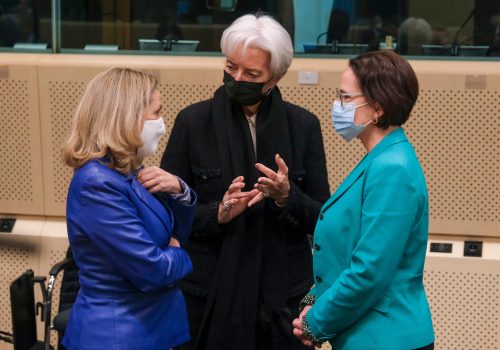
Only 11 percent of finance ministers and central bank governors are women

By Jessie Yin

Some of the most powerful economic institutions in the world are led by women at the moment, but their success hasn’t translated to broad representation. Structural barriers continue to prevent many women from reaching top roles in finance and economics.

Economy & Business
Inclusive Growth

Econographics

May 25, 2023

Global Sanctions Dashboard: US and G7 allies target Russia’s evasion and procurement networks

By Kimberly Donovan, Maia Nikoladze, Benjamin Mossberg and Castellum.AI

Tackling export controls circumvention by Russia; the enforcement and effectiveness of the oil price cap; the failure of the US sanctions policy towards Sudan, and how to fix it.

Africa
Economic Sanctions
Sunset at the Treasury Department

Econographics

May 23, 2023

There is no alternative to US Treasuries

By Josh Lipsky

In the wake of a US default, investors searching for safe assets may have no viable alternative to US Treasuries.

China
Economy & Business

Econographics

May 19, 2023

Can FedNow bring the US closer to real-time payments?

By Piret Loone

This year, the US will launch its FedNow instant payment network. But even after FedNow launches, the US will still have a ways to go before consumers can access instantaneous digital payments.

Economy & Business
Financial Regulation

Econographics

May 15, 2023

The US debt ceiling stalemate threatens money market funds—and financial stability

By Hung Tran

Money markets would be the first to react to a debt ceiling breach, heightening market turmoil at the wrong time and helping to raise the odds of a severe recession.

Economy & Business
Financial Regulation

Econographics

May 10, 2023

What is the G7 still exporting to Russia? 

By Niels Graham

One year into the Russia’s invasion G7 nations continue to export nearly $5B a month to Moscow. A new proposal by the US at the G7 could greatly reduce this.

Economic Sanctions
Economy & Business

Econographics

May 8, 2023

Japan’s monetary trilemma is a warning to the world

By Mark Siegel

High inflation, high levels of debt, and uncertain financial stability – Washington, London, Brussels, Frankfurt and beyond have much to learn from Tokyo’s experience.

Economy & Business
Financial Regulation

Econographics

May 1, 2023

Russia Sanctions Database: May 2023

Explore featured insight part of the May 2023 edition of Atlantic Council’s Russia Sanctions Database.

Russia
Ukraine

Econographics

Apr 27, 2023

The root causes of geopolitical fragmentation

By Hung Tran

Geoeconomic fragmentation is on the rise. Policymakers need to address the root causes: inequality left in the wake of globalization, and the crisis of trust between major countries.

Americas
China

Econographics

Apr 26, 2023

Why emerging markets are stocking up on gold

By Phillip Meng

Financial stability concerns, sanctions, and inflation contributed to the largest net purchases of gold in over seventy years last year—raising questions about its potential role in de-dollarization.

Africa
Americas

Content

EconoGraphics

Jun 20, 2017

Balancing Act

By Samuel Weitzman

On June 12, in US President Donald J. Trump’s first full cabinet meeting, the new US Trade Representative Robert Lighthizer briefly encapsulated the young administration’s philosophy on international trade: “Deficits do matter, and ours are coming down.” This is not a particularly partisan view; Trump’s opponent in the 2016 presidential election, former Secretary of State Hillary Clinton, spoke out against the Trans-Pacific Partnership (TPP) during her campaign despite supporting it previously.

Economy & Business
Trade and tariffs

EconoGraphics

Jun 9, 2017

A Vital Foreign Policy Tool

By Ole Moehr

This is the first EconoGraphic as part of our recently launched Economic Sanctions Initiative. The initiative aims to promote dialogue between the public and the private sector to investigate how to improve the design and implementation process of economic sanctions.

Economic Sanctions
Economy & Business

EconoGraphics

Apr 19, 2017

The European Stability Mechanism

By Lu Ding & Ole Moehr

The global economic and financial crisis, which originated in the United States in 2008, ultimately triggered a sovereign debt crisis in Europe in 2010. As a result of sky high debts, economies lacking in competitiveness, and over lenient banking regulations, the credit ratings of the Eurozone members Cyprus, Greece, Ireland, Portugal, and Spain plummeted. These countries began facing prohibitively high interest rates when they attempted to borrow from international credit markets.

Economy & Business
European Union

EconoGraphics

Mar 17, 2017

The United States Needs Europe And Vice Versa (Pt. 3)

By Lu Ding & Ole Moehr

This EconoGraphic is the final edition of a three-part series on why the United States and Europe need each other. The series highlights excerpts from the EuroGrowth Task Force’s inaugural report on European economic growth and why it matters for US prosperity.

Economy & Business
Europe & Eurasia

EconoGraphics

Mar 7, 2017

The United States Needs Europe And Vice Versa (Pt. 2)

By Lu Ding & Ole Moehr

US economic ties with the European Union (27) generate the largest global bilateral trade flows, worth an estimated $2.4 billion per day. The massive volume of US-EU (27) bilateral trade promotes prosperity on both sides of the Atlantic.

Economy & Business
Europe & Eurasia

EconoGraphics

Feb 22, 2017

The United States Needs Europe and Vice-Versa

By Lu Ding & Ole Moehr

The United States is the world’s largest recipient of global foreign direct investment (FDI). On a current-cost basis, the US FDI stock was more than three times larger than that of the second largest destination country in 2014, the most recent year from which statistics are available. Despite the current fragile global economy and great political uncertainty, foreign investment in the United States remains strong.

Economy & Business
European Union

EconoGraphics

Dec 12, 2016

Refer-Ending Renzi’s Government

By Filippos Letsas

On December 4, Italian voters rejected former Prime Minister Renzi’s constitutional reform referendum. The result of the referendum renewed concerns about the economic recovery in Italy, stability of the Euro, broader European economic integration, and rising populism across Europe. In the week following the referendum, global markets have focused their attention on the ailing Italian banking sector.

Economy & Business
Europe & Eurasia

EconoGraphics

Nov 29, 2016

The United States Needs China and Vice-Versa

By Filippos Letsas

Over the last decade, China’s large holdings of US debt have helped the Bank of China keep the value of the renminbi artificially low. This strengthened China’s competitive position in the global markets, allowing for cheaper Chinese exports and contributed significantly to China’s large trade surplus, which now accounts for about half of the total US trade deficit.

China
Economy & Business

EconoGraphics

Oct 25, 2016

CETA: Why “Comprehensive” Matters

By Filippos Letsas

On October 14th, the regional parliament of Wallonia, a French-speaking region of 3.6 million people in Belgium, voted to block the Comprehensive Economic and Trade Agreement (CETA), a proposed trade agreement between the European Union (EU) and Canada, which has been negotiated for over 7 years.

Economy & Business
European Union

EconoGraphics

Oct 7, 2016

Europe′s Fiscal Burden in Focus

By Filippos Letsas

The European Union’s (EU) Stability and Growth Pact requires Eurozone countries to annually lay out their fiscal plans for the following three years. The European Commission (EC) then compares the member states’ reports with its own projections and those produced by independent bodies, such as the International Monetary Fund (IMF), to evaluate whether the member states are on track to reach their Medium-Term Budgetary Objectives (MTOs).

Economy & Business
European Union