Featured analysis

Latest analysis

EconoGraphics

Aug 23, 2021

IMF delivers fiscal firepower

By Niels Graham and William Howlett

On August 23 the IMF released a historic $650 billion allocation of Special Drawing Rights (SDRs)

Inclusive Growth International Financial Institutions

EconoGraphics

Jun 29, 2021

Global Sanctions Dashboard: 5th edition

By Julia Friedlander, Michael Albanese and Castellum.AI

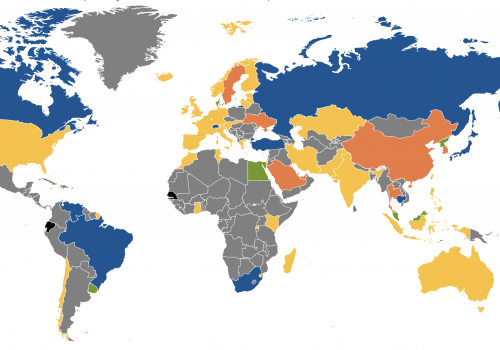
China’s anti-foreign sanctions bill, mapping Belarusian KGB sanctions, and building an anti-kleptocracy playbook.

Belarus China

EconoGraphics

May 14, 2021

Global Sanctions Dashboard: April

By Julia Friedlander, Michael Albanese and Castellum.AI

UN sanctions, UK’s new anti-corruption authority, the Kremlin’s use of sanctions as a law enforcement mechanism.

European Union Financial Sanctions and Economic Coercion

EconoGraphics

May 6, 2021

Chipwreck: Visualizing the downsides of semiconductors

By Niels Graham, Josh Lipsky

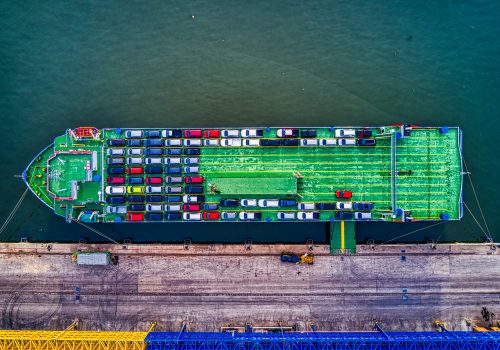
The global chip shortage has impacted automakers far more than initially projected.

China Japan

EconoGraphics

Apr 28, 2021

Rollout of the digital yuan

By The GeoEconomics Center

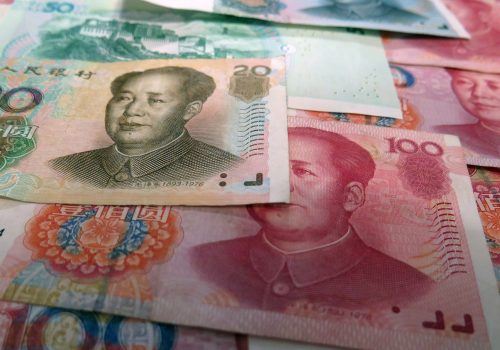
28. That’s the number of cities where China’s about to test drive the digital yuan. Our new animated map shows the rapid expansion planned for the mainland over the next eight months.

China Digital Currencies

Econographics

Apr 20, 2021

The Rise of Central Bank Digital Currencies

By GeoEconomics Center

What exactly is a Central Bank Digital Currency (CBDC) and how does the research compare globally?

Digital Currencies Digital Policy

EconoGraphics

Apr 14, 2021

Global Sanctions Dashboard: March

By Julia Friedlander, Michael Albanese and Castellum.AI

Growing international sanctions response to Chinese behavior, the Iran nuclear deal talks in Vienna, and the crisis in Myanmar.

China European Union

EconoGraphics

Mar 22, 2021

China’s ‘Two Sessions’ goes off script

By Niels Graham, Josh Lipsky

Since their peak in mid-February, Chinese markets have lost $1.3 trillion dollars in value. The market route was likely caused by Beijing’s announcement of tighter fiscal policy and worries about inflation risks in America. Nevertheless, it is still unclear if the Chinese can tolerate the kind of volatility capitalist countries are accustomed to.

China Financial Regulation

EconoGraphics

Mar 19, 2021

Happy St Pats to Ireland: Boom, bust, and recovery for Europe’s most resilient

By GeoEconomics Center

This week, the Atlantic Council’s GeoEconomics Center dressed in green and took a moment to reflect on the Irish economy, one of the most resilient in the European Union.

Digital Policy Eurozone

EconoGraphics

Mar 11, 2021

Global Sanctions Dashboard: February

By Michael Albanese and Castellum.AI

Aligning with allies against human rights abusers and authoritarian regimes, lack of coordinated response to the ongoing genocide in Xinjiang.

China European Union

Content

EconoGraphics

Oct 7, 2016

Europe′s Fiscal Burden in Focus

By Filippos Letsas

The European Union’s (EU) Stability and Growth Pact requires Eurozone countries to annually lay out their fiscal plans for the following three years. The European Commission (EC) then compares the member states’ reports with its own projections and those produced by independent bodies, such as the International Monetary Fund (IMF), to evaluate whether the member states are on track to reach their Medium-Term Budgetary Objectives (MTOs).

Economy & Business European Union

EconoGraphics

Sep 30, 2016

Myanmar: Post-Sanctions Landscape

By Filippos Letsas

On the occasion of Myanmar’s State Counselor Aung San Suu Kyi’s recent visit to the United States (U.S.), President Obama announced that executive sanctions on Myanmar would soon be lifted. This will grant Myanmar greater access to the U.S. market and encourage U.S. companies to invest in the country. Trade between the two countries remains at relatively low levels (i.e. $225 million in 2015), with U.S. investment to Myanmar accounting for only 0.2% of the country’s Foreign Direct Investment (FDI).

Economy & Business Financial Sanctions and Economic Coercion

EconoGraphics

Sep 13, 2016

TTIP = So (Ger)Many Benefits

By Filippos Letsas

As the most export-driven major economy in the European Union (EU), Germany stands to benefit greatly from a robust Transatlantic Trade and Investment Partnership (TTIP) agreement.

Economy & Business European Union

EconoGraphics

Jul 12, 2016

Taking Stock of European Banks: Improvements Amid Challenges

By Nathaniel Rome

Since the British referendum, Europe’s banking sector has come under renewed scrutiny from financial markets as well as European Union officials and finance ministers. A primary focus is on Italy - which has accumulated $400 billion in gross bad loans - and the EU-Italy talks about how to recapitalize the weak Italian banks.

Economy & Business European Union

EconoGraphics

Jun 29, 2016

Econographics – TTIP

By Nathaniel Rome

The United Kingdom’s (UK) vote last week to leave the European Union (EU) has raised questions about the future of the Transatlantic Trade and Investment Partnership (TTIP). TTIP is a trade agreement currently being negotiated by the United States (US) and the EU that will eliminate tariffs, reduce red tape, and set a new standard for international trade agreements. Following the Brexit vote, US Trade Representative Michael Froman and European Commissioner for Trade Cecilia Malmström released statements reaffirming their commitment to TTIP.

Economy & Business European Union

Bremain vs Brexit

Jun 21, 2016

London Riches Falling Down

By Nathaniel Rome

London is the undisputed financial capital of Europe, and is rivaled only by New York City for the top spot worldwide (Global Financial Centers Index). When competing on a level playing field, London outperforms other major European financial centers because of the superior human capital, infrastructure, and regulatory environment of the city. London dominates 78 percent of European FOREX trading and generates a trade surplus worth tens of billions of pounds (UK Office of National Statistics).

Economy & Business European Union

Bremain vs Brexit

Jun 9, 2016

Britannia, Rule the Trade!

By Nathaniel Rome & TK Spandhla

The decades following World War II experienced an explosion of global trade. The annual growth rate of global exports averaged 8 percent in the 1950s, 9 percent in the 1960s, and 20 percent in the 1970s (World Trade Organization). During this boom of global trade, the volume of UK exports grew in absolute terms. However, up until the mid-1970s, the UK trade growth lagged behind the global average.

Economy & Business European Union

EconoGraphics

Jun 1, 2016

Not The Time to Falter: Economic Sanctions Against Russia

By Alvaro Morales Salto Weis

As the European Union (EU) prepares to unanimously extend its economic sanctions on Russia when they expire on July, it is a good opportunity to take a closer look. After Russia´s illegal annexation of Crimea and interference in Eastern Ukraine, the U.S. and the EU enacted economic sanctions in a coordinated manner, which were followed by other Allies and partners like Canada and Australia.

Economy & Business Europe & Eurasia

EconoGraphics

Apr 13, 2016

Europe’s Path to Budget Equilibrium

By Alvaro Morales Salto Weis & TK Spandhla

The European Union’s 28 member nations are required by Stability and Growth Pact to keep their budget deficits to within 3 percent of GDP. According to the European Commission forecast (as of winter 2016) six countries will exceed this level in 2016: the U.K., France, Spain, Greece, Croatia and Portugal. Romania will post a deficit at the threshold. This is an improvement from 2009 and 2010, when no fewer than 22 EU countries overstepped the deficit limit.

Economy & Business European Union

EconoGraphics

Apr 1, 2016

The European Refugee Surge: Transforming Challenges into Opportunities

By Alvaro Morales Salto Weis & TK Spandhla

Asylum applications to the European Union (EU) set an all-time record in 2015, more than doubling the 2014 figure, according to EUROSTAT. After the recent agreement between Turkey and the EU, the influx of refugees is expected to decrease significantly.

Afghanistan Europe & Eurasia