About the Council

The Atlantic Council promotes constructive leadership and engagement in international affairs based on the Atlantic Community’s central role in meeting global challenges. The Council provides an essential forum for navigating the dramatic economic and political changes defining the twenty-first century by informing and galvanizing its uniquely influential network of global leaders. Through the papers we write, the ideas we generate, and the communities we build, the Council shapes policy choices and strategies to create a more secure and prosperous world.

NATO 20/2020

Twenty bold ideas to reimagine the Alliance after the 2020 US election

More than two decades after NATO’s inspired decision to invite former adversaries to join its ranks, the Alliance is in need of equally captivating ideas. The essays in this volume are intended to push the Alliance to think boldly and creatively in the service of recapturing the public’s imagination.
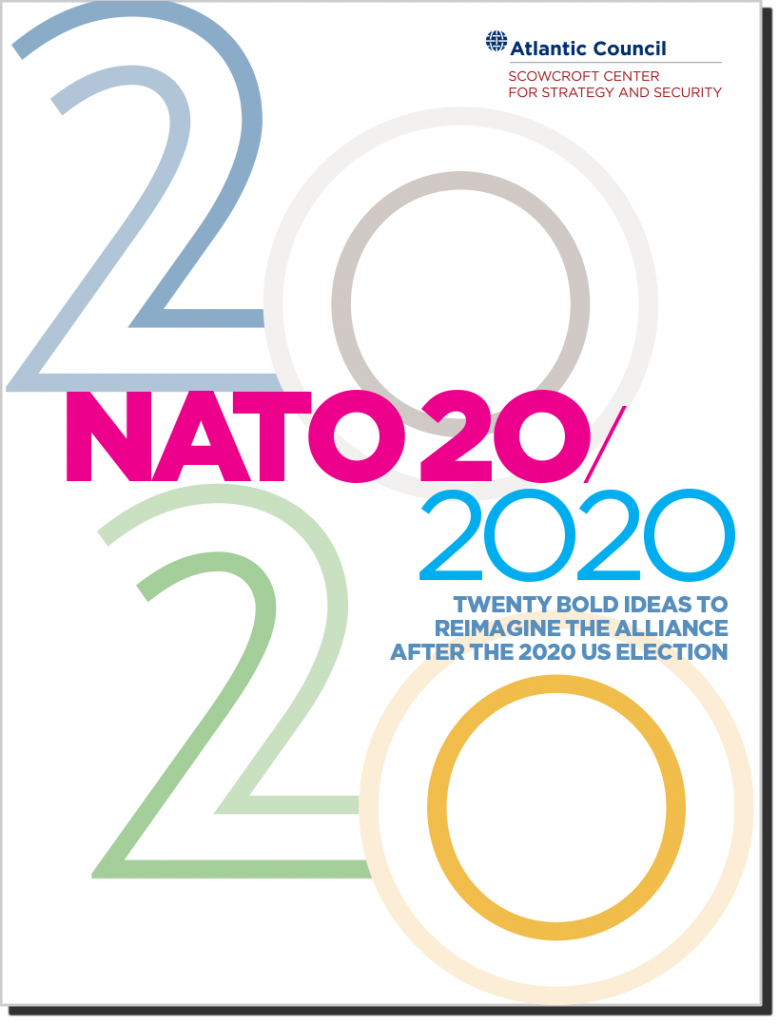
Read our provocative essays on the future of NATO

Explore the podcast series

Making a difference

Learn more about the Atlantic Council’s insights & impact through these stories of how our regional and thematic programs are making a difference not only in shaping how we view global issues but also in shaping their outcome.
Latest commentary and analysis

Latest in-depth research and reports

Content

In the News

Feb 16, 2022

Friedlander and O’Toole quoted in Politico on sanctions against Russia

Read the full article here.

Economy & Business Financial Sanctions and Economic Coercion

In the News

Feb 16, 2022

Wetzel in Bulletin of the Atomic Scientists on the Russia-Ukraine crisis

By Atlantic Council

Senior US Air Force fellow Lt Col Tyson Wetzel describes the potential for a Russian invasion of Ukraine.

Conflict Crisis Management

In the News

Feb 15, 2022

Mu Changchun’s remarks from the UCSD-GeoEconomics Center conference on CBDCs in the Asia Pacific featured in Reuters

Read the full article here.

China Digital Currencies

In the News

Feb 15, 2022

Kramer in The Hill discussing cybersecurity vulnerabilities

By Franklin D. Kramer

On February 15, Atlantic Council Board Director and Distinguished Fellow Franklin D. Kramer authored an article for The Hill arguing that incentivizing the establishment of an industry of private sector integrated service providers through the use of cybersecurity investment tax credits would bolster resilience in the cyberspace.

Cybersecurity Europe & Eurasia

In the News

Feb 15, 2022

Georgieva’s remarks from the IMF-GeoEconomics Center event featured in CNBC India

Read the full article here.

Digital Currencies Economy & Business

In the News

Feb 15, 2022

Polymeropoulos in the New York Times on the role of US intelligence agencies

By Atlantic Council

Forward Defense nonresident senior fellow Marc Polymeropoulos considers the role and limits of US intelligence agencies.

Intelligence Russia

In the News

Feb 15, 2022

Mezran quoted in Formiche on Libya’s transitional government and parliamentary crisis

By Atlantic Council

Africa Democratic Transitions

In the News

Feb 15, 2022

Kadhim quoted in Al-Monitor on Iraq-Iran relations and sectarian parties in Iraq’s government

By Atlantic Council

Democratic Transitions Economy & Business

In the News

Feb 14, 2022

Mu Changchun’s remarks from the UCSD-GeoEconomics Center conference on CBDCs in the Asia Pacific featured in Bloomberg

Read the full article here.

China Digital Currencies

In the News

Feb 14, 2022

Manning in Radio Free Asia: The U.S. will have a tentative list of additional sanctions on North Korea [translated from Korean]

By Atlantic Council

On February 14, Manning was cited by Radio Free Asia regarding how the United States is approaching financial sanctions of North Korea and the administration’s cooperation with allies. “Robert Manning, a senior researcher at the Atlantic Council…told Radio Free Asia (RFA) that the State Department is currently working with the Ministry of Finance to understand what additional sanctions […]

Economy & Business Financial Sanctions and Economic Coercion