Why US strategic nuclear forces must expand after New START
Bottom lines up front
- The United States needs a nuclear force larger than today’s and flexible enough to influence adversary decision-making at all stages of crisis and conflict.
- A US strategic deterrent capable of delivering roughly 2,400 operationally deployed warheads in the near term should be sufficient to meet US strategy requirements.
- Force attributes and flexibility matter as much as numbers, though.
Now that the New Strategic Arms Reduction Treaty has expired, the debate begins over what the United States should do next regarding its nuclear posture. The recently released National Defense Strategy (NDS) sheds little light on the Trump administration’s plans; it does not even mention New START. Instead, the NDS largely eschews details on US nuclear policy and capabilities, noting only that the United States “will modernize and adapt our nuclear forces accordingly with focused attention on deterrence and escalation management.”1U.S. Department of Defense, 2026 National Defense Strategy of the United States of America (Washington, DC: Department of Defense, January 23, 2026), https://media.defense.gov/2026/Jan/23/2003864773/-1/-1/0/2026-NATIONAL-DEFENSE-STRATEGY.PDF. What this means for US force size and posture will play out over the coming months and years, likely beginning with submission of the president’s annual budget request later this spring.
In anticipation of this debate, many commentators urge caution, suggesting that any expansion in US force size (even in response to actions by China and Russia) could prompt an uncontrolled arms race.2Mark Trevelyan, “Explainer: What Is the New START Nuclear Treaty and Why Does Its Expiry Matter?” Reuters, January 30, 2026, https://www.reuters.com/world/what-is-new-start-nuclear-treaty-why-does-its-expiry-matter-2026-01-30/. Others argue that the United States has time to prepare for the emerging threats it faces so there is no need to panic, suggesting that adjustments can wait until the country gets closer to the end of the existing modernization program of record.3Rose Gottemoeller, “Testimony before the Senate Foreign Relations Committee on an ‘Arms Race 2.0,’”US Senate, December 10, 2025, https://www.foreign.senate.gov/imo/media/doc/f44409cc-cc99-f286-066b-1283777d682b/121025_Gottemoeller_Testimony.pdf. Still others contend that the United States already has enough nuclear weapons and that force growth would be expensive and counterproductive.4“Expiration of US-Russia Agreement Could Trigger Rapid, Dangerous Nuclear Arms Race, New Report Warns,”Union of Concerned Scientists, January 12, 2026, https://www.ucs.org/about/news/nuclear-agreement-expiration-could-trigger-rapid-arms-race.One specific argument points to a 2013 Obama administration assessment that the US nuclear force could be reduced by up to one-third, claiming this extra one-third today provides sufficient headroom to manage China’s emergence as a nuclear peer.5Kingston Reif, “Earlier this month Sam Charap and I published an op-ed on where the United States and Russia should try to go on arms control in the near-term. Among our recs: the sides should agree on a…” LinkedIn, June 15, 2025, https://www.linkedin.com/posts/kingston-reif-982a2053_earlier-this-month-sam-charap-and-i-published-activity-7340111754321944576-UrkW?utm_source=share&utm_medium=member_desktop&rcm=ACoAAAFRSmgBZ9X59om6OMkni6whIn4mpEHSAHQ.
While much of this debate focuses on numbers alone, policymakers and military officials must also account for the attributes of the deployed force necessary for effective and credible deterrence. The question of “how much is enough” is not solely a matter of numbers, but of force size and the overall capabilities of the warheads and delivery systems the United States deploys. US force posture must be capable of deterring a diverse array of nuclear-armed adversaries and, if deterrence fails, must enable the achievement of national objectives against one or more of them. In general terms, national objectives include: restoring deterrence and managing escalation; limiting damage to the United States and its allies and partners; and imposing unacceptable damage on an adversary.6Each president has historically provided classified guidance to the Department of Defense on his nuclear employment objectives, referred to herein as national objectives. As one commentator points out, historically unclassified or previously declassified literature suggests four such objectives. Pat McKenna, “Counterforce Strategy versus Counterforce Targeting” in Brad Roberts, ed., “Counterforce in Contemporary US Strategy,” Center for Global Security Research, Lawrence Livermore National Laboratory, May 2025, https://cgsr.llnl.gov/sites/cgsr/files/2025-05/2025-0529-CGSR-Occasional-Paper-Counterforce-In-Contemporary-US-Nuclear-Strategy.pdf. Three of those objectives are the focus of this article. The fourth, according to McKenna, is “managing risks that are inherent to a highly dynamic geopolitical environment.” The capabilities needed to achieve these objectives vary from adversary to adversary. They require not just an appropriately sized force, but one with the attributes needed for the array of objectives that US nuclear forces might need to achieve against each.
Given the evolving security environment and growing demands on US strategic deterrence, a force larger and more diverse from that fielded today is needed as a matter of priority—one that provides capabilities responsive to the deterrence challenges now confronting the United States.
New START’s expiration is good news for US security
Despite the New START treaty (NST) now being in the rearview mirror, it is worth revisiting why its expiration enhances US security. First, today’s security environment is significantly more dangerous than when NST was ratified—or even when it was extended in 2021—a conclusion repeatedly documented by the US government over the past decade. In 2010, Russia was viewed as a potential strategic partner of the United States and NATO, and great-power conflict was widely seen as unlikely.7Reid J. Epstein, “Kerry: Russia Behaving Like It’s the 19th Century,” Politico, March 2, 2014, https://www.politico.com/blogs/politico-now/2014/03/kerry-russia-behaving-like-its-the-19th-century-184280. Since then, both Russia and China have demonstrated a willingness to use force to advance geopolitical aims—Russia in Ukraine and China by expanding its territorial sway in and around the South China Sea. And Russia continues to brandish its nuclear capabilities to coerce Ukraine and the West.8Alexander Smith, “Trump Calls Russia’s Missile Test ‘Inappropriate’—But Is Putin’s Nuclear-Powered Weapon Actually a Threat?” NBC News, October 27, 2025, https://www.nbcnews.com/world/russia/russia-burevestnik-missile-trump-putin-test-inappropriate-ukraine-rcna239984. Great-power conflict is no longer a remote possibility.
Second, in 2010 China’s nuclear posture was not central to US deterrence planning. China’s nuclear force was often treated as a “lesser included” component of the Russian threat, meaning a force sufficient to deter Russia would also suffice for China. This assumption no longer holds. As two senior Biden administration officials responsible for nuclear strategy observed in 2025, “After decades of maintaining only a minimal nuclear capability, China is on pace to nearly quintuple its 2019 stockpile of some 300 nuclear warheads by 2035, in a quest to attain an arsenal equivalent in strength to Russia’s and the United States.’”9Vipin Narang and Pranay Vaddi, “How to Survive the New Nuclear Age: National Security in a World of Proliferating Risks and Eroding Constraints,” Foreign Affairs, July/August 2025, https://www.foreignaffairs.com/united-states/how-survive-new-nuclear-age-narang-vaddi. China’s growth places greater demands on the US nuclear force, due not only to the anticipated size of its future arsenal but also to the quandaries it presents for US military planners who must account for crisis or potential conflict with more than one nuclear adversary.
Third, in 2010 the Obama administration still harbored hopes of negotiating a denuclearization pathway with North Korea regarding its then nascent nuclear program. By the mid-2000s, however, North Korea was already pursuing a breakout capability intended to “directly hold the United States at risk.”10“North Korea Military Power: A Growing Regional and Global Threat,” Defense Intelligence Agency, October 15, 2021, https://www.dia.mil/Portals/110/Documents/News/NKMP.pdf. Today, North Korea possesses a more robust nuclear arsenal capable of striking the United States and its regional allies.11Daniel M. Gettinger and Mary Beth Nikitin, “North Korea’s Nuclear Weapons and Missile Programs,” Congressional Research Service, September 26, 2025, https://www.congress.gov/crs-product/IF10472. In fact, to date, the second Trump administration has not restated the 2018 policy (later adopted by the Biden administration) that any North Korean nuclear use would lead to the end of the Kim Jong-Un regime. This omission might reflect a reassessment of that policy’s feasibility in light of North Korea’s expanding capabilities.12Paul Amato, “Unsettling Allies, Emboldening Pyongyang,” RealClearDefense, January 29, 2026, https://www.realcleardefense.com/articles/2026/01/29/unsettling_allies_emboldening_pyongyang_1161599.html
Fourth, in 2010 there was little apparent evidence of cooperation among rogue or revisionist actors. Today, such cooperation, if not outright coordination, is evident.“132025 Worldwide Threat Assessment: Report to the United States House of Representatives Arms Services Subcommittee on Intelligence and Special Operations,” Defense Intelligence Agency, March 25, 2025, https://armedservices.house.gov/uploadedfiles/2025_dia_statement_for_the_record.pdf?utm_source; Amy Hawkins, Andrew Roth, and Helen Davidson, “Xi, Putin, Kim and the Optics of a New World Order,” Guardian, September 6, 2025, https://www.theguardian.com/news/ng-interactive/2025/sep/06/xi-jinping-vladimir-putin-kim-jong-un-optics-new-world-order. Few in 2010 would have envisioned North Korean soldiers fighting in Ukraine on Russia’s behalf.14Jared Martin, “The Second North Korean Wave in Ukraine: What Next as Pyongyang’s Troops Arrive on Russia’s Front Lines?” Modern War Institute, August 8, 2025, https://mwi.westpoint.edu/the-second-north-korean-wave-in-ukraine-what-next-as-pyongyangs-troops-arrive-on-russias-front-lines. It would be dangerously naïve to assume conflict with one adversary would not elicit support from one or more of the others, whether direct or indirect. Simply put, Russia, China, and North Korea all being armed with nuclear weapons means that any crisis or conflict with one risks a nuclear crisis or conflict with one or both of the others. Credibly deterring all three—even if engaged in conflict with only one—requires a force larger than NST permitted and that is tailored to the distinct deterrence and targeting requirements for each.
Fifth, while NST only addressed strategic systems, the urgent need for the United States to develop and field theater-focused capabilities (so-called non-strategic or theater nuclear weapons) was a reason to allow NST to expire. Russia possesses a far larger theater-focused arsenal than the United States, a disparity NST did nothing to mitigate.152024—Report to the Senate on the Status of Tactical (Nonstrategic) Nuclear Weapons Negotiations Pursuant to Subparagraph (a)(12)(B) of the Senate Resolution of Advice and Consent to Ratification of the New START Treaty,” US Department of State, February 25, 2025, https://www.state.gov/2024-report-to-the-senate-on-the-status-of-tactical-nonstrategic-nuclear-weapons-negotiations-pursuant-to-subparagraph-a12b-of-the-senate-resolution-of-advice-and-consent-to-ratification-of/. Other adversaries similarly see value in developing and fielding such capabilities.16“Annual Report to Congress: Military and Security Developments Involving the People’s Republic of China 2025,” US Department of Defense, December 23, 2025, https://media.defense.gov/2025/Dec/23/2003849070/-1/-1/1/ANNUAL-REPORT-TO-CONGRESS-MILITARY-AND-SECURITY-DEVELOPMENTS-INVOLVING-THE-PEOPLES-REPUBLIC-OF-CHINA-2025.PDF. (“The PLA is probably pursuing nuclear weapons with yields below 10 kilotons. Such weapons address long-held PLA desires to be able to conduct limited nuclear counterstrikes against military targets and control nuclear escalation.”) While the United States is beginning to address this gap by developing a nuclear-armed sea-launched cruise missile, that system remains a decade away and is likely insufficient by itself. Moving beyond NST allows the United States to field additional strategic capabilities to help offset this imbalance, even if imperfectly.
In short, NST was “the wrong treaty for the current time.” Getting out from under its constraints will enable the United States to prepare in earnest for contemporary deterrence challenges—focusing not only on numbers, but on the force attributes required for credible and effective deterrence against a diverse group of nuclear-armed adversaries.17Eric S. Edelman and Franklin C. Miller, “No New START: Renewing the U.S.-Russian Deal Won’t Solve Today’s Nuclear Dilemmas, Foreign Affairs, June 3, 2025, https://www.foreignaffairs.com/united-states/no-new-start.
The current US strategic nuclear force is inadequate
The ability to deter an adversary from taking extreme actions is not simply a matter of having a nuclear weapon that can be delivered to a target. As a senior US Strategic Command deterrence thinker has observed, deterrence is “an intentional act or set of actions aimed to influence adversaries’ decision-making, so that [they] choose restraint over aggression.”18Kayse Jansen, “New Strategic Deterrence Frameworks for Modern-Day Challenges,” Joint Force Quarterly 112, January 2024, https://digitalcommons.ndu.edu/cgi/viewcontent.cgi?article=1029&context=joint-force-quarterlyhttps://digitalcommons.ndu.edu/cgi/viewcontent.cgi?article=1029&context=joint-force-quarterly. Because deterrence is directed at a decision-maker’s perceptions, deterrence planners “must assess our capabilities relative to the doctrine, exercises, statements, threats and behavior of potential adversaries.”19Terri Moon Cronk, “Policy Official: Posture Review Emphasizes Capabilities, Deters Use of Nukes,” US Department of Defense, February 16, 2018, https://www.war.gov/News/News-Stories/Article/Article/1444722/policy-official-posture-review-emphasizes-capabilities-deters-use-of-nukes/. In other words, the United States must be able to influence different adversaries differently. This approach requires maintaining tailored and flexible strategies, plans, and capabilities that can be leveraged effectively across a spectrum of adversaries and contexts. Simply retaining a force structured and sized consistent with NST would limit this flexibility in important ways.
First, US nuclear forces must be able to support multiple objectives depending on circumstances presented. While there are different ways to articulate these requirements, they generally include:
- deterring an adversary from initiating a nuclear attack;
- deterring further use if nuclear weapons have already been employed;
- and rendering an adversary incapable of continuing large-scale nuclear strikes.20See, for example: McKenna, “Counterforce Strategy versus Counterforce Targeting.” Greg Weaver, “Alternative Deterrence Strategies for a Two-Peer Environment,” in Roberts, “Counterforce in Contemporary US Strategy,” describes different US historical objectives for deterrence, assurance, and achieving objectives if deterrence fails. See: Jansen, “New Strategic Deterrence Frameworks for Modern-Day Challenges.”
A force capable of achieving all this requires flexibility and options. This is not a new concept. As the secretary of defense’s fiscal year 1975 annual report noted, to be “credible and hence effective over the range of possible contingencies deterrence must rest on many options and on a spectrum of capabilities . . . to support these options.”21“Annual Defense Department Report: FY 1975,” US Department of Defense, March 4, 1974, 38, https://history.defense.gov/Portals/70/Documents/annual_reports/1975_DoD_AR.pdf. This requires the ability to apply the right force at the right time against the right target or set of targets, consistent with policy guidance and the law of armed conflict.
Numerous factors go into determining how best to service a particular target with a nuclear weapon, factors that multiply with a large adversary target base.22Michael Elliot, “Turning Presidential Guidance into Nuclear Operational Plans“ in Charles Glaser, Austin Long, and Brian Radzinsky, eds.,“Managing US Nuclear Operations in the 21st Century,” (Washington, DC: Brookings Institution Press, 2022), https://www.brookings.edu/books/managing-u-s-nuclear-operations-in-the-21st-century/. In a simpler two-party context, planners must carefully examine the resources at their disposal and the characteristics of the specific targets identified to develop specific approaches to meet national objectives.23Ibid. But all US nuclear weapons are not interchangeable. Among other factors, planners must consider the types of weapons available, the phase of conflict for which they are needed, their flight characteristics, their yield, their range, their time to target, the desired effect on a particular target, and long-standing policy guidance to achieve objectives at the lowest level of damage possible and to minimize unintended effects. Today and in the coming years, moreover, they need to make such plans recognizing that other nuclear-armed adversaries might be poised to exploit US distraction to pursue their own geopolitical objectives.
A nuclear force constrained in size and composition by a 2010-era treaty does not provide sufficient flexibility to effectively manage these factors across all potential adversaries. As an example, intercontinental ballistic missiles (ICBMs) are viewed as the most prompt US capability. But the need for prompt options applies to each US nuclear-armed adversary, and the United States might need to retain such prompt options for other targeting priorities that might arise as a contingency unfolds. In this context, targets that require prompt options could exceed the number of ICBMs available. Similarly, efforts to avoid overflight of one nuclear-armed state while striking another can further restrict ICBM options, increasing escalation risk or undermining mission success.
Other examples include yield and range. Policy directs achieving objectives at the lowest level of damage possible. But if only higher-yield weapons are available to the president at a given stage of conflict, presidential options narrow and escalation risks rise. Simply uploading additional warheads onto existing or future delivery systems like Minuteman III or Sentinel, moreover, is not a panacea, as increased payloads can impose range restrictions that reduce flexibility and further constrain planners.24That is, ballistic missiles that are deployed with multiple independently targetable reentry vehicles.
Given considerations such as these, force adequacy cannot be measured by aggregate numbers alone. Even if the total number of delivery systems and warheads is numerically sufficient on paper to service the required targets, a force constrained by the legacy NST structure would leave little ability to offer the president meaningful options for a force that must be postured to manage a multiple adversary environment. In practice, when facing such an expanded target base, there might be only one or two approaches to a given target set, especially when facing simultaneous or sequential crises or conflicts, sharply constraining presidential decision space.
Second, the US nuclear force must account for operational limitations. For example, analyses that cite bomber payload capacity often ignore attrition that is inevitable in a high-intensity conventional conflict.25Col Mark A. Gunzinger, USAF (Ret.), “The B-21 Bomber: A Cost-effective Deterrent for a Multi-polar World,” Mitchell Institute, September 2024, https://www.mitchellaerospacepower.org/app/uploads/2024/09/The-B-21-Bomber-A-Cost-effective-Deterrent-FINAL.pdf. Whether B-52s, B-2s, or B-21s, some will be destroyed while flying conventional missions, bringing into question how many will be available if and when strategic bomber strikes are needed.26Northrop Grumman corporation, the maker of the B-2 and B-21 bombers, is a sponsor of the Atlantic Council’s work on strategic forces issues. Losses to bombers or critical enablers such as aerial refueling tankers could significantly reduce available nuclear options. Similarly, ballistic missile submarines must periodically return to port for replenishment, and strategic bombers cannot remain on alert indefinitely.27“Fleet Ballistic Missile Submarines—SSBN,” US Navy, last updated February 27, 2025, https://www.navy.mil/Resources/Fact-Files/Display-FactFiles/Article/2169580/fleet-ballistic-missile-submarines-ssbn/; Oriana Pawlyk, “Putting Nuclear Bombers Back on 24-Hour Alert Would Exhaust the Force, General Says,” Military.com, April 22, 2021, https://www.military.com/daily-news/2021/04/22/putting-nuclear-bombers-back-24-hour-alert-would-exhaust-force-general-says.html. Moreover, emerging threats spanning from quantum sensing to unmanned systems could further affect availability of strategic platforms in unknown ways.28Paul Amato, “In Defense of the US Maintaining a Balanced Nuclear Triad,” Atlantic Council, September 29, 2025, https://www.atlanticcouncil.org/blogs/new-atlanticist/in-defense-of-the-us-maintaining-a-balanced-nuclear-triad/. Advocates of a size-constrained force often overlook these risks.
Third, simultaneous or sequential crises dramatically increase complexity. Planners might be required to generate deterrence options across multiple theaters at distinct stages of conflict in support of different political and military objectives, and against adversaries that might be coordinating their actions.
Complexity grows as the number of strategic adversaries increases, their level of coordination deepens, and the range of their escalation options expands. In crisis or conflict, this complexity manifests as a high level of uncertainty regarding potential escalation pathways that the United States must consider and seek to influence.29Jansen, “New Strategic Deterrence Frameworks for Modern-Day Challenges.”
Further, this complexity can evolve over multiple pathways. Deterrence requirements will differ markedly depending on whether a crisis or conflict originates with Russia, China, or North Korea. Where and against whom a crisis begins will impact the mix of capabilities upon which the United States will lean most heavily because US plans necessarily rely on different mixes of capabilities in each case to deter or to achieve objectives.
What should US strategic force posture look like?
The United States does not need a force equal to the combined arsenals of Russia and China. And China’s nuclear growth alone should not dictate US posture. Rather, a decision on the precise nuclear force mix “will depend largely on the choices adversaries make and on how much risk a president is willing to accept in both the most plausible and worst-case nuclear scenarios.”30Narang and Vaddi, “How to Survive the New Nuclear Age;” Edelman and Miller, “No New START.”
So far, the Trump Administration has not directly addressed nuclear force size. The NDS signals an intent to “adapt [US] nuclear forces,”31U.S. Department of Defense, 2026 National Defense Strategy of the United States of America. and Secretary of War Pete Hegseth has similarly pledged to develop “additional options” to support deterrence and escalation management.32“Remarks by Secretary of War Pete Hegseth at the Reagan National Defense Forum (As Delivered),” US Department of Defense, December 6, 2025, https://www.war.gov/News/Speeches/Speech/Article/4354431/remarks-by-secretary-of-war-pete-hegseth-at-the-reagan-national-defense-forum-a/. While these statements suggest an openness to nuclear force expansion, it is impossible to divine the Trump administration’s intent at this time.
In the absence of more detail, the administration could be guided in future posture decisions by recommendations from the 2023 Strategic Posture Commission and other commentators, pursuing options in the short-term that include: uploading additional warheads on ICBMs and submarine-launched ballistic missiles (SLBMs); reopening SLBM tubes that were capped as part of NST; and restoring nuclear capability to the full B-52 fleet.33Congressional Commission on the Strategic Posture of the United States, America’s Strategic Posture: The Final Report of the Congressional Commission on the Strategic Posture of the United States (Washington, DC, October 2023), https://ida.org/-/media/feature/publications/A/Am/Americas%20Strategic%20Posture/Strategic-Posture-Commission-Report.pdf; Narang and Vaddi, “How to Survive the New Nuclear Age”; Edelman and Miller, “No New START Retaining a number of Ohio-class ballistic missile submarines as long as technically and operationally feasible could also help, as could potentially re-operationalizing and loading the 50 ICBM silos that were taken offline as part of NST. In the medium and longer-term, accelerating the nuclear modernization program of record where possible and, eventually, increasing the number of new systems fielded as part of the modernization program would also provide opportunities to increase flexibility.
Of these options, the precise mix will ultimately be determined by Trump administration and military officials based upon classified analysis.34Admiral Charles Richard, USN (Ret.), Hon. Franklin C. Miller, and Robert Peters, “Nuclear Deterrence vs Nuclear Warfighting: Is There a Difference and Does it Matter?” National Institute for Public Policy, April 15, 2025, https://nipp.org/information_series/admiral-charles-richard-usn-ret-hon-franklin-c-miller-and-robert-peters-nuclear-deterrence-vs-nuclear-warfighting-is-there-a-difference-and-does-it-matter-no-623-april-15-2025. Still, the foregoing considerations indicate the need for a force exceeding that previously permitted by NST—an operationally relevant force that is large and flexible enough to influence adversary decision-making at all stages of crisis and conflict, and that is capable of achieving national objectives against more than one nuclear adversary if it becomes necessary.
Specific posture decisions regarding each triad leg bring with them multiple variables that make direct comparisons difficult.35For example, the number of warheads that are available to be delivered by US SSBNs is a function of how many boats are operational; how many are at sea at a given time, how many operational launch tubes are available, and MIRV configuration. Still, given the current trajectory of adversary nuclear force developments, a US strategic deterrent capable of delivering of roughly 2,400 operationally deployed warheads in the near term should be large and flexible enough to meet US strategy requirements.36This estimate draws from public sources. See Hans M. Kristensen, MattKorda, Eliana Johns, and Mackenzie Knight, “United States nuclear weapons, 2025.” Bulletin of the Atomic Scientists, January 13, 2025, https://doi.org/10.1080/00963402.2024.2441624. This estimate uses NST bomber counting rules (~60 airframes); a rough doubling of deployed ICBM warheads (~900 total); and a one-third increase in SLBM warheads (~1440 total), the latter two of these deployed on either the existing or an expanded number of delivery platforms. These increases should be spread across all three triad legs, further diversifying the weapons and delivery platforms available to planners – and to the president – when confronting potential crisis or conflict in today’s multiple adversary environment.37To this end, the Joint Staff and USSTRATCOM in conjunction with policy makers will need to assess the optimal mix of platforms and warheads to maximize the necessary flexibility and operational relevance.
This posture would ensure the United States retains a capability, if needed, to target either Russian or Chinese nuclear forces and have a credible capacity available to deter or if necessary achieve national objectives against the other; provide the president more options to deal with multiple adversaries in simultaneous or sequential contingencies, thereby expanding decision space and increasing his ability to manage escalation; account for potential attrition to US nuclear forces in conflict; and provide the capability to deal with North Korea should that threat manifest, either before or during a crisis or conflict with a peer or near-peer adversary.
This uptick would represent a reasonable increase over NST levels and would set the stage for a more comprehensive assessment of US nuclear capabilities in the longer-term—whether less capability is needed as Russia and China show interest in meaningful arms control engagement, or more is needed if the security environment fails to improve. But today, arbitrarily adhering to limits designed for a different time and a different security environment is not in the US national interest and would stand in the way of fielding the force necessary to maintain credible and effective deterrence.
It’s not 2010 anymore
US strategic nuclear force levels that made sense in 2010 no longer suffice in 2026. The challenges facing planners today are more diverse and complex—and will only grow more so. To maintain credible deterrence, the United States must be able to deter and must be more capable of achieving national objectives against each nuclear-armed adversary individually or in combination, in both and simultaneous and sequential scenarios. A force constrained by legacy NST decisions risks undermining that capacity and inviting the very conflicts US nuclear forces are intended to deter. A larger, more diverse force than the United States fields today is needed to afford the nation the flexibility it needs to maintain credible and effective deterrence in the coming years.
This issue brief is part of the Scowcroft Center for Strategy and Security’s Great nuclear debate series, a curated anthology of perspectives on arms control, force sizing, and missile defense from leading experts.
About the author

explore the program
Forward Defense leads the Atlantic Council’s US and global defense programming, developing actionable recommendations for the United States and its allies and partners to compete, innovate, and navigate the rapidly evolving character of warfare. Through its work on US defense policy and force design, the military applications of advanced technology, space security, strategic deterrence, and defense industrial revitalization, it informs the strategies, policies, and capabilities that the United States will need to deter, and, if necessary, prevail in major-power conflict.
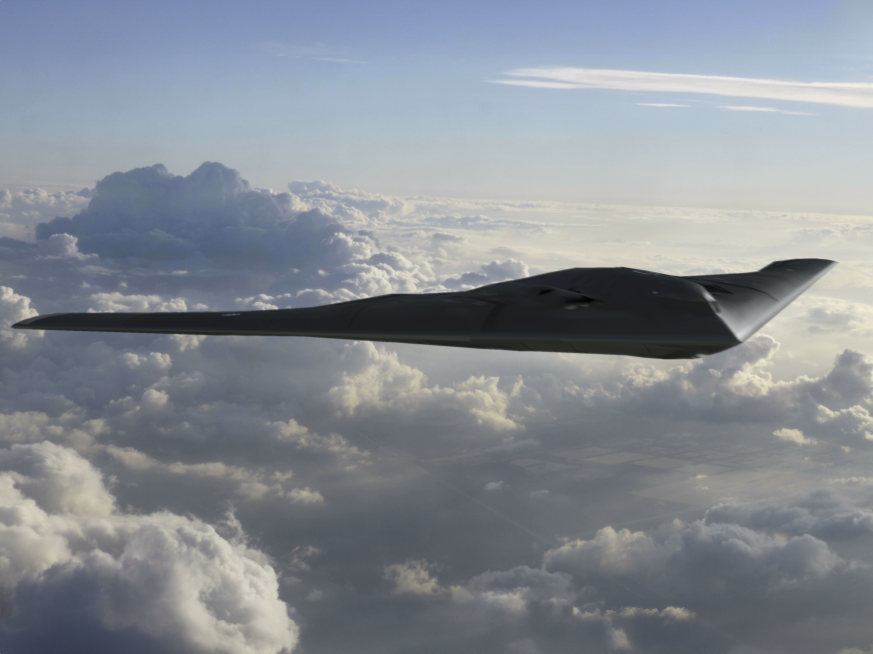
Image: A B-21 Raider test aircraft lands at Edwards Air Force Base, California, during developmental flight testing, September 11, 2025. The B-21 will incrementally replace the nuclear-capable B-1 Lancer and B-2 Spirit bombers. (US Air Force photo by Todd Schannuth)