ByMichael Albertson, Paul Amato, Henry "Trey" Obering, Ankit Panda, Kingston Reif, Amy Woolf
Nuclear weapons are once again at the center of great power politics.
For much of the post–Cold War era, nuclear strategy receded from daily headlines. That era is over now. In the last several years alone, Russia routinely threatened nuclear use to limit Western support to Ukraine and tested new delivery systems capable of carrying nuclear weapons. China rapidly and opaquely expanded its nuclear arsenal, built new missile silos, diversified its delivery systems, and may have conducted a low-yield nuclear explosive test in June 2020. The reliability, survivability, and accuracy of North Korea’s nuclear-capable missiles incrementally improved. In May 2025, during the most serious military crisis between India and Pakistan in decades, Pakistan’s prime minister called a meeting of the National Command Authority, the body that oversees Pakistan’s nuclear weapons. The following month, and again beginning in February 2026, the United States and Israel conducted military strikes on Iranian nuclear sites with the aim of destroying Iran’s nuclear program.
Taken together, these developments force the United States to confront the most complex strategic environment since the advent of nuclear weapons—one defined by simultaneous nuclear challenges across geographies and domains. The February 2026 expiration of the New START Treaty further complicated the landscape by removing the last remaining constraints on US and Russian strategic forces, which raises urgent questions about force sizing, modernization timelines, and the future of arms control. US policymakers must now grapple with whether existing nuclear posture remains sufficient, as well as how best to balance deterrence requirements with fiscal realities and alliance commitments.
This debate extends beyond warhead numbers. New concerns are being raised about how offensive and defensive systems interact to impact strategic stability, driven by the potential impacts of emerging technologies and advanced missile defense architectures, such as the Trump administration’s “Golden Dome” initiative.
Questions about how to deter limited nuclear use, how to manage escalation in regional conflicts, and whether new forms of arms control are feasible in a multipolar nuclear order remain unresolved.
In this context, clarity is urgently needed, though consensus remains elusive. With this Great Nuclear Debates series, we present a curated anthology of perspectives from leading experts who approach these challenges from different vantage points. These essays are not designed to rebut one another or to converge on a single position. Rather, they reflect the diversity of informed opinion about how the United States and its allies should navigate a new nuclear era.
The Forward Defense team at the Atlantic Council’s Scowcroft Center for Strategy and Security has long sought to elevate rigorous, nonpartisan analysis on nuclear deterrence, force posture, and strategic stability. Together, these essays illuminate the breadth of the debate—and the trade-offs inherent in any path forward.
Forward Defense leads the Atlantic Council’s US and global defense programming, developing actionable recommendations for the United States and its allies and partners to compete, innovate, and navigate the rapidly evolving character of warfare. Through its work on US defense policy and force design, the military applications of advanced technology, space security, strategic deterrence, and defense industrial revitalization, it informs the strategies, policies, and capabilities that the United States will need to deter, and, if necessary, prevail in major-power conflict.
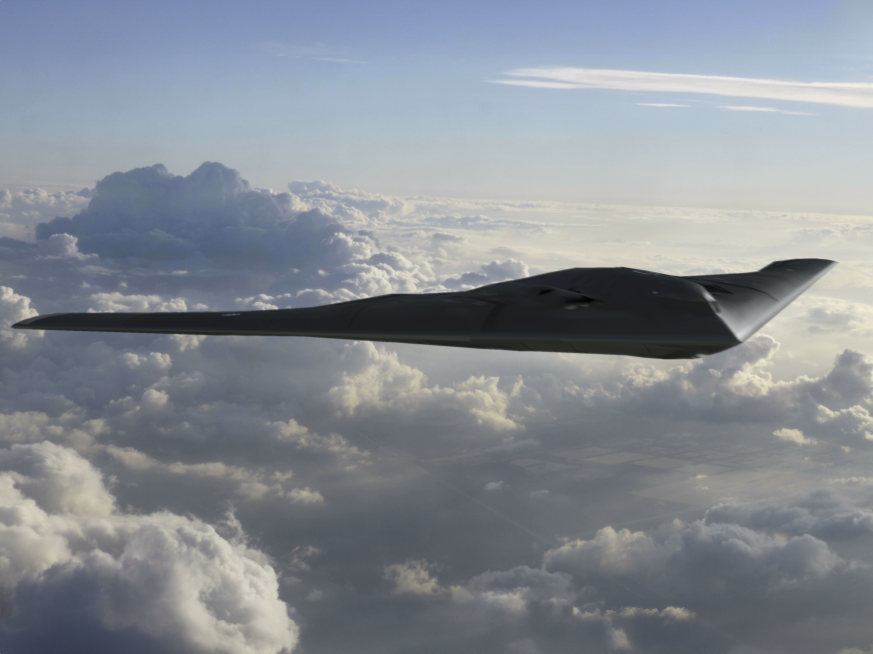
Image: A second B-21 Raider, the nation’s sixth-generation stealth bomber, joins flight testing at Edwards Air Force Base, Calif., Sept. 11, 2025. (Courtesy photo)
ERROR MESSAGE HEADINGERROR MESSAGE SUBHEADINGERROR MESSAGE CONTENTERROR MESSAGE INFO
Oops...
It looks like we're having a technical issue.
If refreshing the page doesn't resolve the issue you could try clearing the sites browser cache.
We use cookies to ensure that we give you the best experience on our website. If you continue to use this site we will assume that you are happy with it.