Disinformation

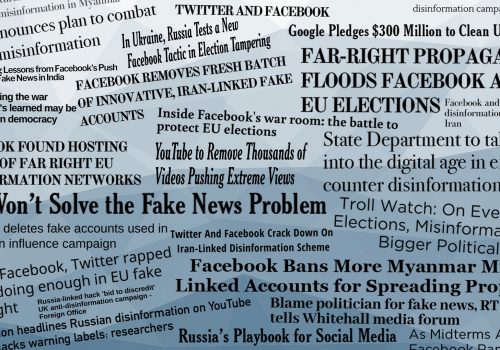
The rise of the internet and online social networks has altered the scope and scale at which people access, consume, and communicate information. But the same technologies that have democratized access to information have also enabled malicious actors who seek to undermine our democratic values and processes. Disinformation is false or misleading information spread with the intention to deceive. It’s distinct from misinformation, which is the unintentional spread of false information. When left unchecked, disinformation has the potential to sow confusion in public dialogue, exacerbate political polarization, and promote distrust in our political systems and democratic institutions.

Content

Report

Mar 28, 2019

Disinformation in democracies: Strengthening digital resilience in Latin America

By Luiza Bandeira, Donara Barojan, Roberta Braga, Jose Luis Peñarredonda, Maria Fernanda Pérez Argüello

2018 saw political tides turn in three of Latin America’s largest democracies. These elections also saw deep polarization and distrust in institutions among Brazilians, Mexicans, and Colombians in an information environment ripe with disinformation. And while disinformation and misinformation are nothing new, the spread of false information at alarming rates – facilitated by politicians, non-state […]

Disinformation Latin America

New Atlanticist

Mar 19, 2019

#StrongerWithAllies: Meet the Latvian who leads NATO’s fight against fake news

By Hal Foster

Sarts believes the ultimate defense against fake news will be to inoculate people against it.

Disinformation NATO

Press Release

Mar 8, 2019

Atlantic Council names Emerson T. Brooking as Resident Fellow at the Digital Forensic Research Lab

By Atlantic Council

The Atlantic Council announced today that author and defense analyst Emerson T. Brooking has joined as Resident Fellow at the Digital Forensic Research Lab.

Disinformation English

New Atlanticist

Mar 8, 2019

Is regulation of social media companies the answer to disinformation?

By David A. Wemer

Governments “only have their word” as evidence that social media companies are adequately addressing the disinformation threat, MP Damian Collins says.

Disinformation

New Atlanticist

Mar 8, 2019

How to kill a disinformation narrative: Make it a whodunit

By David A. Wemer

Ben Nimmo suggested that too many policy makers are focused on disinformation as an information warfare problem rather than “narrative warfare.”

Disinformation English

In the News

Mar 7, 2019

Ben Nimmo quoted in Politico on Facebook removing accounts in UK and Romania

By Ben Nimmo

Ben Nimmo was quoted in Politico on Facebook removing inauthentic accounts in the United Kingdom and Romania.

Central Europe Disinformation

In the News

Mar 7, 2019

Ben Nimmo quoted in The Guardian on Facebook’s takedown of fake network in the United Kingdom

By Ben Nimmo

Ben Nimmo quoted in The Guardian on Facebook's takedown of a network of over 100 false accounts used to spread hate in the United Kingdom.

Disinformation English

New Atlanticist

Mar 7, 2019

The Western Balkans: A growing disinformation battleground

By David A. Wemer

The region has been increasingly targeted by foreign-backed and homegrown disinformation in recent years, made worse by deep public mistrust of governmental institutions.

Disinformation The Balkans

New Atlanticist

Mar 7, 2019

US ambassador to EU promises transatlantic unity in disinformation fight

By David A. Wemer

“We are determined not to allow the Kremlin to undermine our democratic institutions,” Sondland said.

Disinformation European Union

New Atlanticist

Mar 5, 2019

How do you defeat disinformation? Tackle demand, not just supply

By David A. Wemer

“Unless demand is also addressed,” Ana Palacio argued, “we are in for a very, very long and maybe interminable war.”

Disinformation Southern & Southeastern Europe

Experts