


Financial Sanctions and Economic Coercion

Financial sanctions and other forms of economic coercion have become policy tools of choice for the US government to deter illegal activity by international actors or to pressure governments into reversing actions that harm US interests. Yet these instruments and their potential pitfalls are often misunderstood. Restrictive economic measures such as financial sanctions, export controls, tariffs, and investment screening can play an important role in advancing certain policy objectives, but they risk being ineffective if misapplied or poorly implemented. Policymakers must also recognize the impact of economic statecraft on the private sector, which bears many of the compliance burdens and operational costs associated with these measures.

Energy Sanctions Dashboard

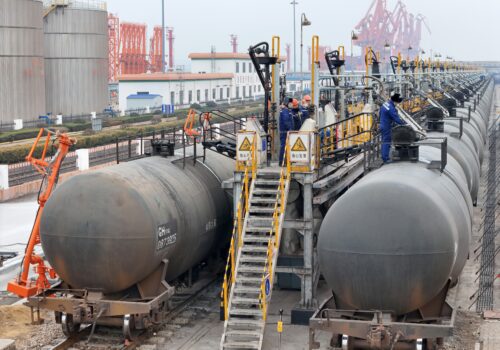
This dashboard focuses on US sanctions and restrictive measures placed on crude oil from Russia, Iran, and Venezuela—including the unintended consequences and the lessons learned.

Econographics

Apr 17, 2025

Russia Sanctions Database

By Kimberly Donovan, Maia Nikoladze, Lize de Kruijf

The Atlantic Council’s Russia Sanctions Database tracks the level of coordination among Western allies in sanctioning Russian entities, individuals, vessels, and aircraft, and shows where gaps still remain.

Eastern Europe Economy & Business

Recent analysis

Programs

At the intersection of economics, finance, and foreign policy, the GeoEconomics Center is a translation hub with the goal of helping shape a better global economic future.

Content

In the News

Feb 19, 2024

Tran cited in Reuters on potential global effects of a Biden re-election

Read the full article here.

Financial Sanctions and Economic Coercion Macroeconomics

In the News

Feb 16, 2024

Garlauskas published in Foreign Affairs

On February 15, Markus Garlauskas and the Korea Society’s Jonathan Corrado published a new piece in Foreign Affairs titled, “The Arsenal of Autocracy: How North Korean Weapons Fuel Conflict—and How to Stop the Flow.” The article emphasizes the importance of building a United States-led international effort to stop North Korea from establishing arms trade relationships […]

Arms Control China

In the News

Feb 15, 2024

Under Secretary Nelson remarks on illicit finance and financial crime quoted by AP

Read the full article here.

Financial Regulation Financial Sanctions and Economic Coercion

In the News

Feb 15, 2024

Under Secretary Nelson remarks on illicit finance and financial crime published by Treasury

Read the full remarks here.

Economy & Business Financial Regulation

In the News

Feb 15, 2024

Braw discusses Western assets in Russia on Yale Books content series

By Elisabeth Braw

On February 15, Transatlantic Security Initiative senior fellow Elisabeth Braw was featured on Yale Books content series discussing Western assets in Russia and the general outlook of globalized economy.

Europe & Eurasia Financial Sanctions and Economic Coercion

In the News

Feb 10, 2024

Donovan quoted in Al-Monitor on Iran sanctions evasion

Read the full piece here.

Economy & Business Financial Sanctions and Economic Coercion

In the News

Feb 9, 2024

Lichfield quoted in Axios on frozen Russian assets

Read the full article here.

Financial Sanctions and Economic Coercion Russia

In the News

Feb 7, 2024

Norrlöf publishes op-ed in Project Syndicate on US sanctions on Israeli settlers

Read the full op-ed here.

Conflict Financial Sanctions and Economic Coercion

In the News

Jan 29, 2024

Russia Sanctions Database cited in CNN on Russian response to sanctions

Read the full article here.

Financial Sanctions and Economic Coercion Russia

Econographics

Jan 25, 2024

Expect Chinese economic retaliation against Taiwan after the DPP’s presidential victory

By Hung Tran

Economic coercion will allow China to increase pressure on Taiwan without directly confronting the US and leave significant leeway to calibrate trade measures.

China Economy & Business

Experts