
Financial Sanctions and Economic Coercion

Financial sanctions and other forms of economic coercion have become policy tools of choice for the US government to deter illegal activity by international actors or to pressure governments into reversing actions that harm US interests. Yet these instruments and their potential pitfalls are often misunderstood. Restrictive economic measures such as financial sanctions, export controls, tariffs, and investment screening can play an important role in advancing certain policy objectives, but they risk being ineffective if misapplied or poorly implemented. Policymakers must also recognize the impact of economic statecraft on the private sector, which bears many of the compliance burdens and operational costs associated with these measures.

Energy Sanctions Dashboard

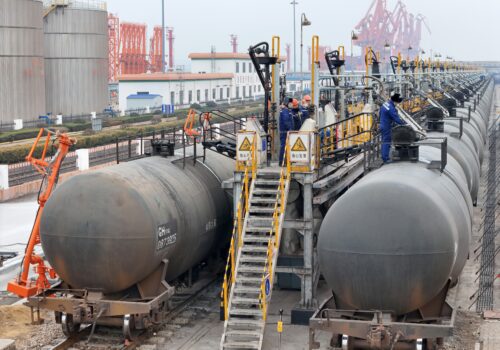
This dashboard focuses on US sanctions and restrictive measures placed on crude oil from Russia, Iran, and Venezuela—including the unintended consequences and the lessons learned.

Econographics

Apr 17, 2025

Russia Sanctions Database

By Kimberly Donovan, Maia Nikoladze, Lize de Kruijf

The Atlantic Council’s Russia Sanctions Database tracks the level of coordination among Western allies in sanctioning Russian entities, individuals, vessels, and aircraft, and shows where gaps still remain.

Eastern Europe Economy & Business

Recent analysis

Programs

At the intersection of economics, finance, and foreign policy, the GeoEconomics Center is a translation hub with the goal of helping shape a better global economic future.

Content

In the News

Nov 2, 2023

Lipsky published in Politico on economic statecraft.

By Josh Lipsky

Read the full Op-Ed here.

Extremism Financial Sanctions and Economic Coercion

In the News

Nov 1, 2023

Lipsky quoted in New York Times’ DealBook on the Israel-Hamas conflict.

Read the full newsletter here.

Extremism Financial Sanctions and Economic Coercion

In the News

Nov 1, 2023

Bauerle Danzman quoted in Bloomberg on political risk and elections.

Read the full article here.

Extremism Financial Sanctions and Economic Coercion

In the News

Oct 31, 2023

Cohen in Forbes: Russia uses new Arctic LNG to dodge energy sanctions

By Atlantic Council

Europe & Eurasia Financial Sanctions and Economic Coercion

In the News

Oct 30, 2023

Global Sanctions Dashboard: How Iran evades sanctions and finances terrorist organizations like Hamas included in the Illicit Edge Newsletter

Read the full newsletter here.

Extremism Financial Sanctions and Economic Coercion

In the News

Oct 30, 2023

Mohseni-Cheraghlou cited in Semafor on trade in the African continent.

Read the full newsletter here.

Extremism Financial Sanctions and Economic Coercion

In the News

Oct 26, 2023

Donovan and event “The Third Party Problem” mentioned in Energy Intelligence on Iran oil sanctions.

Read the full article here.

Extremism Financial Sanctions and Economic Coercion

Econographics

Oct 26, 2023

Global Sanctions Dashboard: How Iran evades sanctions and finances terrorist organizations like Hamas

By Kimberly Donovan, Maia Nikoladze, Ryan Murphy, and Yulia Bychkovska

Iran’s financing of Hamas and other terrorist organizations; UAE’s role in facilitating Iran and Russia sanctions evasion; lifting of UN sanctions on Iran's ballistic missile program.

European Union Financial Regulation

New Atlanticist

Oct 25, 2023

Six steps to disrupt Hamas and other terrorist groups’ finances

By Alex Zerden

After Hamas’s October 7 attack on Israel, the United States must strengthen its capabilities to combat terrorism financing and other illicit finance threats in the Middle East and beyond.

Economy & Business Financial Sanctions and Economic Coercion

In the News

Oct 23, 2023

The third-party problem: Countering sanctions circumvention event featured on Voice of America

Read the full piece here.

Europe & Eurasia European Union

Experts