Middle East Programs Commentary & Analysis

Our blogs feature thoughtful reflections and opinions on current events in the Middle East & North Africa.

Through our Middle East Programs, the Atlantic Council works with allies and partners in Europe and the wider Middle East to protect US interests, build peace and security, and unlock the human potential of the region.
Meet our blogs

All commentary & analysis

IranSource

Dec 9, 2019

US policy hinders positive ‘regime change’ in Iran

By Barbara Slavin

With the rare exception of a weekend prisoner swap, the record of US-Iran relations since the Trump administration came to office has been dismal both for the Iranian people and for US national interests.

Iran Middle East

New Atlanticist

Dec 6, 2019

Détente in the Gulf?

By Kirsten Fontenrose

The National Security Council’s policy process aimed at designating the Muslim Brotherhood a terrorist organization may accidentally contribute to a resolution of the Gulf rift.

Politics & Diplomacy Terrorism

SyriaSource

Dec 6, 2019

Reconstruction and security sector reform in Syria must go hand in hand

By Nora-Elise Beck and Lars Döbert

The structure and characteristics of the pre-conflict Syrian security sector contributed heavily to the outbreak of the Syrian civil war; for decades, it stood for corruption, discrimination, violent repression, and large-scale human rights abuses. When the Arab Spring began to unfold in Egypt and Tunisia in early 2011, a group of Syrian school boys got […]

Germany Peacekeeping and Peacebuilding

IranSource

Dec 3, 2019

New protests expose widening rift between Iran’s regime and ‘the people’

By Borzou Daragahi

Whether one is navigating past truckers driving along country roads, visiting underground parties in the capital, or holding heated debates with members of different political persuasions in cafes or shared taxis, Iran doesn’t feel like a totalitarian dictatorship.  Forty years after a violent revolution that overturned a small Western-oriented elite, Iranians remain irrepressible and irreverent—as […]

Digital Policy Iran

New Atlanticist

Dec 2, 2019

Iraqi prime minister’s resignation: Lessons for the United States and Iran

By Thomas S. Warrick

The current crisis has important lessons for both United States and Iranian policymakers as they consider what relationship they want to have with Iraq: not just the Iraqi political class, but the Iraqis in the street, who represent—in some cases more closely than the Iraqi political class in Baghdad—the 80 percent of Iraqis who are under forty years old.

Democratic Transitions Iraq

Press and members call

Dec 2, 2019

Atlantic Council press call: Iraqi Prime Minister resigns amid violent protests

By Atlantic Council

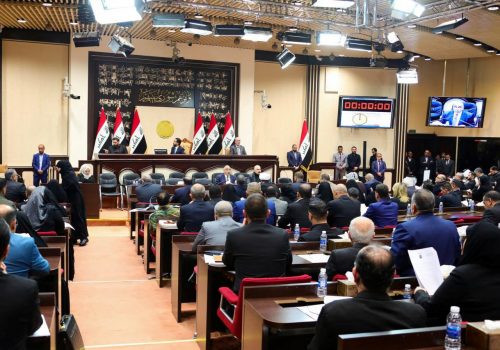
On Friday, November 29, Iraqi Prime Minister Adil Abdul Mahdi announced plans to resign after nearly two months of anti-government protests. The nationwide demonstrations, which have been driven by anger over rampant corruption and high unemployment rates, have turned increasingly violent and have resulted in close to 400 fatalities. Following Mahdi's resignation, Abbas Kadhim, C. Anthony Pfaff, Thomas Warrick, and William Wechsler unpack the crisis in Iraq.

Iraq Politics & Diplomacy
Iraqi prime minister's resignation, Adil Abdul-Mahdi

MENASource

Dec 2, 2019

The Iraqi prime minister’s resignation: A way ahead for the United States

By C. Anthony Pfaff

Iraq’s Prime Minister, Adil Abdul-Mahdi, should be feeling a great sense of relief. Since mid-October, media outlets have reported his intent to resign amid violent protests that have engulfed much of Iraq. His resignation should be no surprise. Since the fall of Saddam, Iraq has a history of picking leaders who do not pose a […]

Corruption Democratic Transitions

IranSource

Dec 2, 2019

Protests challenge Iran’s future position in Iraq

By Robert Czulda

Ongoing violent protests in Iraq have shaken the fragile stability of the country, as well as Iran’s carefully constructed geopolitical strategy for its neighbor and historic rival.

Economy & Business Energy & Environment

MENASource

Nov 30, 2019

The challenges Iraq faces after prime minister’s resignation

By Abbas Kadhim

The news on November 29 that Iraqi Prime Minister Adil Abdul-Mahdi will resign is unprecedented in post-2003 Iraq. Many questions must be answered before his successor is appointed, and in the meantime, we can expect unrest to continue.

Democratic Transitions Iraq

Diversity, Equity, and Inclusion

Nov 26, 2019

How the exclusion of women has cost Libya

By Emily Burchfield

Libya experts frequently call for greater inclusion of civil society and local governance leaders in peace-building efforts in order for the peace process to be more representative of ordinary Libyans. And yet, Libyan women’s powerful role in civil society and the fact that they make up half of the population of “ordinary Libyans” is often overlooked.

Libya Peacekeeping and Peacebuilding