
Projects

Close up of tiger

The Tiger Project: War and deterrence in the Indo-Pacific

Explore the Atlantic Council’s work on current and enduring defense and deterrence issues in the Indo-Pacific, featuring expert commentary, multimedia content, and in-depth analysis.

Explore the programs

The Indo-Pacific Security Initiative (IPSI) informs and shapes the strategies, plans, and policies of the United States and its allies and partners to address the most important rising security challenges in the Indo-Pacific, including China’s growing threat to the international order and North Korea’s destabilizing nuclear weapons advancements. IPSI produces innovative analysis, conducts tabletop exercises, hosts public and private convenings, and engages with US, allied, and partner governments, militaries, media, other key private and public-sector stakeholders, and publics.


Content

In the News

Nov 17, 2020

Manning in The Hill: A gaping hole in US Indo-Pacific strategy

By Atlantic Council

China East Asia

Report

Oct 27, 2020

Enhancing US-Japan cooperation on clean energy technologies

By Reed Blakemore, David Yellen

Japan’s pledge to reach net-zero emissions by 2050 presents an opportunity to expand the robust US-Japan energy partnership into additional clean energy areas. But with a stark divide on energy policy in the United States, how can the US-Japan energy partnership appeal to disparate visions of the energy transition and is politically durable? In the wake of Japan's net-zero announcement, the Global Energy Center is launching this new report, "Enhancing US-Japan cooperation on clean energy technologies," which explores how the United States and Japan can increase the politically durable foundation for clean energy cooperation to their already robust energy partnership.

Energy & Environment Energy Transitions

In the News

Oct 15, 2020

Manning on Asian Insider: Quad not an Indo-Pacific NATO

By Atlantic Council

Australia China

New Atlanticist

Oct 9, 2020

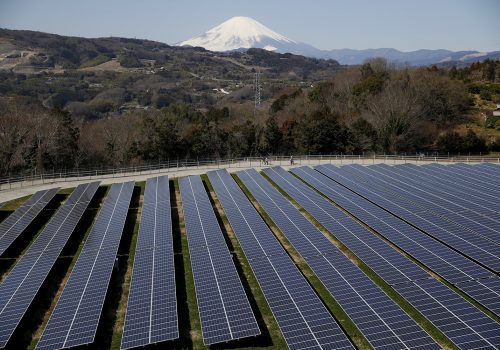
Rising solar: Investing in Japan’s energy transition

By Alexis Crow

The ability to invest in renewable energy assets in Japan—and thus to contribute to the country’s energy transition—also presents a significant opportunity for long-term capital from around the globe

Climate Change & Climate Action Energy Transitions

Article

Oct 3, 2020

Oh on East Asian allies’ response to Washington’s tough stand against China

By Atlantic Council

On October 3, Dr. Miyeon Oh, director and senior fellow of the Asia Security Initiative in the Atlantic Council’s Scowcroft Center for Strategy and Security, was quoted in a Reuters’ article on US Secretary of State Mike Pompeo’s upcoming Asia trip. Oh predicts that both Japan and South Korea will attempt a balancing act during […]

China East Asia

New Atlanticist

Aug 28, 2020

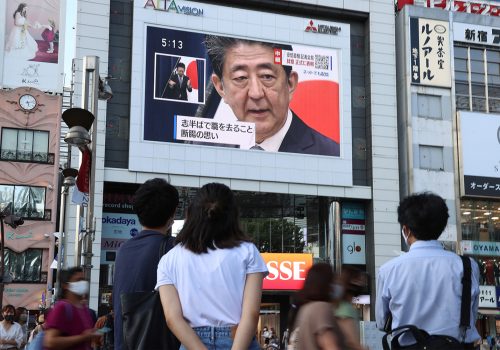
Experts react: The road ahead for Japan after Abe resigns

By Atlantic Council

"New Japanese leadership, combined with the outcome of the US presidential election, could be a game changer for geopolitics in Northeast Asia," Miyeon Oh says.

Japan Macroeconomics

In the News

Aug 10, 2020

Busch in The Hill: Biden’s pre-Trump language on trade needs updating

By Marc L. Busch

Marc Busch writes that President Trump has dramatically changed how we talk about trade and Biden must cut a new path to define his own trade policy.

China Economy & Business

In the News

Jul 21, 2020

Busch in The Hill: US trade policy milks America’s dairy farmers

By Marc L. Busch

Marc Busch writes that for Congress to get US dairy products the same tariff treatment in Japan as those from other markets that it wants, the only solution is for the US to match the free trade deals other countries have built.

Americas Economy & Business

Issue Brief

Jul 7, 2020

Trade and financial fragmentation: New challenges to global stability

By Robert A. Manning

There is greater uncertainty today about the future of global trade than at any time since the post-World War II trading system was created seven decades ago. This was true before the COVID-19 pandemic froze much of the world economy; the health crisis has added a new layer of uncertainty. We are at a historic inflection point: the global trade regime urgently needs renovation and updating to meet new challenges, yet it is fraying and fragmenting.

China Digital Policy

New Atlanticist

Jul 6, 2020

Do deficits matter? Japan shows they do.

By Hung Tran

Japan is often a misleading example for those who downplay the problems of debt. Tokyo has run budget deficits throughout the past three decades, creating one of the world’s highest public debt to GDP ratios, without any adverse effect on inflation and interest rates. But this comes at the cost of high savings by the household and corporate sectors, which has hampered Japanese growth.

Coronavirus Fiscal and Structural Reform

Experts