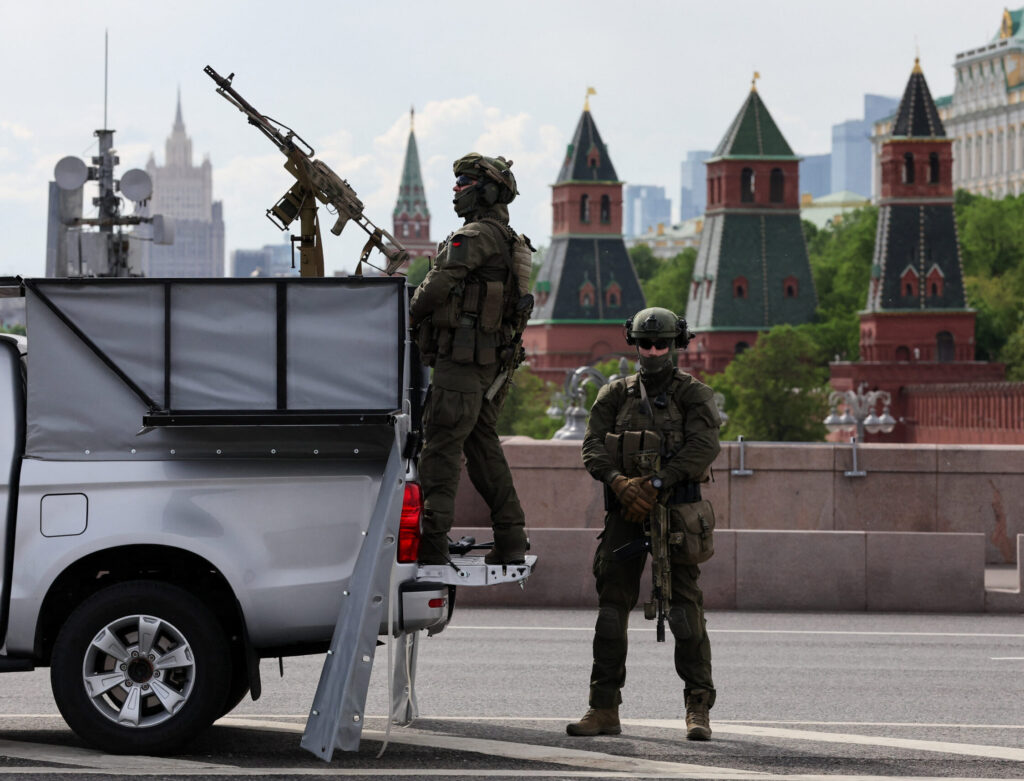
Moscow residents were left shaken last weekend by one of the largest Ukrainian drone attacks of the entire war. The overnight strikes hit a number of key targets in and around the Russian capital including the heavily defended Moscow Oil Refinery, which was reportedly forced to temporarily halt operations. This attack was the latest in a series of recent indications that Ukraine is now gaining the upper hand over Russia in the drone war between the two countries.
A week before Sunday’s drone strikes, Moscow had hosted a dramatically downgraded Victory Day parade that underscored the Kremlin’s mounting inability to cope with the threat posed by Ukrainian drones. Russia’s annual Victory Day celebrations have traditionally been an opportunity for Vladimir Putin to project power and showcase his most impressive military hardware. This year, however, fears of a possible Ukrainian bombardment forced Putin to scale back the parade and tacitly acknowledge that he could no longer guarantee security in the skies above his own capital.
Putin’s Victory Day humiliation came following months of escalating long-range Ukrainian drone strikes on military and industrial sites across Russia. Since early 2026, Ukraine has been able to conduct a series of powerful drone raids on strategic targets including major refineries and multiple oil terminals on the Baltic Sea and Black Sea that play a crucial role in Russian energy exports. These strikes have limited Russia’s ability to benefit economically from the surge in global oil prices due to the war in Iran.
Stay updated
As the world watches the Russian invasion of Ukraine unfold, UkraineAlert delivers the best Atlantic Council expert insight and analysis on Ukraine twice a week directly to your inbox.
The growing effectiveness of Ukrainian long-range drones is in part due to the country’s increasing emphasis on mid-range strikes. The term “mid-range” is used to describe the zone located between twenty kilometers and two hundred kilometers from the front lines. This intermediate area is critical for Russian military logistics and also contains significant quantities of air defense systems. By concentrating drone attacks within the mid-range zone, Ukraine is able to disrupt the invading Russian army’s supply lines while also opening up gaps in Russia’s air defenses that can then be exploited to launch long-range strikes deep inside the Russian Federation.
Ukrainian officials have acknowledged that mid-range drone operations are currently a key focus of the country’s war effort. “One of our priorities for the coming months is middle strikes,” commented Ukrainian President Volodymyr Zelenskyy in late April. “This primarily includes enemy military logistics, depots and command posts, air defense systems, and other components of Russia’s offensive activity against Ukraine. This year, we have already contracted five times more middle-strike capabilities than last year, and we will continue to scale up contracting and production.”
Ukraine’s mid-range strike campaign has been bolstered by a combination of increased resources and technological innovation. One mid-range strike drone attracting significant Russian attention is the Hornet, which uses AI-assisted targeting and is aided by Starlink communications. Thanks to innovative new models like the Hornet, Ukrainian military officials claim they are now able to maintain surveillance and fire control over key supply routes and major cities in Russian-occupied Ukraine.
Kyiv is also extending the reach of first person view drones. Ukrainian activist and government advisor Serhii Sternenko recently reported that Ukrainian forces are able to strike Russian logistics at distances of more than 70 kilometers using cheap FPV drones. “Our goal is to completely halt enemy supplies across the entire front,” he commented.
Mid-range strikes are now threatening to cut off the overland routes used by Russia to resupply occupation forces in southern Ukraine’s Zaporizhzhia and Kherson regions along with the Crimean peninsula. If the current trajectory continues, it will soon become increasingly difficult for Moscow to use the so-called land bridge to Crimea, leaving the entire Russian invasion force in southern Ukraine in a potentially perilous position.
Eurasia Center events

As Russia’s full-scale invasion enters a fifth summer, it is apparent that the tide in the drone war has turned in Ukraine’s favor. Ukrainian drones dominate the front lines, severely restricting Russia’s ability to mass forces and sustain offensives, while accounting for the vast majority of Russian casualties.
At the medium range, Ukraine is methodically targeting Russian air defenses, logistics nodes, and military infrastructure. Meanwhile, long-range Ukrainian strikes are causing serious damage to Putin’s war machine deep inside Russia itself. “The result is clear: Pressure on Ukraine has stabilized, while pressure on Russia has increased,” commented Ukraine’s former foreign minister Dmytro Kuleba recently.
Kuleba’s optimism is justified. Ukraine’s drone warfare success is unlikely to prove decisive, but it is already having a meaningful impact on the course of the war. In recent months, the Russian advance in Ukraine has slowed to a crawl, with some analysts reporting that Putin’s army actually lost ground in April. Beyond the battlefield, escalating long-range Ukrainian attacks have brought the invasion home to Russia and forced millions of ordinary Russians to confront the reality of the war their country has been waging for more than four years.
For now, at least, Ukraine looks capable of retaining the initiative in the drone war. Domestic drone production is increasing rapidly, while intensive innovation cycles and international partnerships help Ukrainian developers to maintain a competitive advantage. As the country’s reputation as a world leader in drone warfare continues to grow, investment and collaboration will further consolidate Ukraine’s position as a drone superpower.
In the coming months, Ukraine will aim to strengthen their drone wall defenses along the front lines, while intensifying mid-range attacks to cut Russian logistics and isolate Crimea. The strategic bombing campaign inside Russia is also likely to reach new levels. “The war is quite predictably returning to its native harbor,” commented Zelenskyy on May 17 in a sarcastic reference to the nautical terminology used by Putin to describe the Russian occupation of Crimea. “This is a clear signal that one should not pick a fight with Ukraine or wage an unjust war of conquest against another people.”
David Kirichenko is an associate research fellow at the Henry Jackson Society.
Further reading

The views expressed in UkraineAlert are solely those of the authors and do not necessarily reflect the views of the Atlantic Council, its staff, or its supporters.


The Eurasia Center’s mission is to enhance transatlantic cooperation in promoting stability, democratic values, and prosperity in Eurasia, from Eastern Europe and Turkey in the West to the Caucasus, Russia, and Central Asia in the East.
Follow us on social media
and support our work
Image: Russian security personnel stand guard next to a pickup truck equipped with a machine gun near the Kremlin in central Moscow. Russia, May 15, 2026. (REUTERS/Anastasia Barashkova)
