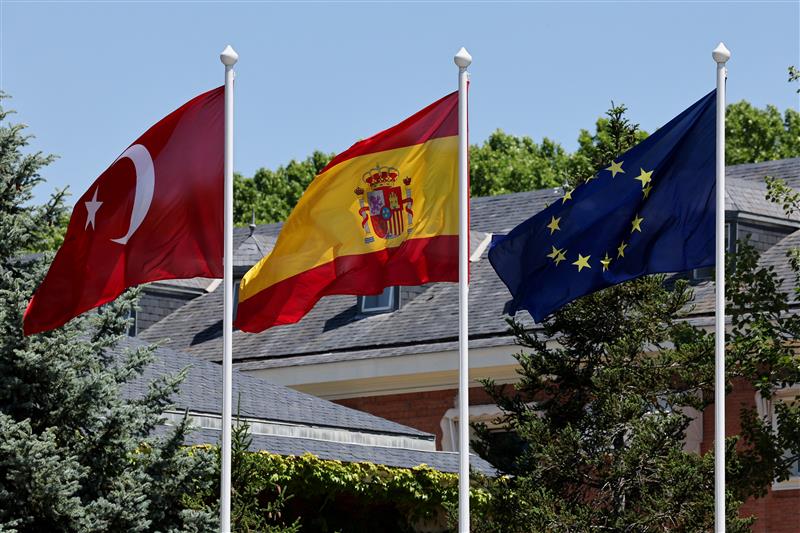
In recent weeks, amid the turmoil sparked by the US-Israeli war against Iran, Turkey-Spain relations have gained unusual visibility. Turkish and Spanish government accounts have posted about the two countries’ “brotherhood” on social media, Turkish journalists have closed their news programs by thanking the Spanish government, and state TV has aired videos highlighting bilateral ties.
Beneath this public-facing layer, however, lies a more consequential trend. Turkey and Spain have been consolidating a pragmatic form of political alignment that is increasingly underpinned by security cooperation. It is shaped less by ideology than by a shared view that their strategic and security environments are becoming more fragmented.
That logic became especially visible after two ballistic missiles launched from Iran entered Turkish airspace and were intercepted by NATO air defenses stationed in the Mediterranean. In Ankara, the episode reinforced the perception that allied reassurance can still be tangible at a time when the credibility of security commitments is being tested. For Spain, whose forces have contributed to NATO’s air and missile defense posture in Turkey for more than a decade—and whose Patriot battery detected the Iranian missile that NATO air defenses shot down on March 9—the incident highlighted how sustained operational cooperation can translate into political capital and strategic trust.
Turkey and Spain are operating under a dual-track approach in which Madrid continues to endorse democratic standards and the rule of law as the normative horizon of Turkey’s relations with the European Union (EU) while deepening defense and security ties with Ankara.
The optics matter here. Spanish President Pedro Sánchez’s outspoken opposition to the US-Israeli war on Iran, widely framed in Turkey as being on the right side of history, has reinforced Madrid’s image as a principled yet pragmatic European interlocutor. In other words, although several political and structural constraints limit further progress within the traditional EU accession process framework, Spain’s approach suggests that pragmatic defense cooperation with Turkey can advance even in the absence of political integration. And this cooperation could help normalize Turkey as a security actor within the Euro-Atlantic perimeter.
A relationship shaped by trust and the absence of vetoes
Often overlooked in debates on Turkey–Europe relations, Spain has nonetheless emerged as one of Ankara’s most pragmatic security partners. And this deepening cooperation comes at a moment when Russia’s war in Ukraine, Middle East volatility, uncertainty over US commitments, and Europe’s rearmament are reshaping the strategic landscape. Turkey has already penetrated Europe’s defense market through bilateral deals and is increasingly discussed as a potential contributor to EU-adjacent instruments such as Security Action for Europe (SAFE) and the European Defense Fund. Yet political constraints remain decisive: Vetoes from some EU member states, low alignment on common foreign and security policy, and the absence of a formal EU–Turkey security framework continue to block meaningful institutionalization. Spain’s approach, therefore, illustrates both an opportunity and its limits. Bilateral defense cooperation can deepen and help normalize Turkey as a security actor. But on its own, this cooperation is unlikely to lead to significant enhancements in EU-Turkey defense cooperation at the broader EU absent changes to the current accession process.
Much of the bilateral relationship hinges on a seeming paradox: The geographical distance between Spain and Turkey has often translated into greater strategic room for convergence on security and defense. Unlike Greece and Cyprus, Spain has no territorial disputes with Turkey. Unlike France, it has not positioned itself as a geopolitical competitor in the Eastern Mediterranean or the Middle East. Unlike Germany or Austria, Spain’s domestic politics are not shaped by large Turkish diaspora communities. Finally, both countries have faced separatist challenges in different forms, a shared experience that can bring their security outlooks closer in some respects. Thus, the relationship is largely depoliticized and insulated from domestic pressures, making it easier for any Spanish government to adopt a relatively favorable posture toward Ankara.
This absence of friction has translated into a high degree of institutional trust. From Ankara’s perspective, Spain is not associated with a priori vetoes against Turkey in European forums. From Madrid’s perspective, Turkey is not a rival—either geopolitically or in the military-industrial domain—but a capable partner whose strategic relevance has increased in a more fragmented security environment. This mutual perception has allowed cooperation to deepen without becoming hostage to broader political tensions.
Spain’s diplomatic posture has reinforced this trust. During periods of heightened tension between Turkey and the EU, Madrid has favored mediation and de-escalation over sanctions and confrontation, as in the case of Eastern Mediterranean energy disputes. Successive Spanish governments, regardless of political orientation, have also maintained a broadly pro-enlargement stance toward Turkey, even as expectations surrounding accession have diminished. Like Italy, Spain has never challenged the EU consensus on Turkey directly but has consistently worked to keep engagement viable and to frame Ankara as a partner rather than an outlier.
Ultimately, despite significant domestic differences, Turkey and Spain have found themselves politically aligned on a critical set of issues, representing among the most critical voices against the war in Gaza and the US-Israeli war against Iran. While this certainly does not suggest ideological alignment between the two governments, it underscores a similar perception of changing global dynamics, paving the way for more direct, constructive engagement.
Strategic convergence under NATO’s umbrella
All this helps explain why defense and strategic cooperation could expand relatively smoothly once geopolitical conditions made such cooperation more necessary. Such convergence can be traced to certain concrete actions within NATO since 2015. As regional instability intensified after the outbreak of the Syrian civil war, Spain assumed a sustained role in Turkey’s air defense by deploying Patriot air and missile defense systems on Turkish territory under NATO command. Since then, this presence has been continuous, involving multiple rotations and thousands of Spanish military personnel at Incirlik air base.
Over time, this interaction came to assume significance beyond its immediate operational function. It created dense networks of cooperation between their armed forces, strengthened interoperability, and generated political capital in Ankara by demonstrating Spain’s willingness to assume tangible responsibility for Turkey’s security.
This NATO-based convergence also reflects a deeper alignment on strategic priorities. Spain has long resisted a narrow focus on NATO’s eastern flank, warning against the risk of neglecting the Alliance’s southern neighborhood. Madrid has consistently emphasized the security relevance of the Mediterranean, the Middle East, and North Africa—regions in which Turkey plays a central role as a frontline NATO ally on the southern flank. The appointment of Javier Colomina as the NATO secretary general’s special representative for the southern neighborhood demonstrates Spain’s insistence on “operating equally” on both flanks and is therefore naturally aligned with Turkey’s security priorities.
From strategic alignment to material cooperation
As operational trust consolidated within NATO, Spain–Turkey relations shifted from political coordination to material cooperation, especially in the defense industry. The logic was straightforward: Spain wanted to modernize and internationalize its defense base, but budget constraints and limited political appetite for reaching NATO’s 2 percent of gross domestic product benchmark for military spending pushed Madrid toward partnerships that can deliver faster and more flexibly than some European-led consortia. The Franco-German dispute surrounding Future Combat Air System fighter jets is a reminder of how slow, costly, and politically rigid intra-European industrial cooperation can become. As one military observer we spoke with put it, Spain needs external partners to accelerate programs, expand exports, and avoid overdependence on larger European defense players.
Turkey’s defense industrial rise has positioned it to meet this demand. Over the past decade, Ankara has moved from supplier-dependence to producing NATO-relevant platforms at scale, with defense exports topping $10 billion in 2025. For Spain, Turkey is less a competitor than a complementary industrial actor—one that brings speed, production capacity, and increasingly interoperable systems.
The bilateral track has also favored coproduction over one-off sales. Navantia’s cooperation with Turkish shipyards on TCG Anadolu established an early template of technology transfer and joint work, now feeding into debates on naval innovation, including drone-enabled concepts. More recently, the relationship has evolved into greater interdependence: In December, Spain finalized a deal to acquire Hürjet to replace its aging F-5s, which will deepen integration in the training and aviation ecosystems. Turkey’s acquisition of Eurofighter Typhoon jets—partly assembled in Spain—links industrial interests, jobs, and production lines. Early talks between Indra and Otokar on land systems point in the same direction. The question is whether this bilateral momentum can be translated into a broader European framework or if it will remain confined to ad hoc cooperation.
Pragmatism under EU constraints
This deepening bilateral cooperation is unfolding against the backdrop of a congested and largely stagnant EU–Turkey relationship. Spain has consistently supported a values-based and institutionalized EU–Turkey horizon, and, more recently, aligned with Josep Borrel, a former EU High Representative from Spain, in advocating a “positive agenda” on common issues. At the margins of the 2024 Madrid bilateral summit, Sánchez emphasized the “exceptional state of bilateral relations,” referring to “Turkey and Spain [as] friends, partners and allies with important cultural, social and economic exchanges.” The numbers seem to confirm this, as the two countries’ bilateral trade reached $20.6 billion in 2025.
This has not prevented Spain from taking public positions on domestic developments in Turkey. Sánchez, especially compared to other European leaders, has been notably vocal on the case against Istanbul Mayor Ekrem İmamoğlu, signaling that Spain’s push for a constructive relationship does not imply silence on democracy and the rule of law. Rather, it reflects a compartmentalized approach in which normative conditionality and security engagement proceed on separate tracks.
This dual-track logic comes to the fore on EU defense initiatives. On paper, instruments such as the European Defense Fund and the SAFE program offer frameworks for cooperation with third countries. SAFE allows for limited non-EU procurement projects, suggesting that Turkish industrial participation is not excluded by design. Spain has also expressed openness to Turkey’s possible inclusion in mechanisms such as Permanent Structured Cooperation (PESCO), a framework aimed at deepening defense cooperation between EU members, but which has also included the United Kingdom since 2022. Yet, Madrid has not been able to leverage its position to convince other EU members to grant Turkey access to the project. Under these conditions, bilateral defense cooperation becomes a means of preserving strategic interdependence when institutional integration remains blocked.
Strategic convergence in an era of uncertainty
The broader geopolitical environment has reinforced incentives for this form of pragmatic engagement. The Trump administration’s foreign policy has heightened concerns over the unpredictable and transactional nature of US security commitments, accelerating a shift toward selective partnerships among middle powers. In this context, states with significant regional exposure are increasingly seeking to reduce risk through flexible coalitions and defense‑industrial linkages that are not fully dependent on Washington.
Finally, the Spain–Turkey partnership raises the question of whether such bilateral pragmatism can resonate in Brussels. Spain can help normalize Turkey as a security actor within the Euro-Atlantic perimeter and keep a “positive agenda” politically viable. Uncertainty over the international order and the fragmented nature of the European security backdrop can help Spain–Turkey relations stand as an example for how strategic convergence can shape and be shaped by political alignment.
Riccardo Gasco is the foreign policy program coordinator at IstanPol Institute and a doctoral researcher at Bologna University.
Samuele C. Abrami is a research fellow at the Barcelona Center for International Affairs (CIDOB) and a former Mercator-Istanbul Policy Center fellow.
The views expressed in TURKEYSource are solely those of the authors and do not necessarily reflect the views of the Atlantic Council, its staff, or its supporters.
Further reading
Thu, Mar 12, 2026
Turkey has weathered regional instability before. But the war in Iran poses greater risks to Ankara than past conflicts.
TURKEYSource By Grady Wilson
Turkey is seeking to limit fallout from the US and Israeli war against Iran but threats to national security increasingly threaten its position.
Mon, Nov 10, 2025
Turkey’s Eurofighter stopgap: The best available, not the best possible
TURKEYSource By
Turkey’s Eurofighter Typhoon procurement offers air superiority and could lead to deeper intra-NATO cooperation.
Tue, Jul 22, 2025
How France and Turkey can renew their ties in a shifting strategic order
TURKEYSource By
Both Paris and Ankara share incentives to pursue a more pragmatic and structured partnership.
Image: Flags of Turkey, Spain and the European Union fly at Moncloa Palace as Turkey's President Tayyip Erdogan visits Madrid, Spain, June 13, 2024. (REUTERS/Violeta Santos Moura)