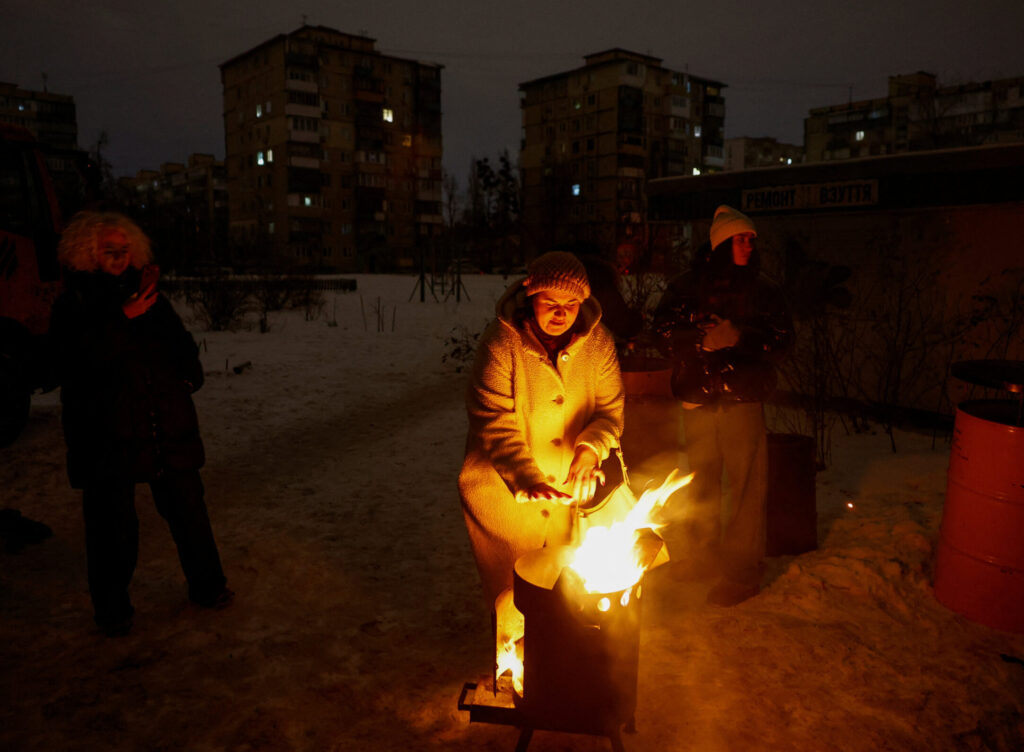
A war crime of staggering proportions is currently unfolding in full public view across Ukraine as Russia methodically bombs the country’s utilities in a calculated bid to freeze millions of civilians in their own homes and spark a humanitarian catastrophe.
Russian strikes against Ukraine’s civilian infrastructure are nothing new, of course. On the contrary, such attacks have been a routine feature since the onset of the full-scale invasion nearly four years ago. However, the current bombing campaign is by far the most comprehensive of the war. In recent months, Russia’s attacks on civilian targets have expanded dramatically in scope as the Kremlin seeks to inflict maximum harm on Ukraine’s population by denying them access to heating, electricity, gas, and water during the coldest period of the winter season.
The impact has been devastating, particularly as most residential districts in Ukrainian cities continue to rely on Soviet-era central heating systems powered by huge plants that are almost impossible to defend. The Kremlin has ruthlessly exploited this weakness with repeated bombardments of the same facilities to disrupt repair efforts. While teams of Ukrainian engineers continue to work miracles, each successive attack makes their task more difficult.
Ukrainians have responded to plummeting temperatures and freezing apartments with a range of improvised solutions such as erecting tents indoors and heating bricks on gas stoves to generate some precious warmth. There has also been plenty of trademark Ukrainian wartime defiance on display, with local communities rallying in support of one another, posting lighthearted videos on social media, and holding street parties in the snow.
At the same time, many have expressed frustration over the continued media emphasis on Ukrainian resilience amid a mounting humanitarian crisis that has left much of the country in desperate need of help. “Resilience doesn’t mean immunity. Ukraine cannot withstand everything indefinitely,” wrote Ukrainian commentator Iryna Voichuk on January 16. “Framing this as only a story of strength risks dulling the urgency of what’s happening.”
Others have echoed this sentiment, including some of Ukraine’s most prominent international supporters. “Mythologizing endurance is a quiet form of abandonment. Resilience does not mean invulnerability,” cautioned R.T. Weatherman Foundation president Meaghan Mobbs in a recent post. “When we speak as if Ukrainians can simply ‘take it,’ we absolve ourselves of responsibility.”
With the present arctic weather conditions expected to continue well into February, the situation in Ukraine is critical. In the high-rise apartment blocks that dominate Ukraine’s cities, many less mobile residents have already been housebound for weeks and will likely remain trapped in frigid darkness throughout the coming month. The outlook is particularly grave for the elderly, those with young families, and people in need of medical care. In other words, Russia’s present bombing strategy appears to have been specifically tailored to target the most vulnerable members of Ukrainian society.
Stay updated
As the world watches the Russian invasion of Ukraine unfold, UkraineAlert delivers the best Atlantic Council expert insight and analysis on Ukraine twice a week directly to your inbox.
As the potential for large-scale loss of life becomes increasingly apparent, international audiences are waking up to the true extent of Russia’s criminal intentions. Wall Street Journal chief foreign affairs correspondent Yaroslav Trofimov recently referred to Russia’s winter bombing campaign as “Putin’s genocidal effort to make Kyiv unlivable.” It is easy to see why such terms are now being employed. The 1948 UN Genocide Convention identifies “deliberately inflicting on the group conditions of life calculated to bring about its physical destruction in whole or in part,” as one of five recognized acts of genocide. At the very least, Russia’s current actions closely resemble this definition.
The current winter bombing campaign reflects a broader trend of mounting Russian attacks against Ukraine’s civilian population. According to UN data, 2025 was the deadliest year of the war for Ukrainian civilians since 2022, with more than 2,500 people killed and over twelve thousand injured. This was 31 percent higher than the figure for the previous year and 70 percent more than in 2023. Many of these deaths were due to a spike in Russian missile and drone strikes on civilian targets including residential buildings, hospitals, and a children’s playground.
Russia also stands accused of conducting a systematic campaign of drone strikes targeting members of the public in the front line regions of southern Ukraine. These attacks have been dubbed a “human safari” by terrified locals. They involve the use of drones with video camera guidance systems to hunt individual victims, underlining the deliberate nature of the killings. An October 2025 United Nations investigation into this drone terror found that Russia was guilty of “systematically coordinated actions designed to drive Ukrainians out of their homes,” and concluded that the Kremlin’s actions in southern Ukraine qualified as the crimes against humanity of murder and of forcible transfer of civilians.
Eurasia Center events

Putin is dramatically escalating attacks on Ukraine’s civilian population because he cannot win the war on the battlefield. When he first launched the full-scale invasion of Ukraine in February 2022, Putin was expecting a quick and complete victory. Instead, his army has become bogged down in a brutal war of attrition that will soon enter a fifth year.
Despite pouring vast resources into the invasion and placing his entire country on a war footing, the Kremlin dictator has been unable to secure a decisive breakthrough. Many in Moscow had hoped the return of Donald Trump to the White House would transform the military situation, but even a dramatic decline in US aid for Ukraine over the past year has failed to turn the tide in Russia’s favor. Putin’s army captured less than one percent of Ukrainian territory during 2025, while suffering hundreds of thousands of casualties. At the present glacial pace, it would take Russia decades and millions of men to fully subjugate Ukraine.
In his official statements, Putin continues to project confidence and boast of his invading army’s success. However, with so few genuine victories to toast, this has often meant inventing imaginary advances. Putin’s habit of exaggerating Russian gains came back to haunt him in late 2025 when he repeatedly claimed to have captured the Ukrainian city of Kupyansk, only for Ukrainian President Volodymyr Zelenskyy to personally visit the city and record a selfie video exposing the Russian ruler’s lies. This embarrassing episode underlined the growing credibility gap between Putin’s bold talk of inevitable Russian victory and the far more sobering battlefield reality of minimal Russian gains and disastrous losses.
With no obvious route to military victory, Putin is now openly embracing a strategy of terror tactics against Ukraine’s civilian population. He hopes that by weaponizing winter and putting millions of lives at risk, he can finally break Ukrainian resistance and force Kyiv to capitulate. Europe has not witnessed criminality on such a grand and terrible scale since the days of Hitler and Stalin.
So far, the international response to Russia’s winter bombing campaign has been utterly inadequate. While many of Kyiv’s partners have rushed to provide humanitarian aid, no additional costs whatsoever have been imposed on the Kremlin. Instead, it is Ukraine and not Russia that is reportedly being asked to make concessions. Unless this changes, the normalization of Russian war crimes will continue and Putin’s sense of impunity will become even more deeply entrenched. It will then only be a matter of time before other civilian populations experience the horrors currently taking place in Ukraine.
Peter Dickinson is editor of the Atlantic Council’s UkraineAlert service.
Further reading
The views expressed in UkraineAlert are solely those of the authors and do not necessarily reflect the views of the Atlantic Council, its staff, or its supporters.

The Eurasia Center’s mission is to enhance transatlantic cooperation in promoting stability, democratic values, and prosperity in Eurasia, from Eastern Europe and Turkey in the West to the Caucasus, Russia, and Central Asia in the East.
Follow us on social media
and support our work
Image: A resident warms up next to fire in front of a food truck of veterans of the 3rd Assault Brigade of the Ukrainian Armed Forces during a power blackout, after critical civil infrastructure was hit by recent Russian missile and drone strikes, amid Russia's attack on Ukraine, in Kyiv, Ukraine, January 26, 2026. (REUTERS/Valentyn Ogirenko)