Content

MENASource

Jan 9, 2020

Qasem Soleimani and escalatory parity

By Frederic C. Hof

For the better part of forty years, American action and inaction have persuaded the Islamic Republic that it could act with impunity; that the United States feared the escalatory implications of push-back. That dangerous, destabilizing belief seems to have been suspended with the killing of Soleimani.

Iran Politics & Diplomacy

UkraineAlert

Jan 9, 2020

Prisoner exchange lifts the veil on Russia’s hybrid war against Ukraine

By Adrian Karatnycky

Moscow's insistence on the inclusion of figures with no apparent relationship to the conflict in eastern Ukraine during a recent prisoner exchange has exposed the nationwide scale of Russia's hybrid hostilities against Ukraine.

Conflict Non-Traditional Threats

IranSource

Jan 9, 2020

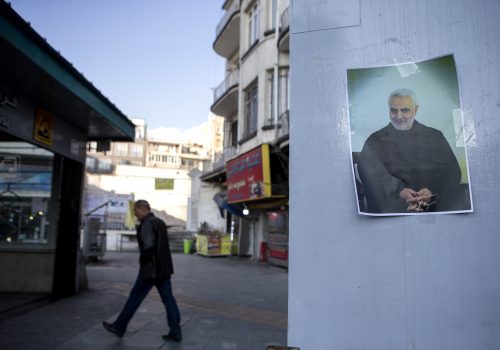
Qasem Soleimani: From meme to martyr

By Suzanne Kianpour

The Quds Force commander was seen by some as the future of Iran’s leadership, in recent years having evolved out of the shadows of spymaster to increasingly in the spotlight as a celebrity officer who took selfies with Shia militias. Now, the seemingly untouchable commander is a martyr—something he always said he dreamed of—and the memes have gone international.

Conflict Iran

MENASource

Jan 8, 2020

The context of today’s Libyan crisis and what to watch for

By Karim Mezran, Emily Burchfield

On April 4, 2019, troops led by Khalifa Haftar, a former general of Libyan leader Muammar Qaddafi who now contests the authority of the UN-sponsored Government of National Accord (GNA) seated in Tripoli, launched an attack against the Libyan capital. The real reasons for staging such an attack on that specific day are still unclear.

Libya Politics & Diplomacy

New Atlanticist

Jan 8, 2020

After Maduro’s latest ploy, what’s next for the Venezuelan opposition?

By Jasper Gilardi

"The images of Juan Guaidó and other democratically-elected members of the National Assembly being physically barred from entering the assembly building was visible proof of how far Nicolás Maduro is willing to go to deny any semblance of democracy in Venezuela," Jason Marczak says.

Civil Society Corruption

IranSource

Jan 8, 2020

Both the United States and Iran proved their points. Now they need to de-escalate tensions

By Robert Czulda

After Trump’s press conference, there are some good reasons to be optimistic and believe that both sides will remain restrained. However, on the other hand, in the Middle East restraint is very often seen not as a virtue, but as a sign of weakness which has to be exploited by one’s enemies.

Conflict Iran

New Atlanticist

Jan 8, 2020

De-escalation still possible after Iran’s missile retaliation

By Atlantic Council

Iran avoided a central US red line, and "therefore, the Trump administration will have the opportunity to test Iranian claims that they truly do not seek any further escalation," Will Wechsler says.

Conflict Iran

New Atlanticist

Jan 8, 2020

Iran’s missiles may have avoided the worst outcome

By Thomas S. Warrick

If there had been significant US casualties, the world would have awoken to the dawn of a regional war, because the Trump administration would have been compelled to attack the launch sites in Iran—and probably other targets in Iran, also. If the present news holds, the situation is slightly less dangerous, if still perilous.

Conflict Geopolitics & Energy Security

New Atlanticist

Jan 8, 2020

Washington and Tehran can step back – if they want to

By William F. Wechsler

After the January 8 Iranian missile attacks on Iraq, a successful tactical de-escalation requires both that the Iranian leadership intends for its military actions not to be escalatory and that the Trump administration perceives those actions as they were intended. In the absence of direct communications between the United States and Iran, however, the potential for misunderstanding and thus the risk of miscalculation remains high.

Conflict Geopolitics & Energy Security

New Atlanticist

Jan 7, 2020

US-Iran in crisis: Strategic ambiguity and loud weapons in cyberspace

By Simon Handler, Katherine Wolff, Will Loomis

Iran’s government will feel the need to retaliate against the United States, but it does not wish to ignite a prolonged war with the United States. The regime’s near-term aim is to demonstrate to its domestic and regional constituencies that it has the capability and the resolve to avenge Soleimani’s killing and, more strategically, to drum up support for hardliners ahead of legislative elections next month. While Iran has a number of options available, its cyber toolkit not one to be overlooked.

Cybersecurity Iran