Toplines: Deterring Putin’s aggression against NATO
Top three
- If Vladimir Putin can’t win a clear victory in Ukraine, he will seek one elsewhere; a clear victory in Ukraine would embolden Moscow to further aggression.
- Europe must prepare to meet these threats with less American support.
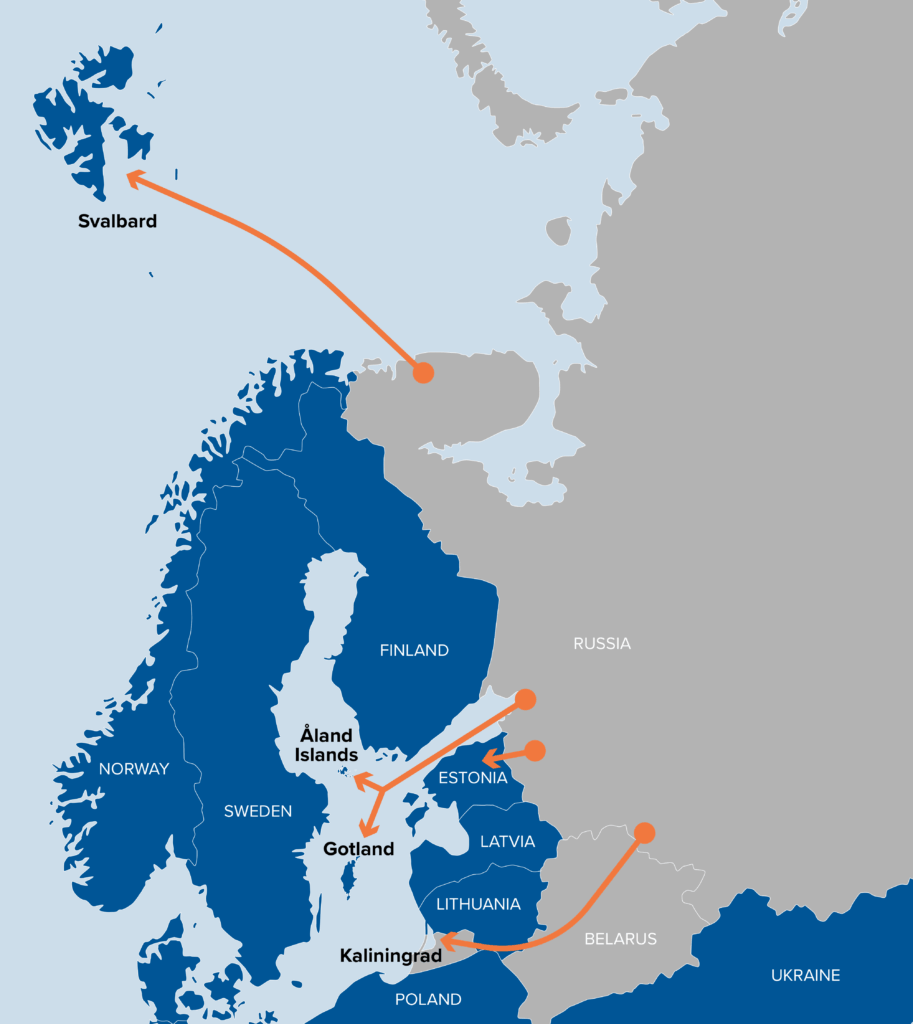
- The lowest risk option for Moscow—and therefore the threat Europe needs to prepare for most urgently—is Russian forces occupying Norway’s Svalbard archipelago.
worth a thousand words
The Diagnosis
The strategic context: The rise of autocratic regimes worldwide poses an alarming challenge to the global community of democracies, leading to an international system marked by instability and increasing fragmentation. Debates over how to approach the threat have divided the community, with traditional alliances and coalitions under increasing strain. Further, the current US administration’s response to these challenges is strikingly different from those of past administrations. Over time, the US presence in Europe is likely to decline, and Europe must rapidly increase its defense capabilities in response.
The threat: Despite its losses in Ukraine, Russia is reconstituting its forces and continues to pose a formidable military threat. The Russian economy has rebounded from 2022’s historic sanctions and looks unlikely to collapse in the near term. Further, there are no political checks within Russia on Putin’s desire to re-establish dominance in Eurasia.
The risk: NATO isn’t ready— militarily, intellectually, diplomatically—to confront Moscow’s determined testing of the Alliance’s resolve. Should Moscow actually seek to enact one of these scenarios, the Alliance is at risk of fracturing–nothing short of a robust Article 5 response from the Alliance would be sufficient to credibly reset allied deterrence against any further provocations against NATO territories by Russia and thereby preserve the alliance itself.
The prescription
Here are five potential Russian attack scenarios for which NATO must prepare, ordered from least to most risky from Moscow’s perspective.
Target 1: Svalbard archipelago
The Svalbard archipelago, a lightly populated Norwegian territory near the North Pole, could be a target of Russian occupation. Remote and militarily undefended, Svalbard is governed by a 1920 treaty, which stipulates that military installations cannot be placed there. Citizens of any treaty signatory can reside and pursue commercial opportunities on the islands, subject to Norwegian law, and all parties must respect and preserve the local environment. Russian nationals make up seventeen percent of the population on Svalbard, with their presence largely focused in the Barentsburg settlement (population of 343 in 2025) where Russia operates a mine and a research station.
The attack
A Russian occupation of Svalbard would likely begin with hybrid measures, cyber disruption, telecommunications sabotage, and disinformation about treaty violations, followed by a rapid insertion of Russian special forces or naval infantry to seize the airfield and key infrastructure before NATO can react.
The risks for Moscow
Given the archipelago’s lack of defenses and small population, occupying Svalbard would strengthen Moscow’s geostrategic position in the High North while presenting NATO with an immediate credibility dilemma under Article 5, making it a tempting opportunity for Russia to test Alliance resolve at relatively low risk. This target presents the lowest risk of the five presented.
What might prompt Moscow to act?
A perception of declining US engagement in Europe, visible NATO political divisions, or intelligence suggesting that the Alliance would struggle to generate a rapid and unified military response.
How to prevent it
To prevent occupation of Svalbard, Norway and NATO should
- strengthen deterrence through visible political signaling
- establish a small rotational military or paramilitary presence on the archipelago (which is allowed for under the 1920 treaty banning permanent military installations on Svalbard)
- enhance intelligence and surveillance focused on early warning
- regularly conduct exercises demonstrating rapid reinforcement capability, such as through the existing BALTOPS exercise
Target 2: Åland islands
The Åland islands, demilitarized, undefended, sovereign Finnish territory at the strategic entrance to the Gulf of Bothnia, could also be targeted for Russian occupation. The Åland islands sit near three NATO capitals—Stockholm, Tallinn, and Helsinki—making the islands an attractive target. Their seizure would dramatically shift the balance of power in the Baltic Sea, strengthening Russia’s defensive depth around St. Petersburg and Kaliningrad, and confront NATO with an immediate test of credibility.
The attack
The operation would likely begin with the covert insertion of Russian special operations forces to secure Mariehamn’s airfield and key infrastructure, followed by a rapid deployment of naval infantry or airborne units supported by Russia’s Baltic Fleet assets and air defense systems.
The risks for Moscow
This target presents a low to moderate risk for Russia. The risk is higher than with Svalbard, given Finland’s stronger military capacity and the islands’ proximity to NATO forces, but still potentially attractive if Moscow anticipates any hesitation or delay in Alliance response.
What might prompt Moscow to act?
Perceived NATO political fragmentation, a reduced or limited forward presence in the Baltic region, or signals that Finland would hesitate to remilitarize the islands could convince Moscow that a swift fait accompli would succeed before reinforcements arrive.
How to prevent it
Finland, together with Sweden and NATO, should end the islands’ effective military vacuum by
- forward deploying a credible mechanized defensive force
- strengthening air and maritime patrols
- pre-positioning supplies
- conducting regular exercises to ensure rapid reinforcement and deny Russia the possibility of an uncontested landing on the Åland Islands.
Target 3: Eastern Estonia
Eastern Estonia, particularly the region including and surrounding Narva near the Russian border, combines geographic proximity, a significant ethnic Russian population, and limited national military depth, making it a plausible target for calibrated aggression. A limited seizure or engineered separatist enclave would test NATO’s Article 5 credibility while exploiting hybrid tactics and ambiguity to divide the Alliance.
The attack
The scenario would likely begin with the covert insertion of Russian paramilitary units and special operations forces posing as “local self-defense groups,” backed by cyberattacks, disinformation, and unrest in Narva, with the intent of carving out a separatist enclave of “oppressed” Russian minorities. These actions would be followed by rapid reinforcement from nearby Russian airborne and ground units under the pretext of protecting ethnic Russians.
The risks for Moscow
This target presents a low to moderate risk for Russian occupation. Such action would represent a higher escalation potential than Svalbard or Åland due to the likelihood of direct fighting and seizure of a contiguous region of a NATO territory. However, this target is still potentially attractive if Russia judges NATO’s likely response to be slow, divided, or limited.
What might prompt Moscow to act?
Perceived NATO hesitation, insufficient forward-deployed heavy forces in the Baltics, domestic unrest in Estonia, or signals of reduced US commitment to European defense could convince Moscow that a limited territorial grab would succeed before a robust Alliance response materializes.
How to prevent it
Estonia and NATO should strengthen deterrence by
- expanding Estonian force structure
- forward-deploying a full NATO brigade with enablers
- enhancing cyber and hybrid resilience
- preparing territorial defenses
- conducting frequent rapid-reinforcement exercises to deny Russia the possibility of a quick fait accompli.
Target 4: Gotland
Another potential target of Russian aggression is the Swedish island of Gotland, which sits at the center of the Baltic Sea. Its position confers decisive advantages in air and maritime control, making it strategically vital in any regional conflict. Its seizure would shift the Baltic balance toward Russia’s favor, secure access routes to Kaliningrad, and deliver a major strategic and symbolic blow to NATO.
The attack
A surprise coup de main by Russian naval infantry or airborne (VDV) forces, preceded by sabotage, cyber disruption, and covert special operations reconnaissance, could aim to overwhelm the island’s garrison before Swedish mainland reinforcements arrive.
The risks for Moscow
This target presents a moderate risk—higher than Svalbard, Åland, or eastern Estonia because Sweden has standing forces on the island. The direct conflict with armed forces mean NATO involvement would be more certain, increasing the likelihood of escalation.
What might prompt Moscow to act?
If Russian planners assess that NATO reinforcement timelines are slow, Swedish defenses remain limited to battalion strength, or Alliance unity is politically fractured during a wider crisis, the perceived opportunity for a rapid fait accompli could grow.
How to prevent it
Sweden, with NATO support, should
- expand Gotland’s defense from battalion to brigade strength
- reinforce it with artillery, air defense, and anti-ship systems,
- pre-position supplies
- rehearse rapid multinational reinforcement to ensure Russia cannot seize the island quickly or cheaply.
Target 5: Land bridge to Kaliningrad
Russian aggression through Lithuania to connect Belarus with Kaliningrad is a fifth potential attack scenario. Kaliningrad is a critical Russian exclave and home to the Baltic Fleet, whose overland access through Lithuania is vulnerable in a NATO-Russia conflict. A sudden Russian strike through Lithuania could link Russian forces to Kaliningrad, isolate the Baltic states, and achieve strategic depth, making rapid forward defense and NATO reinforcement essential.
The attack
Russia could initiate a sudden, large-scale invasion from Belarus and western Russia, preceded by airborne and special operations units, cyberattacks, and disinformation, advancing along the most direct roads to Vilnius and Kaunas to secure a land corridor to Kaliningrad.
The risks for Moscow
This is a high risk, high reward target for Russia. NATO and Polish forces, combined with the vulnerability of Russian supply lines and the potential for escalation, make such an operation costly and politically dangerous despite the operational advantage of surprise.
What might prompt Moscow to act?
Perceived NATO disengagement, diversion of US or EU resources elsewhere, internal pressures in Russia, or a belief that Baltic defenses are weak and NATO reinforcement delayed, encouraging Moscow to act before defenses harden.
How to prevent it
Lithuania, supported by NATO, should
- expand active and reserve forces to divisional strength
- establish a combined Baltic corps with NATO enablers
- fortify key terrain and infrastructure
- pre-position supplies
- rehearse rapid multinational reinforcement to deter or defeat a Russian push toward Kaliningrad.
Bottom lines
By themselves, none of the Nordic or Baltic countries can deter or fend off Russian aggression in any of these five scenarios. At this time, NATO is not postured to do so either. To deter these scenarios, here are the first steps:
- Place NATO brigades in the Nordic-Baltic region, as promised at the Madrid summit in 2022.
- Create a comprehensive exercise schedule building on or similar to BALTOPS, specifically for Svalbard and Åland, to demonstrate capability to rapidly move in and defend the territory.
- Mobilize the NATO alliance and Europe writ large to provide the Baltic states with critical financial assistance beyond what already exists, to a level that has not been forthcoming to date.
- Accelerate the preparation of the populations of these countries for the reality of the risk of Russian aggression. While this is primarily a responsibility for the national governments, NATO can and should have a role to play.
Read the full report
About the author

Related content

Explore the program
The Transatlantic Security Initiative aims to reinforce the strong and resilient transatlantic relationship that is prepared to deter and defend, succeed in strategic competition, and harness emerging capabilities to address future threats and opportunities.
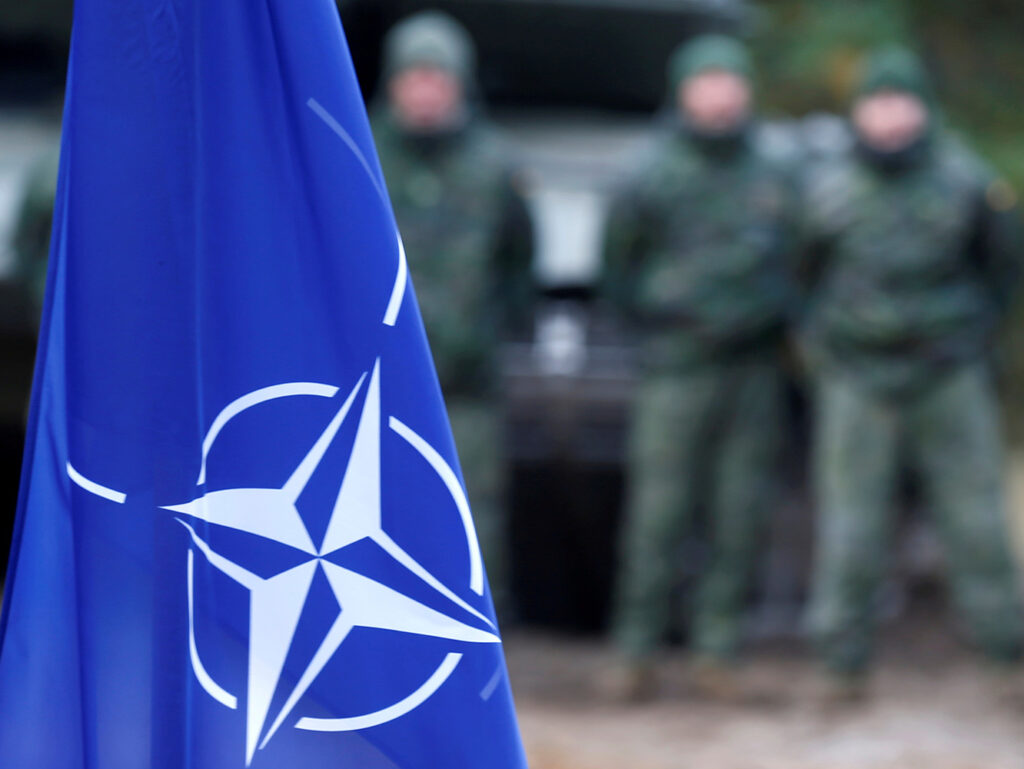
Image: US Marines with Alpha Company, 2d Light Armored Reconnaissance Battalion, 2nd Marine Division, and Portuguese Navy service members conduct a simulated amphibious raid during exercise Baltic Operations 2025 (BALTOPS 25), June 12, 2025 in Liepaja, Latvia. BALTOPS 25, the premier maritime-focused exercise in the Baltic Region, provides a unique training opportunity to strengthen combined response capabilities critical to preserving freedom of navigation and security in the Baltic Sea. Photo courtesy of NATO