


Energy Sanctions Dashboard

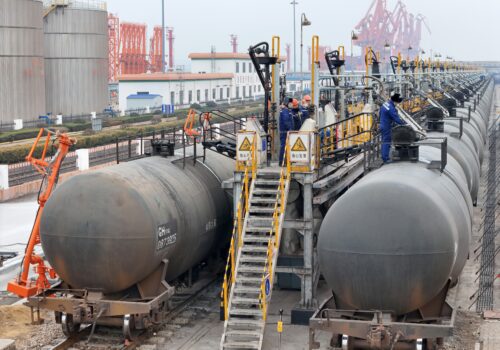
This dashboard focuses on US sanctions and restrictive measures placed on crude oil from Russia, Iran, and Venezuela—including the unintended consequences and the lessons learned.

Econographics

Apr 17, 2025

Russia Sanctions Database

By Kimberly Donovan, Maia Nikoladze, Lize de Kruijf

The Atlantic Council’s Russia Sanctions Database tracks the level of coordination among Western allies in sanctioning Russian entities, individuals, vessels, and aircraft, and shows where gaps still remain.

Eastern Europe Economy & Business

Recent analysis

Programs

At the intersection of economics, finance, and foreign policy, the GeoEconomics Center is a translation hub with the goal of helping shape a better global economic future.

Content

In the News

Oct 14, 2019

O’Toole quoted in Foreign Policy on Turkey sanctions

By Atlantic Council

Economy & Business
Financial Sanctions and Economic Coercion

In the News

Sep 27, 2019

Slavin joins France 24 to discuss Trump, UNGA, and sanctions on Iran

By Atlantic Council

Financial Sanctions and Economic Coercion
International Organizations

In the News

Sep 25, 2019

Hudson in Foreign Policy: The United States should lift sanctions on Sudan

By Atlantic Council

Africa
English

Event Recap

Sep 24, 2019

Key Sanctions Risks and Trends

By Global Business & Economics Program

On September 19th, the Atlantic Council’s Global Business & Economics Program’s Economic Sanctions Initiative hosted an event alongside Kharon to discuss key sanctions risks and trends. Ambassador Daniel Fried, the Weiser Family distinguished fellow at the Atlantic Council, offered brief opening remarks to introduce the event’s topic and presenters.

China
Economy & Business

Feature

Sep 22, 2019

Sanctions explained: How a foreign policy problem becomes a sanctions program

By Brian O'Toole and Samantha Sultoon

Sanctions allow a US president to exercise power unilaterally and often expeditiously. They are often one of the few middle grounds between war and words.

Financial Sanctions and Economic Coercion

Inflection Points

Sep 21, 2019

Trump’s Iran test: Nerves and vision

By Frederick Kempe

President Trump’s maximum pressure and Iran’s escalating responses have increased the risks of conflict. They have also brought a new chance of resolution that may become the most significant test yet of President Trump’s ability to transform his disruptive foreign policy into positive outcomes.

Defense Policy
Financial Sanctions and Economic Coercion

MENASource

Sep 20, 2019

To deal, or not to deal: Iran remains divided on the United States

By Sara Bazoobandi

The Iranian leadership has been unable to find a consensus on when the negotiations should begin, or what a final agreement should achieve.

Financial Sanctions and Economic Coercion
Iran

New Atlanticist

Sep 20, 2019

Iranian central bank designation: What does it mean?

By Brian O'Toole

The only appreciable impact of the September 20 designation will be to further impair the delivery of food and medicine to the Iranian people, who are already struggling to get needed supplies and to antagonize US partners around the globe.

Financial Sanctions and Economic Coercion
Iran

In the News

Sep 20, 2019

Sultoon quoted in Reuters on Iran’s central bank sanctions

By Atlantic Council

Financial Sanctions and Economic Coercion
Iran

Issue Brief

Sep 19, 2019

Secondary sanctions’ implications and the transatlantic relationship

By Samantha Sultoon & Justine Walker

The term secondary sanctions provokes strong reactions from allies and markets. Due to the power of the US dollar, breadth of the US market, and dominance of the US financial system, even the threat of secondary sanctions prompts many non-US companies to change their behavior to avoid the risk of such sanctions. Although this approach has furthered US policies, it has resulted in transatlantic political divergence and enhanced compliance uncertainty among private sector actors.

China
Economy & Business

Experts