

Financial Sanctions and Economic Coercion

Financial sanctions and other forms of economic coercion have become policy tools of choice for the US government to deter illegal activity by international actors or to pressure governments into reversing actions that harm US interests. Yet these instruments and their potential pitfalls are often misunderstood. Restrictive economic measures such as financial sanctions, export controls, tariffs, and investment screening can play an important role in advancing certain policy objectives, but they risk being ineffective if misapplied or poorly implemented. Policymakers must also recognize the impact of economic statecraft on the private sector, which bears many of the compliance burdens and operational costs associated with these measures.

Energy Sanctions Dashboard

This dashboard focuses on US sanctions and restrictive measures placed on crude oil from Russia, Iran, and Venezuela—including the unintended consequences and the lessons learned.

Econographics

Apr 17, 2025

Russia Sanctions Database

By Kimberly Donovan, Maia Nikoladze, Lize de Kruijf

The Atlantic Council’s Russia Sanctions Database tracks the level of coordination among Western allies in sanctioning Russian entities, individuals, vessels, and aircraft, and shows where gaps still remain.

Eastern Europe Economy & Business

Recent analysis

Programs

At the intersection of economics, finance, and foreign policy, the GeoEconomics Center is a translation hub with the goal of helping shape a better global economic future.

Content

MENASource

Sep 20, 2019

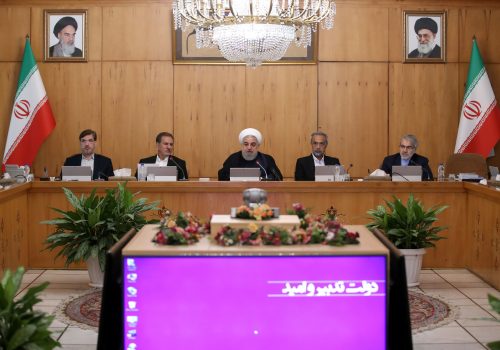
To deal, or not to deal: Iran remains divided on the United States

By Sara Bazoobandi

The Iranian leadership has been unable to find a consensus on when the negotiations should begin, or what a final agreement should achieve.

Financial Sanctions and Economic Coercion Iran

New Atlanticist

Sep 20, 2019

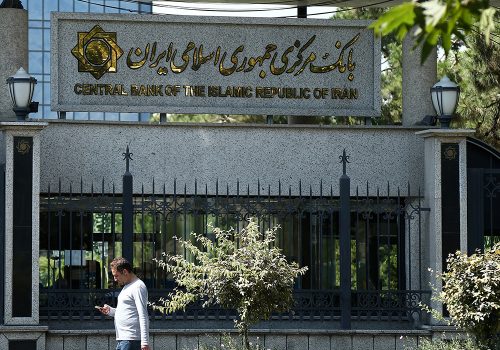
Iranian central bank designation: What does it mean?

By Brian O'Toole

The only appreciable impact of the September 20 designation will be to further impair the delivery of food and medicine to the Iranian people, who are already struggling to get needed supplies and to antagonize US partners around the globe.

Financial Sanctions and Economic Coercion Iran

In the News

Sep 20, 2019

Sultoon quoted in Reuters on Iran’s central bank sanctions

By Atlantic Council

Financial Sanctions and Economic Coercion Iran

Issue Brief

Sep 19, 2019

Secondary sanctions’ implications and the transatlantic relationship

By Samantha Sultoon & Justine Walker

The term secondary sanctions provokes strong reactions from allies and markets. Due to the power of the US dollar, breadth of the US market, and dominance of the US financial system, even the threat of secondary sanctions prompts many non-US companies to change their behavior to avoid the risk of such sanctions. Although this approach has furthered US policies, it has resulted in transatlantic political divergence and enhanced compliance uncertainty among private sector actors.

China Economy & Business

In the News

Sep 18, 2019

Slavin in The American Conservative: Iran and the Poisonous Fruits of ‘Maximum Pressure’

Financial Sanctions and Economic Coercion Iran

Report

Sep 12, 2019

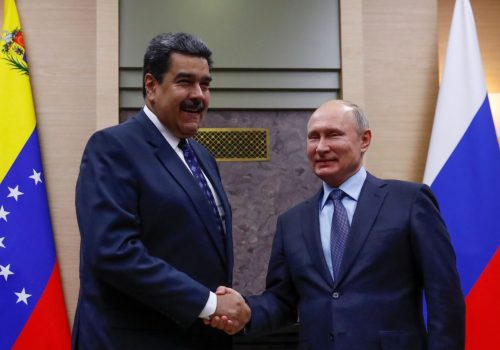
Russia’s intervention in Venezuela: What’s at stake?

By John E. Herbst and Jason Marczak

Venezuela is suffering one of the world’s worst humanitarian crisis in recent memory, Russia has become a key actor that has provided a lifeline of support to Maduro and his cronies. Today, Russia’s efforts to prop up Nicolás Maduro have been a relatively low-cost, but high-reward strategy for Moscow to sow further instability in the United States' own hemisphere.

Democratic Transitions Financial Sanctions and Economic Coercion

IranSource

Aug 27, 2019

It’s time to admit that we don’t understand Iran’s economy

By Esfandyar Batmanghelidj

The United States is pursuing an “economic war” on the basis of a very crude understanding of Iran’s economy. Should the goal of its sanctions policy be havoc, such an understanding will suffice.

Financial Sanctions and Economic Coercion Iran

IranSource

Aug 23, 2019

The Trump administration’s Iran policy shows meager results

By Holly Dagres

Though there are differences between factions about how to confront the United States, the heavy US pressure on Tehran in recent months has led to a rally-around-the-flag effect as Iranians push back against what many view as a Western imperialism.

Financial Sanctions and Economic Coercion Iran

New Atlanticist

Aug 20, 2019

The financial implications of deploying sanctions in Hong Kong

By Michael B. Greenwald

If the situation worsens in Hong Kong, Washington should not hesitate to not only use Global Magnitsky, but also take tangible steps to boost its hard power position in the region.

China Financial Sanctions and Economic Coercion

New Atlanticist

Aug 13, 2019

The winners and losers of the US-China trade war

By Andrew LaScaleia

The world continues to become more economically intertwined as each day passes, and as the US-China conflict escalates, more countries will find themselves impacted for better or for worse via supply chains, foreign demand and investment, and insecurity.

China Financial Sanctions and Economic Coercion

Experts