
Financial Sanctions and Economic Coercion

Financial sanctions and other forms of economic coercion have become policy tools of choice for the US government to deter illegal activity by international actors or to pressure governments into reversing actions that harm US interests. Yet these instruments and their potential pitfalls are often misunderstood. Restrictive economic measures such as financial sanctions, export controls, tariffs, and investment screening can play an important role in advancing certain policy objectives, but they risk being ineffective if misapplied or poorly implemented. Policymakers must also recognize the impact of economic statecraft on the private sector, which bears many of the compliance burdens and operational costs associated with these measures.

Energy Sanctions Dashboard

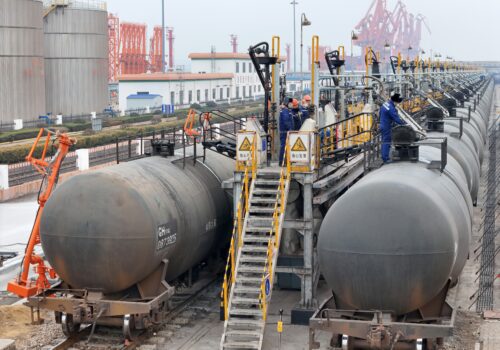
This dashboard focuses on US sanctions and restrictive measures placed on crude oil from Russia, Iran, and Venezuela—including the unintended consequences and the lessons learned.

Econographics

Apr 17, 2025

Russia Sanctions Database

By Kimberly Donovan, Maia Nikoladze, Lize de Kruijf

The Atlantic Council’s Russia Sanctions Database tracks the level of coordination among Western allies in sanctioning Russian entities, individuals, vessels, and aircraft, and shows where gaps still remain.

Eastern Europe Economy & Business

Recent analysis

Programs

At the intersection of economics, finance, and foreign policy, the GeoEconomics Center is a translation hub with the goal of helping shape a better global economic future.

Content

In the News

Mar 24, 2025

O’Toole interviewed by the Institute for Financial Integrity for a podcast on the convergence of sanctions and financial crimes

Listen to the full podcast here

Economy & Business Financial Regulation

In the News

Mar 24, 2025

Donovan and Nikoladze cited by Modern Diplomacy on US sanctions on Iranian oil

Read the full article here

Economy & Business Financial Sanctions and Economic Coercion

In the News

Mar 18, 2025

Tabaqchali in London School of Economics: the empire strikes back: Trump 2.0 and Iraq’s dollar accounts at the federal reserve

By Atlantic Council

Economy & Business Financial Sanctions and Economic Coercion

New Atlanticist

Mar 17, 2025

Enough carrots for Putin. For better negotiations, serve ‘maximum pressure’ instead.

By Benjamin L. Schmitt, Richard L. Morningstar, and Daniel Fried

Since Russia appears content for negotiations to move slowly, the Trump administration should turn up the pressure with new sanctions.

Conflict Financial Sanctions and Economic Coercion

UkraineAlert

Mar 11, 2025

Pressure is now on Putin as Ukraine agrees to Trump’s ceasefire proposal

By Peter Dickinson

Ukraine has agreed to a United States proposal for a 30-day ceasefire with Russia, representing a potentially significant breakthrough in US-led diplomatic efforts to end the largest European conflict since World War II, writes Peter Dickinson.

Conflict Financial Sanctions and Economic Coercion

In the News

Mar 11, 2025

Klamberg quoted in Deutsche Welle on Trump’s executive order and its consequences on the ICC

By Atlantic Council

Financial Sanctions and Economic Coercion Israel

UkraineAlert

Mar 5, 2025

Prospect of peace talks sparks fresh debate over Russia’s frozen assets

By Ivan Horodyskyy

US President Donald Trump's efforts to broker a peace deal between Russia and Ukraine are sparking fresh debate over the fate of $300 billion in frozen Russian assets, writes Ivan Horodyskyy.

Conflict European Union

Trackers and Data Visualizations

Mar 3, 2025

Venezuela sanctions tracker: Who is the international community sanctioning in Venezuela?

By Lucie Kneip, Geoff Ramsey, Ilona Barrero

International actors including the US, Canada, and the EU have imposed sanctions on individuals responsible for acts of corruption, human rights violations, and the breakdown of democratic rule in Venezuela. How aligned are these countries on sanctions, and where do gaps exist?

Americas Europe & Eurasia

EconoGraphics

Feb 27, 2025

Could the EU ‘blocking statute’ protect the ICC from US sanctions?

By Lize de Kruijf

The new US sanctions targeting ICC personnel could severely disrupt the Court’s operations—particularly if Dutch banks suspend financial services to the ICC out of fear of violating US sanctions.

Economy & Business Europe & Eurasia

New Atlanticist

Feb 26, 2025

Why the US should not lift sanctions against Russia

By Charles Lichfield

Sanctions are having an unmistakable effect, albeit below the inflated expectations of many in the West in early 2022. Lifting them now would be a mistake.

Conflict Economy & Business

Experts