Financial Sanctions and Economic Coercion

Financial sanctions and other forms of economic coercion have become policy tools of choice for the US government to deter illegal activity by international actors or to pressure governments into reversing actions that harm US interests. Yet these instruments and their potential pitfalls are often misunderstood. Restrictive economic measures such as financial sanctions, export controls, tariffs, and investment screening can play an important role in advancing certain policy objectives, but they risk being ineffective if misapplied or poorly implemented. Policymakers must also recognize the impact of economic statecraft on the private sector, which bears many of the compliance burdens and operational costs associated with these measures.

Energy Sanctions Dashboard

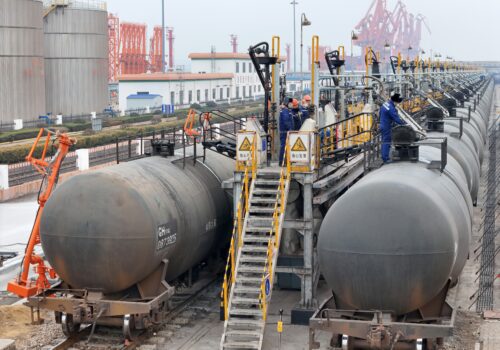
This dashboard focuses on US sanctions and restrictive measures placed on crude oil from Russia, Iran, and Venezuela—including the unintended consequences and the lessons learned.

Econographics

Apr 17, 2025

Russia Sanctions Database

By Kimberly Donovan, Maia Nikoladze, Lize de Kruijf

The Atlantic Council’s Russia Sanctions Database tracks the level of coordination among Western allies in sanctioning Russian entities, individuals, vessels, and aircraft, and shows where gaps still remain.

Eastern Europe Economy & Business

Recent analysis

Programs

At the intersection of economics, finance, and foreign policy, the GeoEconomics Center is a translation hub with the goal of helping shape a better global economic future.

Content

New Atlanticist

Sep 10, 2021

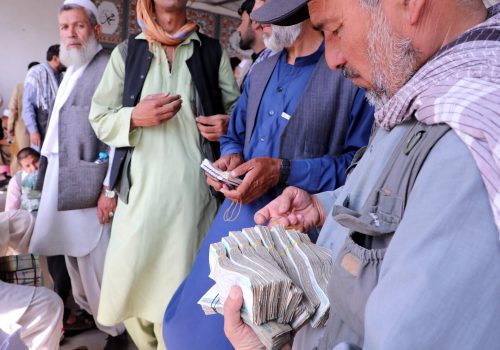
Afghanistan’s ex-central bank chief: The Taliban has money to ‘run an insurgency but not a government’

By Dan Peleschuk

At an Atlantic Council event, Ajmal Ahmady discussed how the Taliban must govern a country short on cash and mired in multiple crises.

Afghanistan Conflict

New Atlanticist

Sep 9, 2021

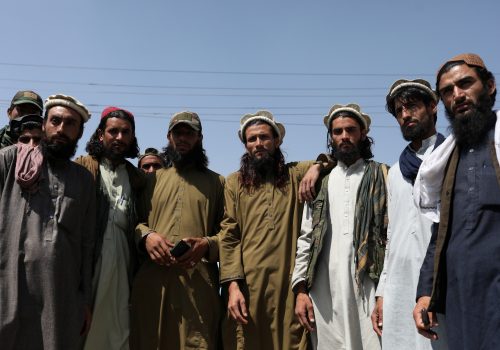
Sanctions alone won’t tame the Taliban

By Brian O’Toole

The United States and its allies will need to wield both existing and new sanctions as strategically as possible, but changing the regime's behavior will be difficult.

Afghanistan Financial Sanctions and Economic Coercion

In the News

Sep 8, 2021

Friedlander quoted by Wall Street Journal about Biden’s embrace of economic sanctions

By Julia Friedlander

Read the full article here.

Economy & Business Financial Sanctions and Economic Coercion

In the News

Sep 7, 2021

Slavin quoted in Tehran Times on the American view of the Iran deal

By Atlantic Council

Financial Sanctions and Economic Coercion Iran

In the News

Sep 4, 2021

Slavin joins Al Hurra to discuss the Iran nuclear deal and Vienna negotiations

By Atlantic Council

Arabic Financial Sanctions and Economic Coercion

BelarusAlert

Sep 3, 2021

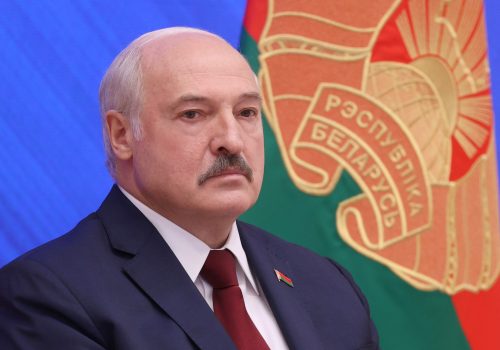
Broadening the pressure on the Lukashenka regime

By Daniel Fried

Recent news of fresh IMF financing for Belarus has sparked controversy at a time when the democratic world is seeking to impose sanctions on the country's Kremlin-backed dictator Alyaksandr Lukashenka.

Belarus European Union

Fast Thinking

Sep 3, 2021

FAST THINKING: Who’s funding the Taliban?

By Julia Friedlander

On this episode of Fast Thinking, the Atlantic Council's Julia Friedlander and Mark Nakhla, the executive vice president of Kharon, dive into the Taliban's funding networks (don't miss the helpful visuals!), which are primarily outside the reach of the international finance system.

Afghanistan Conflict

In the News

Sep 3, 2021

O’Toole quoted in Reuters about the potential impact of releasing Afghan assets

By Brian O’Toole

Read the whole article here.

Afghanistan Economy & Business

In the News

Aug 28, 2021

O’Toole quoted in The Economist about Russia’s attempts to circumvent sanctions

By Brian O’Toole

Read the whole article here.

Economy & Business Financial Sanctions and Economic Coercion

In the News

Aug 27, 2021

Cohen quoted in Jewish News Syndicate on Iran taking advantage of lax enforcement of US sanctions to export fuel

By Atlantic Council

Economy & Business Energy & Environment

Experts