International Financial Institutions

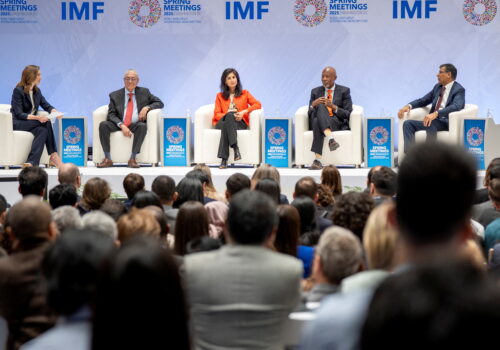
International financial institutions, such as the World Bank Group and the International Monetary Fund, are a key pillar of the rules-based international order. These institutions facilitate multilateral solutions for today’s most pressing economic opportunities and risks. Bi-annual IMF/World Bank meetings also provide the Atlantic Council the opportunity to convene global policy makers to discuss the most pressing economic and societal challenges.

Content

EconoGraphics

Oct 16, 2020

The world in debt

By Stefan de Villiers

On Tuesday, the IMF released a new World Economic Outlook report for October 2020. In the report, alongside adjusted growth expectations, were updated measures of government debt. From that data, the GeoEconomics Center has created a visualization to track the debt burden felt across the globe. Our new tracker focuses on general government gross debt […]

Economy & Business Financial Regulation

New Atlanticist

Oct 16, 2020

The US government makes its big push for investment in Africa

By David A. Wemer

Buoyed by bipartisan commitment and a new government agency, the United States has taken new and significant steps to help drive investment in Africa, strengthen the region’s dynamic economies, create lucrative opportunities for US and African businesses, and advance US foreign-policy goals in the region.

Africa Inclusive Growth

New Atlanticist

Oct 15, 2020

Regional development banks play a critical role in COVID-19 response and recovery

By Nicole Goldin

As the pandemic calls into question the effectiveness of the global order and systems of economic and financial governance, the pivotal role of RDBs in improving billions of lives, bolstering markets, and strengthening economies should not be overlooked

Inclusive Growth International Financial Institutions

NATO 20/2020

Oct 14, 2020

Open a bank

By Max Bergmann and Siena Cicarelli

NATO can fund critical defense investments by bringing the necessary financial tools in house.

Economy & Business Europe & Eurasia

In the News

Oct 13, 2020

Moehr quoted in the New York Times on the Airbus-Boeing WTO dispute

By Ole Moehr

Read the full article here.

European Union International Financial Institutions

Event Recap

Oct 9, 2020

Event recap: A conversation with Deputy Secretary of the Treasury, Justin Muzinich

By GeoEconomics Center

A recap of the event featuring Deputy Secretary of US Treasury Justin Muzinich, who joined the Atlantic Council’s GeoEconomics Center for an address on the transatlantic economy.

Europe & Eurasia European Union
Mediterranean

Report

Oct 7, 2020

Value beyond price: Prioritizing political stability and regional integration when financing Mediterranean gas

By Olgu Okumuş

A comprehensive overview of the tensions surrounding natural gas resources in the Eastern Mediterranean which argues that development projects must take into account geopolitical rivalries as a reality in determining how to leverage East Med gas by mobilizing the power of multilateral dialogue platforms and international development banks.

Europe & Eurasia European Union

New Atlanticist

Oct 7, 2020

The time to address an emerging market crisis is before it hits

By Jeremy Mark and Vasuki Shastry

The global economy is too weak to wait for another full-blown financial crisis to erupt. Now is the time to anticipate solutions.

Coronavirus International Financial Institutions

New Atlanticist

Sep 29, 2020

Three Seas Initiative could help jumpstart Europe’s post-COVID recovery and green economy transformation

By David A. Wemer

Buoyed by a new commercially managed investment fund and a $1 billion pledge from the United States, leaders from the Three Seas Initiative will convene for a summit on October 19 to move the project into its next stage.

Central Europe Climate Change & Climate Action

New Atlanticist

Sep 29, 2020

Government response to economic crisis now is pivotal—but will risk future financial stability

By Hung Tran

Governments deploying economic and financial support measures have been able to protect from a major pandemic era crisis, but the emergency measures have entrenched inefficiencies, imbalances, and vulnerabilities that suggest a future financial crisis.

Economy & Business Financial Regulation

Experts

Events