Content

In the News

Mar 30, 2026

Matchett quoted in CNN on the Iran war’s threat to desalination plants and data center investment in the Gulf

By Ginger Matchett

On March 30, GeoStrategy Initiative assistant director Ginger Matchett was quoted in “Trump helped build the Middle East’s AI ambitions. Could his war break them?” for CNN on the risk to data center investment because of the US-Israel-Iran war. She explained how the war is leaving data center investment up in the air because protection of data centers […]

Energy & Environment Infrastructure

Report

Mar 30, 2026

How the West lost the post-Cold War era

By Brian Whitmore

The latest Atlantic Council Eurasia Center report examines the lessons from the post-Cold War period and what the United States and its allies can do to counter Russian revanchism today.

Europe & Eurasia Politics & Diplomacy
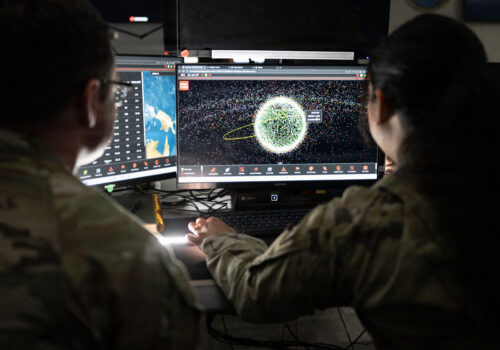
VANDENBERG SPACE FORCE BASE, CALIF., CALIFORNIA, UNITED STATES 12.18.2025

Report

Mar 30, 2026

How NATO can integrate AI to prevail in future algorithmic warfare

By Dominika Kunertova

NATO’s competitive edge in the era of emerging and disruptive technologies will come from treating AI as a general-purpose enabler embedded across the Alliance’s digital backbone. Military AI does not generate new risks but creates more room for human error and miscalculation. Accidents and inadvertent escalation thus become more likely as military systems bring in more AI components.

Artificial Intelligence Cybersecurity

Dispatches

Mar 27, 2026

Ten lessons from the first month of the Iran war

By Atlantic Council experts

Atlantic Council experts identify ten important takeaways from the Iran war so far, covering issues from global energy markets to the Iranian regime.

Conflict Economy & Business

Issue Brief

Mar 27, 2026

Deterrence in a two-peer world requires prudence

By Kingston Reif

Washington faces the challenge of preserving credible deterrence and reassuring allies against two potential nuclear peers—possibly acting together—without fueling dangerous instability or draining resources from other defense priorities. This will require a balanced approach that avoids counterproductive arsenal growth.

China Nuclear Deterrence

Issue Brief

Mar 27, 2026

Why US strategic nuclear forces must expand after New START

By Paul Amato

With the New START treaty's caps on the US nuclear force expired, the United States has an opportunity to increase and adapt its nuclear force to deter both Russia and China. Policymakers should seize it.

China Defense Policy

UkraineAlert

Mar 26, 2026

Only additional pressure can push Putin toward peace

By Kira Rudik

With the Kremlin ignoring calls for a compromise peace, the only way to advance negotiations is by putting more pressure on Putin. Failure to do so could have disastrous consequences that would be felt far beyond the borders of Ukraine, writes Kira Rudik.

Conflict Disinformation

UkraineAlert

Mar 26, 2026

Drone superpower Ukraine is an ideal tech partner for the Gulf states

By Anatoly Motkin

Kyiv's decision to help defend the Gulf states against Iranian drones by deploying teams of Ukrainian specialists is highlighting the scope for broader tech sector cooperation between Ukraine and the region, writes Anatoly Motkin.

Conflict Defense Technologies

MENASource

Mar 26, 2026

As Iran attacks, the US should provide air defense for Iraqi Kurdistan

By Yerevan Saeed

Washington faces a choice: Continue to defer to Baghdad’s procedural objections while Iran conducts unimpeded strikes on Kurdish territory or acknowledge the strategic reality and take decisive action.

Conflict Crisis Management

Dispatches

Mar 26, 2026

The Anthropic standoff reveals a larger crisis of trust over AI

By Tess deBlanc-Knowles

Treating public skepticism as noise to be managed rather than a signal to be heeded risks causing rapid political polarization on artificial intelligence.

Artificial Intelligence Defense Policy

Experts

Events