Nuclear strategy project

The Scowcroft Center is proud to play a central role in crafting an effective and nonpartisan strategic forces policy for the twenty-first century.

The Scowcroft Center’s namesake, General Brent Scowcroft, was the chairman of the 1983 Scowcroft Commission that established the foundation for US nuclear deterrence and arms control policy through the present day. As the United States enters a new era of strategic challenges, the Scowcroft Center’s Forward Defense program is proud to play a central role in crafting an effective and nonpartisan strategic forces strategy and policy for the twenty-first century.

The 2022 National Defense Strategy and Nuclear Posture Review caution that the United States will, for the first time in its history, face the challenge of simultaneously deterring two nuclear great powers, each with aggressive revisionist goals. Our Nuclear Strategy Project, within the Forward Defense program, focuses on the role of nuclear deterrence, nuclear strategy and employment, missile defense, and arms control in deterring conventional aggression and nuclear escalation against the United States, its allies, and partners.

Principal research areas

Must Reads
Report

Jan 4, 2025

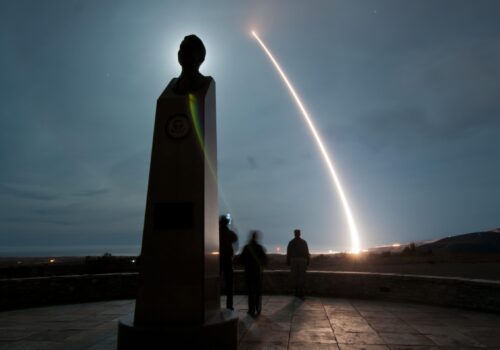
‘First, we will defend the homeland’: The case for homeland missile defense

By Robert Soofer with contributions from Kari Anderson, James McCue, Tom Karako, Mark J. Massa, Alyxandra Marine, and Jonathan Rosenstein

A comprehensive analysis of U.S. homeland missile defense, addressing policies, security challenges, and strategies to counter threats from North Korea, China, and Russia.

China Defense Technologies

Reports & issue briefs

Report

Sep 8, 2026

Preparing for and countering limited nuclear attacks in East Asia: Guardian Tiger III

By Markus Garlauskas with John Park and Kyoko Imai. Contributors: Andrew Brown and Jonathan Corrado

The risk of North Korea launching a limited nuclear attack will likely increase over the coming decade. The United States and its allies are not preparing adequately to deter and prevail in the face of such nuclear strikes.

Indo-Pacific Korea

Issue Brief

Jun 18, 2026

The case for a US Northeast Asia Command

By Christopher Lee, Ben Blane, and Markus Garlauskas

To maximize its deterrent and warfighting effectiveness in the Indo-Pacific region, the United States must reform its military command-and-control structure in Northeast Asia.

Arms Control East Asia

Issue Brief

May 21, 2026

For homeland missile defense, think Golden Zones, not a Golden Dome 

By Ankit Panda

While the second Trump administration correctly diagnoses a more dangerous nuclear environment facing the country, a comprehensive defensive system is the wrong prescription. The risks of prompting adversary proliferation and stretching US resources thin are too high.

Defense Technologies Missile Defense

Issue Brief

May 21, 2026

Golden Dome is the missile defense the US needs

By Henry “Trey” Obering

The United States should pursue a comprehensive missile defense system to protect the homeland from advanced threats posed by China, Russia, and North Korea. Political will from the Trump administration and advances in technology make the idea of the long-discussed "dome" over the United States more feasible now than ever.

Missile Defense Security & Defense

Issue Brief

Mar 27, 2026

Deterrence in a two-peer world requires prudence

By Kingston Reif

Washington faces the challenge of preserving credible deterrence and reassuring allies against two potential nuclear peers—possibly acting together—without fueling dangerous instability or draining resources from other defense priorities. This will require a balanced approach that avoids counterproductive arsenal growth.

China Nuclear Deterrence

Commentary & quick analysis

Past events
In the news

In the News

Jan 31, 2024

Garlauskas published in Newsweek on rising threat of North Korea

On January 30, Markus Garlauskas published an op-ed in Newsweek at their request on “The Rising Threat of Kim Jong Un’s North Korea.” In his article, he explained that despite recent concerns that Pyongyang will pursue war on the Korean Peninsula, the imminent threats posed by North Korea are its advancing weapons programs, its evolving […]

Defense Technologies Indo-Pacific

In the News

Jan 29, 2024

IPSI report on deterrence in Korea cited across major media platforms

This month, IPSI’s latest report, Deterrence is crumbling in Korea: How we can fix it, has been cited in Reuters, the Washington Post, and Newsweek. These articles highlighted several key points from the report, including its warning that although Kim Jong Un is unlikely to pursue a full-scale nuclear war, North Korea still has the […]

China Indo-Pacific

In the News

Jan 22, 2024

Narang on the State of the World podcast

Neil Narang joins the University of California Institute on Global Conflict and Cooperation's State of the World podcast

China Conflict

In the News

Jan 15, 2024

IPSI report on simultaneous conflicts referenced in VOA

On January 14, IPSI’s report, “The United States and its allies must be ready to deter a two-front war and nuclear attacks in East Asia,” was referenced in a VOA article, which underscored the report’s warning about the potential for China to target US bases in South Korea in a conflict with the United States.

Arms Control China

In the News

Dec 30, 2023

Soofer on Voice of America on North Korean missile threat

By Atlantic Council

Robert Soofer speaks on Voice of America to discuss the rising missile threat from North Korea.

Arms Control China

Subscribe to stay engaged

Sign up for updates from Forward Defense to hear the latest on the trends, technologies, and military challenges shaping tomorrow.


  • This field is for validation purposes and should be left unchanged.

Related experts

Forward Defense develops and shapes policy solutions that build US military power to deter war and secure the future.