Featured commentary & analysis

Podcast series

Listen to the latest episode of the China-MENA podcast, featuring conversations with academics, government leaders, and the policy community on China’s role in the Middle East.

Programs

Gulf Security Task Force

The Gulf Security Task Force is revisiting the question of how to best protect US interests in this sensitive, always relevant region. Our goal is to provide US decision-makers with an updated, fact-based strategy for protecting US interests in the air and maritime domain from the Persian Gulf to the Red Sea, and ensuring Gulf partners’ ability to assume this responsibility, with the assistance and leadership of the United States.

Learn more about the Middle East programs

Middle East Programs

Working with our allies and partners in Europe and the wider Middle East to protect US interests, build peace and security, and unlock the human potential of the region.
Content

Inflection Points

Jan 11, 2020

Abu Dhabi dispatch: The Soleimani earthquake and coming aftershocks

By Frederick Kempe

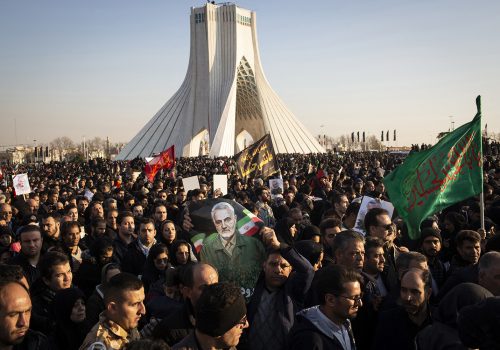
The conventional wisdom – underpinned by visuals from Iran – is that the US drone strike reinforced hardliners and shifted the internal Iranian dynamics from protests against the regime to angry demonstrations against the United States. Far harder to measure is the longer-term impact of Soleimani’s absence on the country’s revolutionary effectiveness and structure.

Conflict Iran

New Atlanticist

Jan 11, 2020

How can oil and gas companies contribute to the energy transition?

By David A. Wemer

“There is no thing that is a magic solution” to climate change, according to Musabbeh Al-Kaabi, chief executive officer for petroleum and petrochemicals at the Mubadala Investment Company, but oil and gas companies are increasingly realizing that “the future outlook for energy consumption will require different sources of energy.”

Climate Change & Climate Action Energy Markets & Governance

New Atlanticist

Jan 11, 2020

Climate commitments needed to head off threats of volatility and instability

By Adal Mirza

A widening gap between perceptions and reality of the global energy markets could increase volatility as governments, policy makers, and industries struggle to tackle climate change, according to Fatih Birol, the executive director of the International Energy Agency.

Climate Change & Climate Action Energy Markets & Governance

Transcript

Jan 11, 2020

Setting the 2020 energy agenda

By Atlantic Council

Atlantic Council 2020 Global Energy Forum Setting the 2020 Energy Agenda Speakers: H.E. Suhail Al Mazrouei, Minister of Energy and Industry, United Arab Emirates The Hon. Dr. Tawfiq-e Elahi Chowdhury, Energy Adviser to the Honorable Prime Minister, People’s Republic of Bangladesh Majid Jafar, Chief Executive Officer, Crescent Petroleum Michael Sen, Chief Executive Officer, Siemens Energy […]

Bangladesh Energy & Environment

Transcript

Jan 11, 2020

Official opening of the Fourth Global Energy Forum

By Atlantic Council

Atlantic Council 2020 Global Energy Forum Official Opening of the Fourth Global Energy Forum Speakers: Frederick Kempe, President and CEO, Atlantic Council General James L. Jones, Jr., USMC (Ret.), Executive Chairman Emeritus, Atlantic Council H.E. Dr. Sultan Al Jaber, Minister of State, United Arab Emirates; Chief Executive Officer, Abu Dhabi National Oil Company H.E. Suhail […]

Energy & Environment The Gulf

Report

Jan 9, 2020

Energy sector diversification: Meeting demographic challenges in the MENA region

By Bina Hussein

The Middle East and North Africa (MENA) region is projected to experience significant demographic growth by 2050, growth which will have to be met with commensurate economic expansion and job opportunities, or the region will risk an increase in political instability. To meet this challenge, countries in the region must diversify their economies beyond the energy sector and expand their energy sector beyond hydrocarbons. What are the key trends that MENA countries will have to contend with, what is already being done, and what further steps should be taken?

Energy Markets & Governance Energy Transitions
Manufacturing facility

Issue Brief

Jan 9, 2020

The Saudi Aramco-SABIC merger: How acquiring SABIC fits into Aramco’s long-term diversification strategy

By Private: Jean-François Seznec

Throughout 2019, financial markets have watched the planned Saudi Aramco initial public offering (IPO), which was finally launched in December. A quieter, but no less significant, story was the Saudi oil company’s acquisition of SABIC. Saudi Aramco strove to have a successful IPO, especially through increased transparency and diversification, and the SABIC acquisition was a key element of Saudi oil company's diversification strategy. Going forward, what does the merger mean for both companies, what is the new relationship between Saudi Aramco and SABIC, and what are the merger’s implications for the intricate relationship between the various bureaucracies and leadership in Saudi Arabia?

Energy Markets & Governance Energy Transitions

New Atlanticist

Jan 8, 2020

Iran’s missiles may have avoided the worst outcome

By Thomas S. Warrick

If there had been significant US casualties, the world would have awoken to the dawn of a regional war, because the Trump administration would have been compelled to attack the launch sites in Iran—and probably other targets in Iran, also. If the present news holds, the situation is slightly less dangerous, if still perilous.

Conflict Geopolitics & Energy Security

New Atlanticist

Jan 8, 2020

Washington and Tehran can step back – if they want to

By William F. Wechsler

After the January 8 Iranian missile attacks on Iraq, a successful tactical de-escalation requires both that the Iranian leadership intends for its military actions not to be escalatory and that the Trump administration perceives those actions as they were intended. In the absence of direct communications between the United States and Iran, however, the potential for misunderstanding and thus the risk of miscalculation remains high.

Conflict Geopolitics & Energy Security
Stock exchange

EnergySource

Dec 30, 2019

The Aramco IPO isn’t quite enough to realize MBS’s diversification ambitions

By Randolph Bell

After significant delays and a number of setbacks, Aramco finally listed shares representing 1.5 percent of the company’s total value on the domestic Tadawul exchange. The $25.6 billion that the IPO raised is nothing to scoff at, but it still is not enough to fully realize MBS’ ambitions. Where does the IPO go from here?

Energy Markets & Governance Energy Transitions

Experts