Countering Russian escalation in space
Executive summary
This report’s findings are meant to guide policymakers in making important decisions about safety, security, and sustainability in the space domain, as well as to better inform the public on these issues. The report explains why current US space policy, Department of Defense (DOD) acquisition programs, and commercial integration strategies by themselves are inadequate to address the growing threats from Russia in space. The report makes the case for the development of policies, practical strategies, and more effective acquisition programs to better address a range of potential futures, considering possible space-related actions by Russia’s political leadership.
Beyond recommending changes to US declaratory policy, this report details why the United States needs a more resilient space architecture. It examines how Russia’s nuclear threat—specifically, its designs to place a nuclear weapon in orbit, in clear violation of its obligations under international law—could alter the rationale for pursuing proliferated low-Earth orbit (LEO) constellations. This report also explores the kind of space architecture the United States would need during a conflict against a major power, and how the United States can further integrate the private sector and allies in pursuit of its national security objectives. Each of these issues carries significant near-term policy and acquisition implications.
This report explains why some US policymakers might be reluctant to take the necessary coercive action to compel acquiescence by Russian political and military leaders. This reluctance is driven by a Western sense of morality and “rightness,” an inherent right of self-defense mentality, and current conceptions of international humanitarian law. US anticipatory actions seeking to deter Russian malicious actions might prove unreliable because any anticipatory action will be a political decision based upon a Western mindset and worldview. This observation underscores that deterrence by denial of benefit—including resilience and active defense—should play a substantial role in military strategies, one even more substantial than cost-imposition efforts. Additionally, assurance and reassurance efforts directed toward Chinese and Indian leadership could help dissuade potential Russian aggressive behavior and deescalate crises.
This report’s analysis illuminates important defense and force planning considerations. Its three scenarios span a catastrophic nuclear detonation (NUDET) in LEO to debris-generating anti-satellite (ASAT) weapons to less aggressive action against commercial satellites. A qualitative assessment using a detailed framework highlights the relative importance of the methods used to dissuade potential aggression while also prevailing in conflict. In priority order, the relative importance of affecting Russian leadership’s decision calculus is: deterrence by denial of benefit; assurance and reassurance; and deterrence by cost imposition.
Finally, this report provides fifteen actionable policy and defense acquisition recommendations for advancing a comprehensive and practical framework to counter potential Russian aggression and escalation in space. Should dissuasion efforts fail and conflict in space occur, it is necessary that the United States, its allies, and commercial partners fight through Russia’s irresponsible and aggressive actions in space, while working to deescalate any crisis and seek a lasting peace.
Read the full report
About the authors
John J. Klein, PhD, is a nonresident senior fellow in the Forward Defense program of the Atlantic Council’s Scowcroft Center for Strategy and Security. Klein is a subject matter expert on space strategy and also instructs space policy and strategy courses at the undergraduate, graduate, and doctorate levels at several universities around Washington, DC. He routinely writes on space strategy, deterrence, and the law of armed conflict. He is the author of the books Space Warfare: Strategy, Principles and Policy, 2nd Edition (2024), Understanding Space Strategy: The Art of War in Space (2019), and Fight for the Final Frontier: Irregular Warfare in Space (2023), along with a score of other book chapters and articles.
Klein is also a retired United States Navy commander, receiving his commission through the Navy Reserve Officer Training Corps program at Georgia Tech. He served for twenty-two years as a naval flight officer, primarily flying in the S-3B Viking carrier based aircraft. Klein supported combat operations in Iraq and Afghanistan. His tours included service as the executive officer of Sea Control Squadron Twenty-Four and the final commanding officer of the Sea Control Weapons School.
Clementine Starling-Daniels is a vice president at Beacon Global Strategies, the former director of the Atlantic Council’s Forward Defense program, and a nonresident senior fellow at the Council’s Scowcroft Center for Strategy and Security. At Beacon, she advises at the intersection of national security and technology policy, helping clients navigate evolving defense, intelligence, and technology landscapes. As a national security expert, her research explores how emerging technologies and operational innovation enhance US and allied deterrence, defense, and joint warfighter capabilities amid strategic competition with China and Russia. Her work particularly focuses on space strategy and policy, and on the role of special operations and unconventional warfare in modern deterrence and conflict.
As founding director of Forward Defense, Starling-Daniels led a team advancing research and thought leadership on the future of warfare. She spearheaded bipartisan commissions on Defense Innovation Adoption and Software-Defined Warfare, developing approaches to leverage technologies—including AI, hypersonics, autonomy, and space systems—to solve complex defense challenges. Earlier in her career, she served as deputy director of the Atlantic Council’s Transatlantic Security Initiative, guiding task forces on NATO force posture, military mobility, contested logistics, and Arctic security. She also supported NATO’s Public Diplomacy Division during key summits and gained extensive experience in NATO and EU defense policy and industrial cooperation.
Acknowledgements
This report was produced in accord with the Atlantic Council’s policy on intellectual independence, which states that the Atlantic Council and its staff, fellows, and directors generate their own ideas and programming, consistent with the Council’s mission, their related body of work, and the independent records of the participating team members. The Council as an organization does not adopt or advocate positions on particular matters. The Council’s publications always represent the views of the author(s) rather than those of the institution.
The Atlantic Council maintains strict intellectual independence for all of its projects and publications. Council staff, fellows, and directors and those who the Council engages to work on specific projects, are responsible for generating and communicating intellectual content resulting from Council projects. The Council requires all donors to agree to the Council maintaining independent control of the content and conclusions of any products resulting from sponsored projects. The Council also discloses sources of financial support in its annual reports to ensure transparency.
This report does not necessarily reflect the views of the US Department of Defense, the US Department of the Air Force, or any other institution with which either of the co-authors or any of the contributors are now, or have in the past been, affiliated.
The co-authors acknowledge with gratitude the sponsorship of the Smith Richardson Foundation for this project.
Explore the program
Forward Defense develops and shapes policy solutions that build US military power to deter war and secure the future.
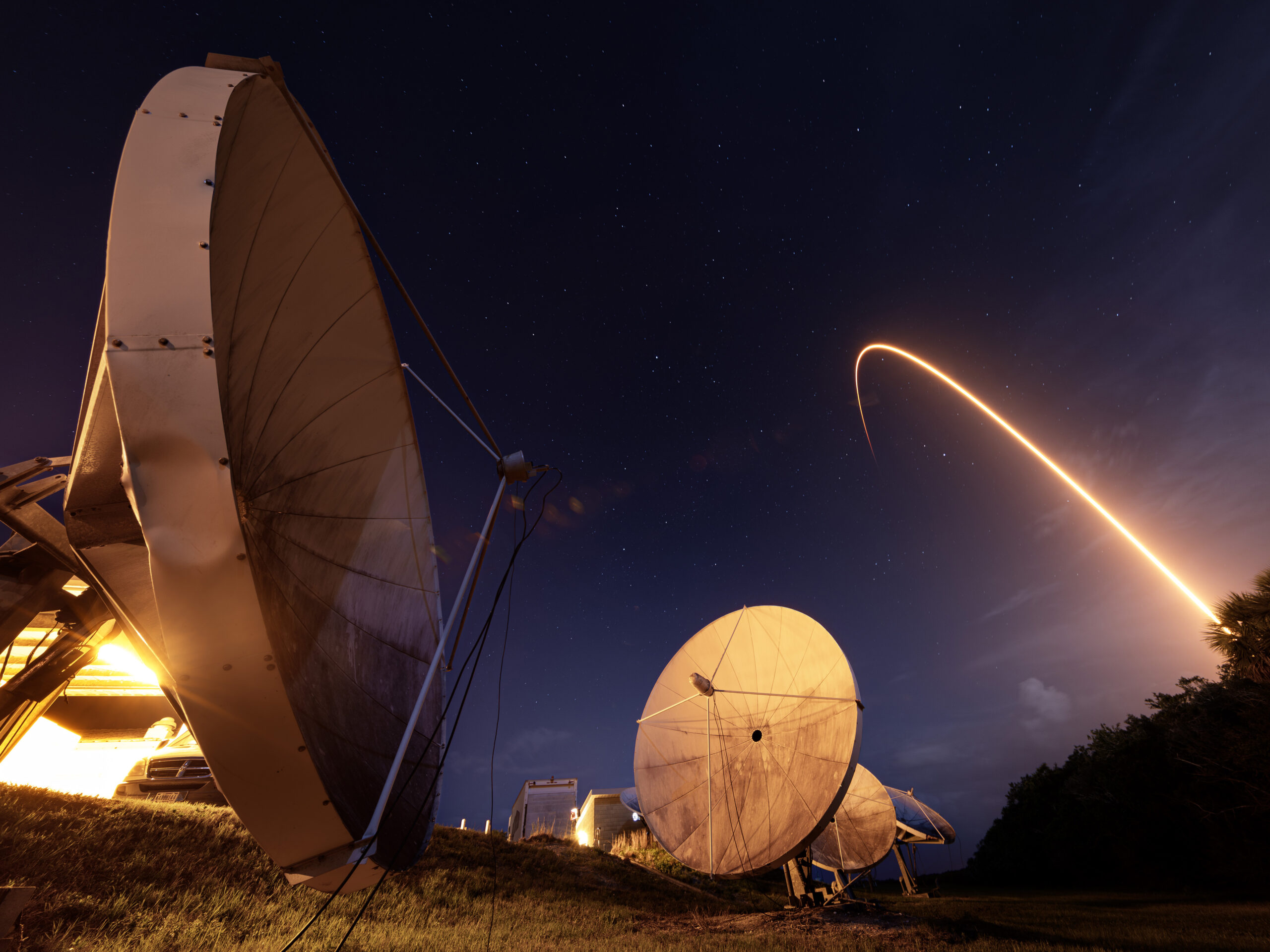
Image: A Falcon 9 rocket carrying the SXM-10 mission lifts off from Space Launch Complex 40 at Cape Canaveral Space Force Station, Florida, on June 7, 2025. (US Space Force photo illustration by Robert Mason)