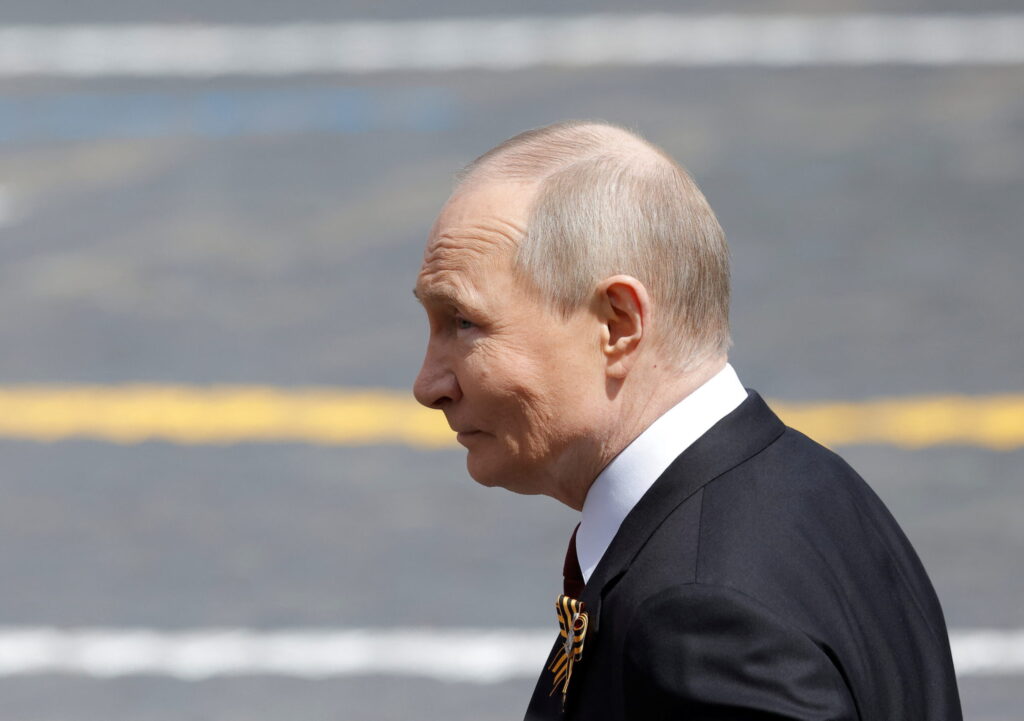
Russian President Vladimir Putin insists his invasion of Ukraine is going according to plan, but indications that all is not well are becoming increasingly difficult to disguise. While his army struggles to advance in Ukraine amid catastrophic casualties, the Ukrainians are bombing high-value targets deep inside Russia with alarming regularity. Concerns over the security of next week’s Victory Day parade in Moscow are now threatening to further embarrass the Kremlin dictator and reveal the reality behind his boasts of Russian military success.
For Putin, the annual Victory Day parade is no mere formality; it is the main event on the Kremlin calendar. This prominence reflects Putin’s efforts to revive Russian patriotism following the fall of the USSR and place the Soviet World War II experience at the heart of the country’s modern national identity.
During the Soviet era, Victory Day had not been the leading public holiday, with only four parades held between 1945 and 1991. Since the start of Putin’s reign, however, Victory Day has been elevated in status to the level of pseudo-religion, complete with its own saints, symbols, dogmas, and heretics. Indeed, it is no coincidence that enemies of the Kremlin are routinely branded as “Nazis.”
The Victory Day military parade on Red Square is the centerpiece of this entire approach. It has traditionally served as an opportunity for Russia to demonstrate its military might to the watching world, with Putin himself presiding over proceedings as the all-powerful ruler of a great nation.
Since 2022, the full-scale invasion of Ukraine has cast a long shadow over this spectacle. With Russia needing all available armor to replace heavy combat losses in Ukraine, finding enough vehicles for the parade has become increasingly challenging. In 2023, the Kremlin could only muster a single tank, sparking widespread mockery. “There are farmers in Ukraine with more Russian tanks than that,” quipped one internet wag.
This year’s parade is shaping up to be even more awkward. The Kremlin has already announced that due to the threat of Ukrainian drone and missile strikes, the event will proceed in a scaled back format without any tanks or military equipment whatsoever. Instead, the pageantry will be limited to columns of troops marching across Moscow’s central square. This dramatic downgrade represents a tacit admission by Putin that he can no longer ensure security in his own capital.
Stay updated
As the world watches the Russian invasion of Ukraine unfold, UkraineAlert delivers the best Atlantic Council expert insight and analysis on Ukraine twice a week directly to your inbox.
Downsizing his precious parade will have been particularly painful for Putin, but it has clearly not succeeded in entirely calming his nerves ahead of Victory Day celebrations on May 9. This week, the Russian ruler took the further step of telephoning US President Donald Trump in an apparent bid to enlist his help and secure a temporary ceasefire for the coming holiday. In a call initiated by the Russian side, Putin proposed pausing hostilities on Victory Day, presumably hoping his American counterpart would support the initiative and push Kyiv to agree.
So far, Ukraine has offered a lukewarm response. Ukrainian President Volodymyr Zelenskyy said he had asked colleagues to investigate the details of Russia’s proposal, but indicated that he had little interest in stunts aimed solely at safeguarding Putin’s propaganda parade. “We will clarify what exactly this is about: A few hours of security for a parade in Moscow, or something more. Our proposal is a long-term ceasefire, reliable and guaranteed security for people, and a lasting peace. Ukraine is ready to work toward this in any dignified and effective format,” the Ukrainian leader commented.
Eurasia Center events

Five years ago, the entire notion of Putin seeking American assistance to protect Moscow from Ukrainian attack would have seemed absurd. This humiliating turn of events will not have passed unnoticed inside Russia, where rumblings of dissent are already becoming more audible amid a grinding war, deteriorating economic outlook, and escalating government restrictions on internet access. Putin’s obvious inability to protect his own showpiece parade will now underscore perceptions that the regime is rapidly losing control of the narrative and has become trapped in a war it cannot win but dare not end.
All this is welcome news for Ukraine. Officials in Kyiv frequently complain that many of their Western counterparts have been much too cautious in their response to Putin’s invasion due to escalation fears that are rooted in exaggerated impressions of Russian military strength. This has consistently undercut international support for Ukraine, while also hampering efforts to impose meaningful costs on the Kremlin.
The Ukrainians will now be hoping that Putin’s parade problems can help highlight Moscow’s military limitations and embolden Kyiv’s Western partners to act with greater resolve. Russia is evidently struggling to cope with Ukraine’s strategic bombing campaign and is in a far weaker position than many international observers had previously imagined. With sufficient Western backing, Kyiv could build on this military momentum and increase the pressure on Putin to end his invasion.
Peter Dickinson is editor of the Atlantic Council’s UkraineAlert service.
Further reading
The views expressed in UkraineAlert are solely those of the authors and do not necessarily reflect the views of the Atlantic Council, its staff, or its supporters.

The Eurasia Center’s mission is to enhance transatlantic cooperation in promoting stability, democratic values, and prosperity in Eurasia, from Eastern Europe and Turkey in the West to the Caucasus, Russia, and Central Asia in the East.
Follow us on social media
and support our work
Image: Russian President Vladimir Putin leaves after a military parade on Victory Day, marking the 80th anniversary of the victory over Nazi Germany in World War Two, in Red Square in central Moscow, Russia, May 9, 2025. (REUTERS/Maxim Shemetov)