Atlantic Council blogs

Atlantic Council blogs provide short-form analyses from Council experts and a wider community of global voices on the world’s most important news stories.
View all
of our blogs
Subscribe to our
newsletters

Latest from across our blogs

New Atlanticist

Mar 29, 2011

A Long-Term Strategy for Libya and the Mediterranean: Over to the European Union

By Sven Biscop

Now that operations have started, all eyes are fixed on the military intervention in Libya. That can only be useful though in the context of a comprehensive political strategy for the country and the region. Crafting such a strategy is the role of the EU. Intervening in Libya is not evident. The operation is far […]

European Union International Organizations

New Atlanticist

Mar 29, 2011

Libya War: An Obama Doctrine?

By James Joyner

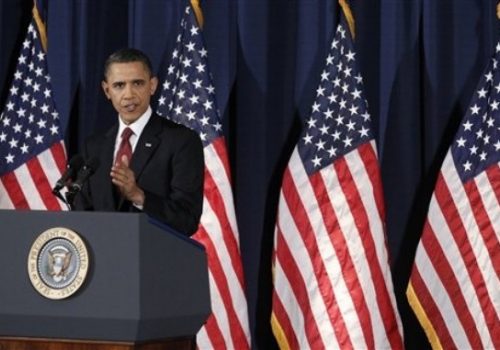
Ten days after sending American forces into kinetic military action in Libya, President Obama addressed the nation to explain "what we’ve done, what we plan to do, and why this matters to us."

NATOSource

Mar 29, 2011

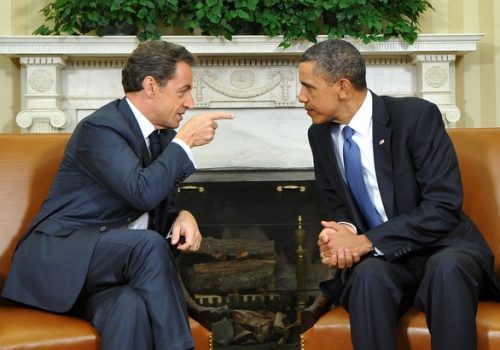
Did Obama threaten to withdraw from coalition?

By Anne Applebaum, the Washington Post

From Anne Applebaum, the Washington Post:  The French Socialist Party triumphed in local elections last weekend. The Libyan rebels triumphed in Brega and Ras Lanouf.

European Union International Organizations

NATOSource

Mar 29, 2011

US increases air assets and ground attacks in Libya operation

By Eric Schmitt, the New York Times

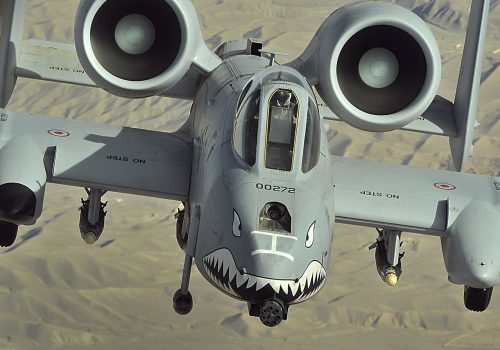
From Eric Schmitt, the New York Times:  In his speech on Monday night, Mr. Obama, as he has in the past, portrayed the mission as a limited one, and described the United States’ role as “supporting.” But interviews in recent days offer a fuller picture of American involvement, and show that it is far deeper […]

United States and Canada

New Atlanticist

Mar 29, 2011

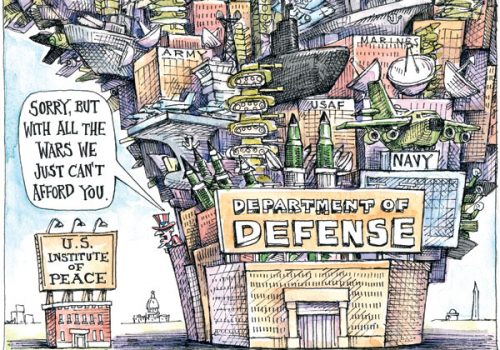
Cartoon: We Can’t Afford U.S. Institute of Peace With all the Wars

By James Joyner

In the above cartoon, Politico‘s Matt Wuerker illustrates the funding disparity between the U.S. Department of Defense and the U.S. Institute of Peace. Despite a budget of only $44 million, a small fraction of the costs of the Tomahawks fired by the U.S. in the first few hours of Operation Odyssey Dawn, there have been calls to eliminate USIP entirely. […]

New Atlanticist

Mar 28, 2011

NATO Libya Roundtable: Endgame?

By James Joyner

As NATO and its constituent states sort through the conflicting policy goals and logistics of the mission in Libya, some members of the Atlantic Council Strategic Advisors Group have offered some insights. What is the coalition’s endgame in Libya? There is considerable ambiguity about the ultimate endgame of coalition operations in Libya. The coalition military […]

New Atlanticist

Mar 28, 2011

NATO Libya Roundtable: A More Martial Europe?

By James Joyner

As NATO and its constituent states sort through the conflicting policy goals and logistics of the mission in Libya, some members of the Atlantic Council Strategic Advisors Group have offered some insights. From Bob Kagan’s "Power and Paradise" to Bob Gates’ February 2010 speech bemoaning the "demilitarization of Europe," American defense experts have long derided […]

New Atlanticist

Mar 28, 2011

NATO Libya Roundtable: Command and Control

By James Joyner

As NATO and its constituent states sort through the conflicting policy goals and logistics of the mission in Libya, some members of the Atlantic Council Strategic Advisors Group have offered some insights. NATO member states have struggled for days to resolve the debate within the Alliance about the proper role for NATO in the coalition […]

NATOSource

Mar 28, 2011

German ships rejoin NATO command, but not Libya operation

By DPA

From DPA:  Two German navy vessels in the Mediterranean are to be placed back under NATO command, a week after the military alliance became involved in the Libya conflict, a defence ministry spokesman said in Berlin Monday.

NATOSource

Mar 28, 2011

North Africa is Europe’s problem – not Obama’s

By the Editors of the Observer

From the Editors of the Observer:  Committees are sometimes the fairest way to decide policy; rarely, if ever, are they the most efficient. As a system for conducting wars, their shortcomings are obvious.

International Organizations Politics & Diplomacy