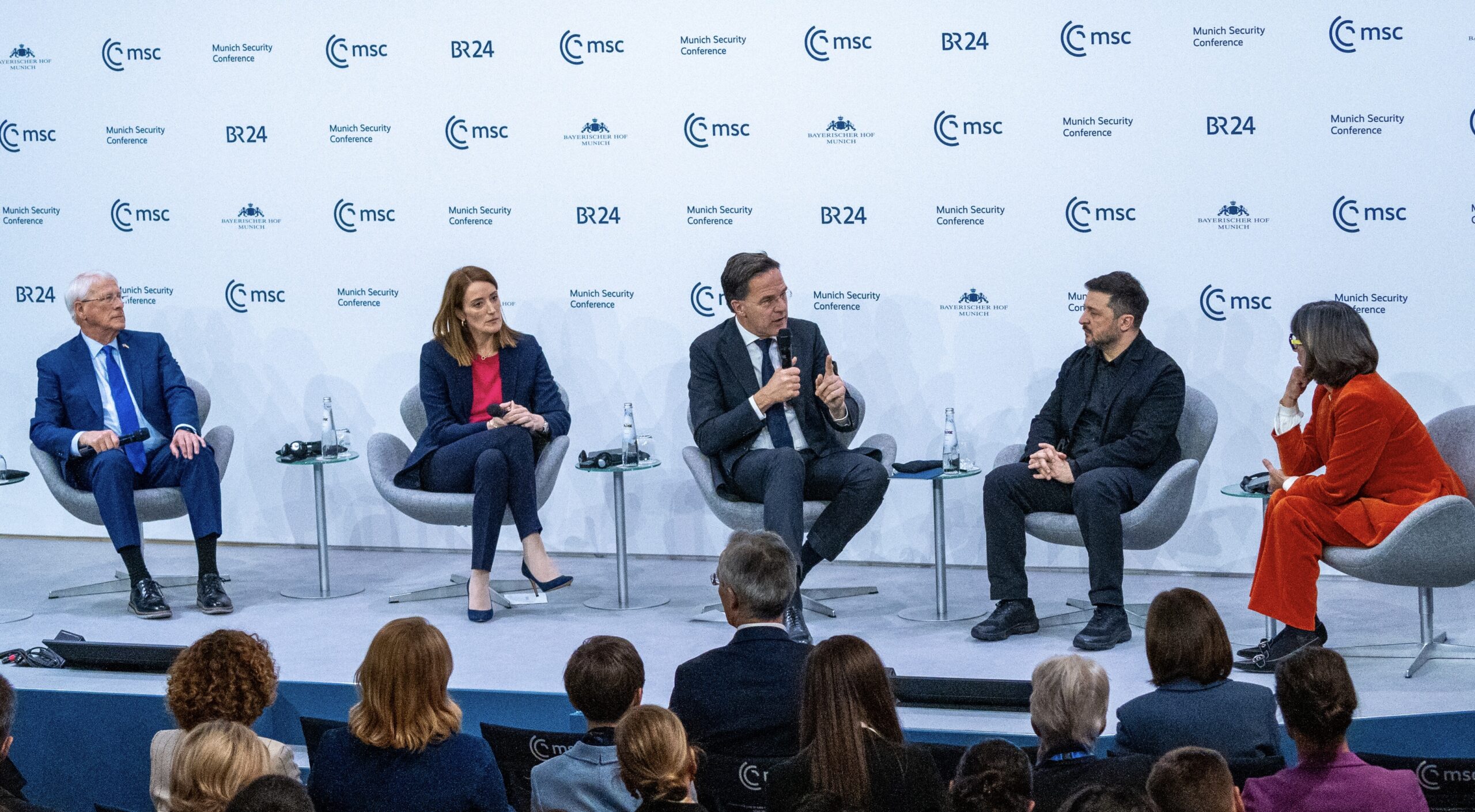
In Munich, a reminder that economic security is national security
MUNICH—A palpable shift took place at this year’s Munich Security Conference (MSC). While policymakers primarily focused on hard security challenges, as they have for more than sixty years here, they consistently raised economic security as an issue that they cannot cordon off separately from traditional defense and security issues.
On the main stage, NATO Secretary General Mark Rutte underscored that bringing an end to the war in Ukraine will require sending more arms support to Ukraine and also placing sustained economic pressure on Russia. He highlighted the need to address China’s evasion of Western sanctions and its role in sustaining Russia’s wartime economy. The message was clear: Military resilience and economic pressure are two sides of the same coin.
The leaders gathering at MSC also discussed trade, highlighting how trade deals and tariffs have become geopolitical instruments. US Senator Thom Tillis (R-NC) argued that trade policy and national security are deeply intertwined, warning that if the United States creates an untenable trade environment for smaller economies, it risks driving them toward malign actors such as China and Russia. Economic policy, in other words, can either reinforce alliances or fracture them.
German Chancellor Friedrich Merz echoed this concern, pointing to the erosion of multilateralism. He warned that the world has entered an era defined by great-power politics above all else, and that in such an environment, some countries are increasingly deploying natural resources, technologies, and supply chains as bargaining tools. Smaller economies, he argued, must coordinate more closely to avoid being squeezed in the crossfire. In a world in which some weaponize economic interdependence, economic unity becomes a form of defense.
This convergence of economics and security was on display not only in Munich but also weeks earlier in Davos. The World Economic Forum has traditionally been a platform to discuss markets, business, and the state of the global economy, and while this continues to be the case, these conversations now require more consideration for geopolitical issues, which increasingly play a role in shaping markets. For example, US President Donald Trump’s remarks about Greenland, and the tariffs he placed on Europe, stole much of the spotlight, as did Canadian Prime Minister Mark Carney when he called on middle powers to band together in the face of coercive economic practices.
Geopolitical challenges are increasingly being tackled in the economic domain. Governments are deploying instruments of economic power and coercion such as sanctions, export controls, investment screening, tariffs, and control over critical mineral supply chains to confront adversaries. Governments are also using economic tools on allies and partners to create leverage in negotiating favorable trade agreements. The use of these tools has required governments to reflect on their longstanding geopolitical relationships and consider how and with whom they will need to work to defend their economic sovereignty and security.
In this moment, smaller trade-dependent economies will need to build coalitions among like-minded partners to preserve the multilateral institutions that maximize their agency. To avoid any vulnerability to coercion by larger powers, these smaller trade-dependent economies will need to invest in their collective resilience by diversifying their supply chains, coordinating sanctions, codifying shared standards, and forming trusted technology partnerships.
Additionally, countries will need to address persistent trade imbalances and perceived inequities in burden-sharing within alliances. If left unaddressed, these imbalances and inequities will continue to drive decision-making that prioritizes short-term economic leverage instead of long-term economic security strategies. Such strategies require sustained alignment between economic and security objectives, not episodic reactions to crisis.
Governments cannot meet the challenge of building economic resilience alone, since it is built in markets, supply chains, capital flows, and innovation ecosystems. As economic tools become central to foreign policy, the private sector increasingly sits at the tip of the spear of national security, implementing export controls, monitoring sanctions compliance, reconfiguring supply chains, and making investment decisions.
Our team at the Atlantic Council’s Economic Statecraft Initiative, in partnership with the United Kingdom House of Commons’ Business and Trade Committee, convened policymakers and business leaders in Munich in a discussion that illuminated the need to redesign globalization in this age of strategic competition, where the line between boardroom decisions and national security outcomes is increasingly blurring.
Economic security will depend on the private sector’s ability to implement governments’ foreign policy decisions, making a new level of public-private partnership essential. Governments must clearly communicate the rationale behind deploying economic tools and provide the private sector with consistent, clear, and sustainable guidance and signals through enhanced public-private partnerships and dialogue. Information sharing related to national security risks will also be vital. Furthermore, governments should seek out and incorporate private sector feedback into their foreign policy decisions to mitigate against unintended consequences in the economic domain.
The MSC has long been the premier forum for confronting hard security questions. This year’s convening made clear that economic security belongs squarely in that category. Thus, at future MSCs, expect to see more and more finance ministers, trade negotiators, sanctions envoys, and business leaders roaming the streets of Munich.
Kimberly Donovan is director of the Economic Statecraft Initiative within the Atlantic Council’s GeoEconomics Center. She is a former senior Treasury official and National Security Council director.
Lize de Kruijf is a program assistant at the Atlantic Council’s Economic Statecraft Initiative within the GeoEconomics Center.
Housed within the GeoEconomics Center, the Economic Statecraft Initiative (ESI) publishes leading-edge research and analysis on sanctions and the use of economic power to achieve foreign policy objectives and protect national security interests.
Further reading
Thu, Apr 17, 2025
Russia Sanctions Database
Econographics By Kimberly Donovan, Maia Nikoladze, Lize de Kruijf
The Atlantic Council’s Russia Sanctions Database tracks the level of coordination among Western allies in sanctioning Russian entities, individuals, vessels, and aircraft, and shows where gaps still remain.

Tue, Sep 16, 2025
The Supreme Court’s decision on Trump tariffs will have lasting impact on US economic statecraft
Econographics By
Regardless of how the Supreme Court rules, the case will shape US economic policy for years to come.
Thu, Mar 27, 2025
Canada needs an economic statecraft strategy to address its vulnerabilities
Issue Brief By Kimberly Donovan, Maia Nikoladze, Lize de Kruijf
To address threats from Russia and China and reduce trade overdependence on the United States, Canada’s federal government will need to consolidate economic power and devise an economic statecraft strategy that will leverage Canada’s economic tools to mitigate economic threats and vulnerabilities.
Image: The 2026 Munich Security Conference takes place at the Hotel Bayerischer Hof in Munich, with a panel featuring Ukrainian President Volodymyr Zelenskyy, NATO Secretary General Mark Rutte European Parliament President Roberta Metsola, and US Senator Roger Wicker. Photo by Michael Bihlmayer/ddp via Reuters.