
While the Middle East is embroiled in its most perilous crisis in decades, Turkey is trying to position itself as an indispensable stabilizer in a region that cannot afford Iran’s total collapse. At first glance, Turkey’s ambition may surprise those who view the country as a foreign policy problem to be managed rather than a partner in managing problems. But as US President Donald Trump searches for a way to exit the US-Israeli war against Iran, a new geopolitical reality may be emerging: one in which Turkey could be a useful mediator between the warring parties.
Ankara’s self-image: Peacemaker and stabilizer
For years, the government of Turkish President Recep Tayyip Erdoğan has consistently described Turkey’s role in the world as providing moral and strategic leadership, seeking peace and stability in its region and beyond. As tensions between the United States and Iran escalated earlier this year, Erdoğan underscored Turkey’s readiness to mediate between the two countries. Indeed, Turkish Foreign Minister Hakan Fidan, hosted Iranian Foreign Minister Abbas Araghchi in Istanbul in late February. Since the war began, Fidan has echoed this sentiment throughout his intensive engagement with Gulf leaders, asserting that Turkey’s unique ability to talk to all parties is a strategic asset that can prevent regional contagion and foster long-term stability.
Fidan’s goal is clear: a “regional ownership” of security that prevents the Middle East from becoming a permanent playground for external military escalations. In the run-up to the US invasion of Iraq in 2003, Turkish officials pleaded with Washington not to attack without a detailed and workable plan to stabilize the country after its military was defeated. Today, Turkey is eager to prevent another cauldron of chaos from emerging on its southern border, this time in a country that is larger, militarily stronger, and more politically and ethnically complex than Saddam Hussein’s Iraq. Ankara’s successes so far in its efforts to help stabilize post-Assad Syria have provided Turkish leaders with a new confidence that the country can similarly reduce regional tensions by helping to mediate an end to the war in Iran.
Diplomatic dissonance in the Mediterranean
This vision of Turkey as a regional stabilizer sharply contradicts conventional wisdom across much of Europe. In Athens in particular, memories of the 2020 tensions in the Eastern Mediterranean remain vivid. At that time, Turkish Navy warships accompanied a seismic survey ship of Turkey’s national oil company, TPAO, as it searched for oil and natural gas in waters that both Turkey and Greece claim as part of their exclusive economic zones. Tensions peaked in August 2020, when a Turkish and Greek warship collided near Crete. Recent months have seen a resurgence of pointed rhetoric over the countries’ maritime claims. Senior Greek officials have expressed deep skepticism regarding Ankara’s ambitions, with Greek Defense Minister Nikos Dendias early last month stating that Turkey’s “revisionist agenda” remains a threat to Aegean stability. Greek leadership has specifically raised alarms over Turkey’s rapidly expanding defense industrial sector and its “Blue Homeland” (Mavi Vatan) naval doctrine, which calls for Turkey to defend its interpretation of international law on maritime borders and exclusive economic zones. For Greece, Turkey’s strong military is viewed less as a tool for regional peace and more as a mechanism for coercive diplomacy that continues to challenge Greek and Greek Cypriot sovereignty.
The rhetorical attacks have been even sharper between Turkey and Israel, posing a potentially serious challenge to Ankara’s mediation ambitions. Erdoğan and Israeli Prime Minister Benjamin Netanyahu have regularly accused each other of crimes against humanity.
Growing support for Turkish mediation elsewhere
Despite the reservations of Greece and Israel, interest in Turkish mediation is growing elsewhere. On March 1, European Commission President Ursula von der Leyen stated in a social media post that she welcomes Turkey’s “readiness to mediate and support a resolution” to the Iran war “through peaceful means.” Pakistan, along with Turkey, Saudi Arabia, and Egypt, have now taken the lead in relaying messages between the warring parties in the hope of containing regional chaos.
Most importantly, US support for Turkish mediation also seems to be growing. A key factor is the personal rapport between the US and Turkish presidents. US President Donald Trump has frequently praised Erdoğan, describing him in October 2019 as a “hell of a leader” and a “tough man who deserves respect.” More recently, when asked whether Erdoğan could play a useful mediation role between Ukraine and Russia in October 2025, Trump replied, “Yeah, Erdoğan can. He’s respected by Russia, Ukraine. I can’t tell you about it, but he is respected by the world. And he’s a friend of mine.”
Ankara has indeed taken a balanced approach toward Kyiv and Moscow. On the one hand, Turkey has sustained military-technical cooperation with Ukraine throughout Russia’s invasion and steadfastly supported its territorial integrity. Turkey also prevented Russia from reinforcing its Black Sea Fleet via the Turkish Straits in accord with the Montreux Convention of 1936. On the other hand, Turkey has refused to join sanctions against Russia and Erdoğan has maintained a robust communication line with Russian President Vladimir Putin. This evenhanded positioning allowed Turkey to broker, together with the United Nations, the July 2022 agreement between Ukraine and Russia on grain exports via the Black Sea.
Turkey’s behind-the-scenes mediation was also crucial to securing the release of hostages from Gaza in late 2023. While the world focused on Qatar’s high-profile mediation, Ankara quietly leveraged its long-standing relations with Hamas’s political bureau, (a relationship that had irritated both Israel and the United States for years), to facilitate the release of more than twenty Thai agricultural workers who were not part of the primary prisoner-exchange deals negotiated by the United States, Qatar, and Egypt. Hamas credited Turkish mediation with securing the deal.
At the time, then US President Joe Biden made no mention of Erdoğan’s role in securing the Thai hostages’ release, instead crediting trilateral efforts by Washington, Doha, and Cairo. Trump has been more willing to publicly credit Turkey’s mediation role in the Israel-Hamas war. While announcing his twenty-point plan to end the Gaza conflict in October 2025, Trump stated, “President Erdoğan was fantastic. He really helped a lot, because he’s very respected.”
US embraces Turkey’s mediation
Trump’s appreciation for Turkey’s mediation seems sufficiently strong to have prompted his administration to drop the criminal case against Halkbank, a major Turkish state-owned bank. The bank was awaiting a multibillion-dollar fine after its 2019 indictment for money laundering over illicit gold shipments to Iran. Had the United States imposed the fine, Halkbank could have collapsed, possibly sparking a crisis across Turkey’s banking system. For years, the Turkish government argued that Halkbank enjoyed sovereign immunity and the case should be dropped, but as recently as October 2025, the Trump administration refused to express support to the US Supreme Court for Halkbank’s appeal that the case be dropped.
Then on March 6, the US Department of Justice (DOJ) requested that Judge Richard Berman drop the case, citing “extraordinary national security and foreign policy considerations.” The DOJ’s main justification was that Turkey’s assistance was “critical to securing the ceasefire agreement and Hamas’s release of the hostages” that the Trump administration brokered in early 2025.
The timing of the Trump administration’s reversal on the Halkbank case may be telling. Coming a week after the United States and Israel launched their attacks on Iran, Washington’s move may suggest that Trump foresees a role for Turkish mediation in the war. While Netanyahu may balk, Trump may find Ankara’s record of mediation too successful to resist. And indeed, Ankara has already begun playing that mediation role in concert with Pakistan, Saudia Arabia, and Egypt.
Matthew Bryza is a nonresident fellow with the Atlantic Council’s Turkey Program.
The views expressed in TURKEYSource are solely those of the authors and do not necessarily reflect the views of the Atlantic Council, its staff, or its supporters.
Further reading
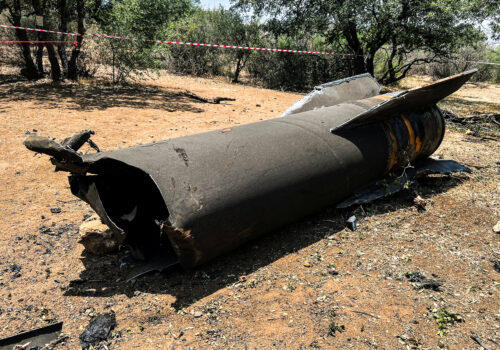
Thu, Mar 26, 2026
What Iran’s attacks on Turkey reveal about NATO’s future
TURKEYSource By
Turkey’s recent missile incidents reveal something important about NATO’s future and what the Alliance will need to do to maintain its credibility.
Wed, Mar 18, 2026
The unspoken yet growing synergy in Turkey–Spain relations
TURKEYSource By
Spanish-Turkish defense cooperation could help normalize Turkey as a security actor within the Euro-Atlantic perimeter.
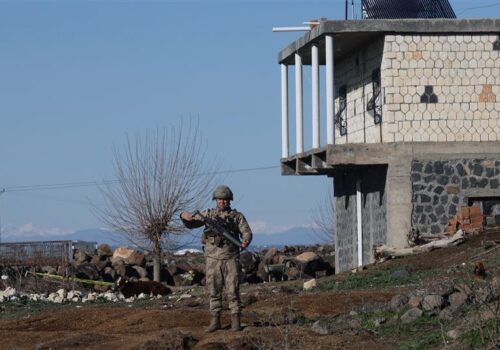
Thu, Mar 12, 2026
Turkey has weathered regional instability before. But the war in Iran poses greater risks to Ankara than past conflicts.
TURKEYSource By Grady Wilson
Turkey is seeking to limit fallout from the US and Israeli war against Iran but threats to national security increasingly threaten its position.
Image: Foreign Ministers Badr Abdelatty of Egypt, Prince Faisal bin Farhan Al Saud of Saudi Arabia, Ishaq Dar of Pakistan and Hakan Fidan of Turkey meet to discuss regional de-escalation, amid the U.S.-Israel conflict with Iran, in Islamabad, Pakistan, March 29, 2026. Muammer Tan/Turkish Foreign MinistryHandout via REUTERS ATTENTION EDITORS - THIS PICTURE WAS PROVIDED BY A THIRD PARTY. NO RESALES. NO ARCHIVES.