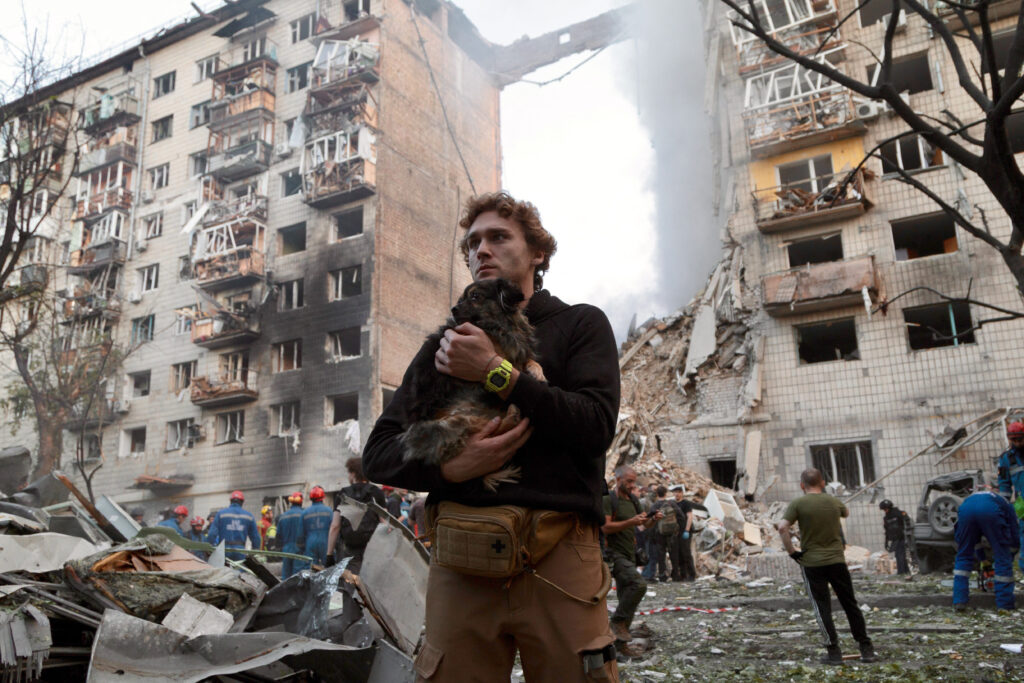
As the world marks the fourth anniversary of Vladimir Putin’s full-scale Ukraine invasion this week, we can expect to see plenty of praise in the international media for the remarkable resilience of the Ukrainian people. This is thoroughly deserved. After all, whether we’re talking about holding back one of the world’s most powerful armies or maintaining a semblance of normality amid the largest European invasion since World War II, Ukraine has undoubtedly surpassed all expectations.
Nevertheless, there are many in Ukraine who no longer welcome the whole resilience narrative that has taken shape over the past four years. Critics argue that it creates unrealistic expectations while crediting the Ukrainian population with superpowers they do not possess. At a time when Ukraine desperately needs more international support, they warn that endless upbeat talk of Ukrainian resilience risks distracting from the urgency of the situation. At worst, it can serve as a substitute for action or an excuse to do nothing.
Rather than mythologizing Ukrainian resilience, international audiences should be asking themselves what drives this incredible durability and determination. Where do millions of Ukrainians find the strength to carry on amid barely imaginable hardships and trauma? The short answer is that Putin has given them no other choice.
Stay updated
As the world watches the Russian invasion of Ukraine unfold, UkraineAlert delivers the best Atlantic Council expert insight and analysis on Ukraine twice a week directly to your inbox.
Even before the Russian invasion of Ukraine began with the 2014 seizure of Crimea, Putin was well known for questioning Ukraine’s right to exist as an independent state. Recently declassified transcripts show that in 2008, the Russian leader told US President George W. Bush that Ukraine was an “artificial country.” He was also notorious for promoting an unashamedly imperialistic version of Ukrainian history and insisting that Ukrainians were actually Russians (“one people”).
These trends intensified following the start of Russia’s armed intervention, with Putin becoming openly dismissive of Ukraine’s legitimacy and laying claim to Ukrainian territory. In summer 2021, he took the highly unusual step of publishing a 5000-word history essay that read like a declaration of war against Ukrainian statehood. At around the same time, the Kremlin dictator began referring ominously to independent Ukraine as an “anti-Russia.”
Meanwhile, Putin’s formidable propaganda machine was busy demonizing and dehumanizing Ukrainians. Anyone who rejected the official Kremlin vision of Ukraine as an “inalienable” part of Russia’s own history, culture, and spiritual space was depicted as a Nazi and a traitor. This extreme anti-Ukrainian rhetoric set the stage for the crimes committed following the onset of the full-scale invasion in February 2022.
Eurasia Center events

The horrors of the past four years have gone far beyond the death and destruction associated with conventional armed conflicts. In areas of Ukraine currently under Kremlin control, the Russian occupation authorities have launched a campaign of national destruction and set out to completely erase all traces of Ukrainian culture, history, language, and identity. Untold thousands have been detained in waves of arrests that United Nations investigators have branded as a crime against humanity.
Those who remain are being subjected to ruthless russification encompassing virtually every aspect of daily life. Anyone who refuses to accept Russian citizenship faces the prospect of deportation from their own homes. Military age men are liable to be conscripted into the Russian army and obliged to fight against their fellow Ukrainians.
Perhaps the single most shocking Russian war crime committed in occupied Ukraine has been the mass abduction of children, who are sent to Russia for indoctrination in order to rob them of their Ukrainian heritage and impose an imperial Russian identity. In 2023, the International Criminal Court in The Hague issued an arrest warrant for Putin in connection with Russia’s large-scale child kidnapping campaign.
These crimes have taken place against a backdrop of genocidal language that is now a routine feature of Russia’s political and media discourse. Kremlin officials and propagandists frequently call for the liquidation of Ukraine and indicate that they intend to extinguish Ukrainian national identity completely. Based on the crimes taking place in Ukraine and the intent on display in Moscow, numerous international experts have concluded that the Russian invasion qualifies as an act of genocide.
Ukrainians are acutely aware of Russia’s genocidal objectives. They know what is happening in the occupied regions of their own country, and are all too familiar with the sickening propaganda emanating from the Kremlin. This awareness is a crucial factor fueling the phenomenon of Ukrainian resilience. Far from being comic book heroes, most Ukrainians are ordinary folk who recognize that if they stop resisting, their country will not survive.
Since 2022, Ukraine’s bravery has captured the imagination of the watching world. But as we marvel at the courage of a nation defying seemingly impossible odds, it is crucial to also act accordingly by increasing international support for the Ukrainian war effort. Too often, vocal cheerleading in Western capitals has not translated into robust backing. This only emboldens Russia and prolongs the war.
As Putin’s invasion enters a fifth year, it is now abundantly clear that Russia aims to destroy Ukraine as a state and as a nation. Ukrainian resilience alone will not be enough to prevent this catastrophe. If Kyiv’s partners fall short, the applause of the past four years will ring very hollow indeed.
Peter Dickinson is editor of the Atlantic Council’s UkraineAlert service.
Further reading
The views expressed in UkraineAlert are solely those of the authors and do not necessarily reflect the views of the Atlantic Council, its staff, or its supporters.

The Eurasia Center’s mission is to enhance transatlantic cooperation in promoting stability, democratic values, and prosperity in Eurasia, from Eastern Europe and Turkey in the West to the Caucasus, Russia, and Central Asia in the East.
Follow us on social media
and support our work
Image: A man holds his dog in front of a bomb-damaged residential building in the Solomianskyi district, where a Russian missile strike caused a section to collapse, Kyiv, Ukraine, on June 17, 202. (Photo by Kyrylo Chubotin/Ukrinform/ABACAPRESS.COM)