Featured analysis

Latest analysis

Econographics

Nov 11, 2022

The target of limiting global warming to less than 1.5 degrees is practically dead. Why do emissions per capita matter?

By Amin Mohseni-Cheraghlou

Achieving the target to limit global warming to below 2, preferably 1.5 degrees Celsius, by the end of the century seems more unfeasible than ever. The reason is simple. The most critical of greenhouse gases have continuously risen in the past decade and CO2 emissions are only expected to grow more in 2022 and for the foreseeable future. COP27 needs to pave the path for a renewed international cooperative and enforceable framework to reduce global greenhouse gas emissions by the world’s top emitters both in absolute terms and in per capita terms.

Climate Change & Climate Action
Economy & Business

Econographics

Nov 8, 2022

What US outbound investment screening means for Transatlantic relations

By Elmar Hellendoorn

Whether the EU follows through with new outbound investment controls and what those might look like will also depend on the evolution of American national security policy and transatlantic diplomacy.

China
Economy & Business

Econographics

Oct 31, 2022

The global infrastructure financing gap: Where sovereign wealth funds and pension funds can play a role

By Amin Mohseni-Cheraghlou and Naomi Aladekoba

Having more than $65 trillion in assets, institutional investors such as SWFs and pension funds are uniquely positioned to bridge low-income economies’ infrastructure financing gap in the coming decades. The Bretton Woods Institutions (BWI) can encourage investment in developing countries’ infrastructure through providing various guarantee and insurance mechanisms, thereby reducing risk for private investors.

Economy & Business
Inclusive Growth

EconoGraphics

Oct 28, 2022

How the US compares to the world on unionization

By Jeff Goldstein

Explore how US unionization rates compare to other economies and what that means for US labor markets going forward.

Economy & Business
Inclusive Growth

EconoGraphics

Oct 24, 2022

Dual circulation in China: A progress report

By Hung Tran

Faced with a challenging international environment and hostile efforts by the United States to restrict China’s access to high technology and its products, China has adopted a dual circulation strategy to make its economy more balanced and resilient. Dual circulation means reducing the role of foreign trade in driving the Chinese economy while improving the quality of trade.

China
Economy & Business

Econographics

Oct 12, 2022

Companies on the front line: Trends in overseas Chinese listings

By Maia Nikoladze

Delisting more than 150 Chinese companies is a bigger hit than Chinese private sector can take at this time. However, we don’t yet know whether Beijing will follow through on its side of the audit-sharing deal. 

China
Economy & Business

Econographics

Sep 8, 2022

Global Sanctions Dashboard: Sanctioning soars across the board

By Charles Lichfield, Maia Nikoladze, and Castellum.AI

Iran nuclear deal negotiations; Russia’s domestic sanctions against terrorism and extremism; Latin America drug trafficking sanctions.

Europe & Eurasia
European Union

Econographics

Sep 8, 2022

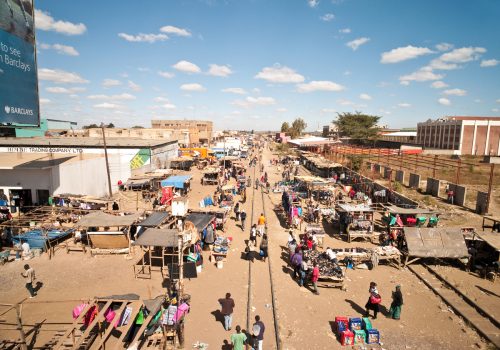
Zambia: A template for debt restructuring?

By Hung Tran

Zambia shows that progress can be made to render the Common Framework more workable. However, more needs to be done to refine a comprehensive, efficient, and effective sovereign debt restructuring procedure.

Africa
China
Dollar Currency Exchange rate

Econographics

Sep 7, 2022

Don’t expect a Plaza Accord 2.0 to reverse the dollar’s surge

By Mrugank Bhusari

Neither China, nor the original participants of the Plaza Accord, are willing to engage in such market intervention to return a soaring dollar to normal levels.

China
Economy & Business

Econographics

Aug 25, 2022

Delisting Chinese companies from the New York Stock Exchange: Signs of decoupling

By Hung Tran

China’s decision to delist five companies from the NYSE is motivated by its unwillingness to comply with US regulations.

China
Economy & Business

Content

EconoGraphics

May 8, 2020

US States’ Covid-19 Response – Short-Term Pain = Long-Term Gain?

By Ole Moehr | Graphics by Nikolai Albishausen and William Bonney

This edition of the EconoGraphic compares Covid-19’s impact with previous economic shocks, presents data on how public health restrictions influenced economic recoveries during the Spanish Flu, and contrasts US states’ reopening decisions with unemployment trends across the country.

Economy & Business
Macroeconomics

EconoGraphics

Apr 1, 2020

Coronavirus versus financial crisis: US policy responses compared

By Ole Moehr | Graphics by Nikolai Albishausen

A look at the economic harm done so far and contrasts the measures taken by the Federal Reserve (Fed), Congress, and the G20 in response to coronavirus.

Economy & Business
Macroeconomics

EconoGraphics

Aug 28, 2019

US-EU Auto Tariffs: What’s at Stake?

By OLE MOEHR | GRAPHICS BY MARIANNA ASLUND, NICK BROWN, ANDREW LASCALEIA

Escalating trade tensions between the world’s major economies are widely considered the greatest threat to the global economy’s health. Following the White House’s cancellation of its threatened tariffs on all Mexican imports on June 7, attention swiftly turned back to the brewing US-China trade war. This edition of the EconoGraphic, however, puts the focus on how US tariffs on cars and car parts might disrupt transatlantic trade flow.

Economy & Business
European Union

EconoGraphics

Aug 9, 2019

Breaking Down France’s Digital Tax

By BY ANDREW LASCALEIA, EDITED BY OLE MOEHR | GRAPHICS BY MARIANNA ASLUND AND ANDREW LASCALEIA

In July, France’s parliament ratified a new law to tax big digital tech firms making it the first country to pass a tax law of this manner. Paris’ new tax scheme triggered criticism from the Trump Administration and is further complicating the transatlantic relationship. This edition of the EconoGraphic explains the motivation behind taxing digital technology firms more aggressively, the way that the French tax will work, and the potential impacts and response to the tax.

Economy & Business
Financial Regulation

EconoGraphics

Jul 23, 2019

My Way or the Huawei: 5G at the Center of US-China Strategic Competition

By OLE MOEHR | GRAPHICS BY MARIANNA ASLUND, NICK BROWN, ANDREW LASCALEIA

On July 22, President Trump met with a group of major tech CEOs to discuss the easing of some restrictions on US companies supplying high-tech parts to Chinese telecommunications company Huawei. In May, the US Commerce Department banned US companies from selling any products to Huawei. The Chinese company’s position as the world’s leading provider of 5G technology has made it a focal point of the escalating great power competition between China and the United States. This edition of the EconoGraphic explains the US government’s move to blacklist Huawei, outlines the ban’s potential costs, and describes why US allies are conflicted about banning Huawei.
China
Economy & Business

EconoGraphics

Jun 3, 2019

US Cuba policy: EU and Canadian firms to suffer?

By BY OLE MOEHR | GRAPHICS BY SHIQING HUA, FRANCIS AUBEE, AND NICK BROWN

On April 17 2019, US Secretary of State Michael Pompeo announced an important change in the United States’ policy toward Cuba: Title III of the Cuban Liberty and Democracy Solidarity Act of 1996 (LIBERTAD Act) would no longer be suspended. As a result of this decision, US claimants can now seek compensation for property confiscated by the Castro government. The move has important implications for US and foreign companies doing business in Cuba. This edition of the EconoGraphic explains the history and purpose of the LIBERTAD Act, evaluates the policy’s potential impact on US allies’ economic interests in Cuba, and highlights its implications for the pressure campaign against the Maduro regime in Venezuela.

Cuba
Economy & Business

EconoGraphics

Apr 29, 2019

Central Bank Independence Under Scrutiny

By Ole Moehr | Graphics by Shiqing Hua and Francis Aubee

On April 26, following stronger than expected US economic growth numbers, the White House’s National Economic Council director, Larry Kudlow, urged the Federal Reserve (Fed) to cut interest rates by 50 basis points.

Economy & Business
Financial Regulation

EconoGraphics

Feb 6, 2019

A Breakdown of the Sanctions Deal between the United States and Oleg Deripaska

By Ole Moehr | Graphics by Shiqing Hua and Zachary Coles

On January 16, a US Senate resolution to maintain US sanctions on the Russian aluminum giant RUSAL and its holding company EN+ failed to garner the necessary 60 votes to pass. As a result, the Trump administration lifted its economic sanctions on RUSAL and EN+ on January 27.

Economy & Business
Financial Sanctions and Economic Coercion

Blogs

Dec 21, 2018

Economic Outlook for 2019

By Global Business & Economics Program

December 2018 is set to become the worst year-end finish for US markets since 1931. A yield curve inversion combined with the fourth annual rate hike by the US Federal Reserve (Fed) and growing geo-political uncertainty, triggered widespread angst among US investors about an economic slowdown and the increasing probability of a recession. This edition of the EconoGraphic assesses key economic indicators to make a case that while a slowing of the US economy seems certain, a recession in the next two years remains unlikely.

China
Economy & Business

EconoGraphics

Dec 5, 2018

Trade Disrupted: US and China Need More Than a Truce

By Ole Moehr

At this year’s G20 summit in Buenos Aires, the trade dispute between China and the United States took center stage. Chinese President Xi and his US counterpart President Donald Trump agreed to avoid further escalations of the ongoing bilateral trade war for the next 90 days. The temporary deal does not assuage the escalatory measures already taken, leaving the existing tariffs in place. This edition of the EconoGraphic explores how the brewing trade conflict is impacting manufacturing supply chains, soybean cargo routes, and trade flows of liquefied petroleum gas (LPG) among the United States, China, and the rest of the world.

China
Economy & Business