Featured analysis

Latest analysis

Econographics

Aug 16, 2022

US climate spending may soon match that of developed peers

By Sophia Busch, Carrie Hsu

Now that the US has passed the Inflation Reduction Act, its spending commitments on climate adaption and mitigation may match those for the UK and EU through 2025.

Economy & Business
United Kingdom

Econographics

Aug 12, 2022

Summer reading list: Future of money edition

By Ananya Kumar

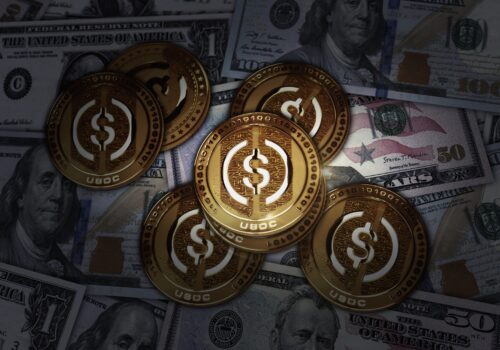
These are our top picks for your summer reading list on the future of money: everything from trying to understand the news better to what’s next in the world of innovation.

Digital Currencies
Digital Policy

Econographics

Aug 3, 2022

Trading geopolitics: The US-Chinese capital markets

By Elmar Hellendoorn

Increased Chinese-Western capital market integration is just one scenario. Instead, ”strong decoupling” or “muddling through” may prove more likely.

China
Economy & Business

Econographics

Aug 2, 2022

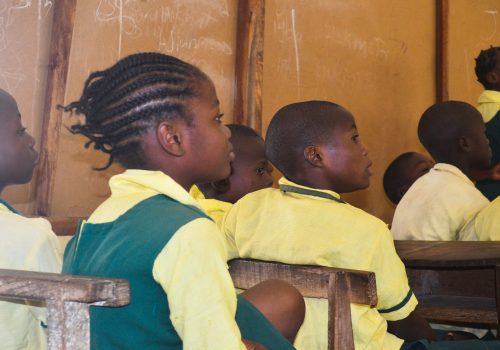
The global slowdown: Why Sub-Saharan Africa is so important

By Amin Mohseni-Cheraghlou and Naomi Aladekoba

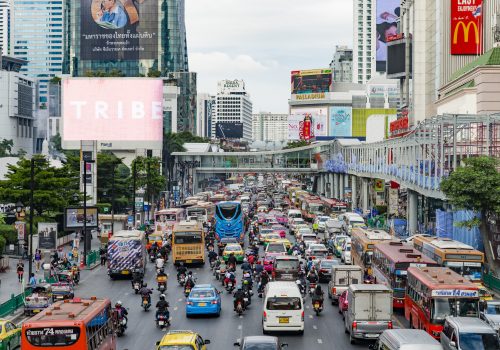
The global community, with the leadership of the IMF and the World Bank, needs to focus on Sub-Saharan Africa. While the population in countries that have moved into the high-income and upper middle-income categories are now aging rapidly, Sub-Saharan Africa is home to one of the world’s youngest population structure. In addition to lifting hundreds of millions of people out of poverty in this region, sustained and inclusive growth over the next two decades in Sub-Saharan Africa could contribute to the growth in the global economy.

Africa
Economy & Business

Econographics

Jul 28, 2022

Keeping everyone in the club: How sanctions complicate the Bretton Woods Institutions’ job

By Mrugank Bhusari, Maia Nikoladze, Amin Mohseni-Cheraghlou

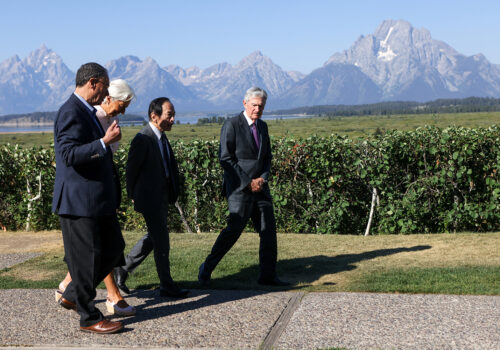
With a voting majority at the Bretton Woods Institutions, the G7 and EU can collectively ask the institutions to comply with their sanctions. This is complicating the IMF and World Bank’s functions.

Economic Sanctions
Economy & Business

Econographics

Jul 28, 2022

When does an economy enter recession?

By Charles Lichfield, Sophia Busch

US GDP growth was negative for two consecutive quarters, fulfilling textbook definitions of a recession. Regardless of definition, this period of contraction is different from previous periods with a much tighter labor market.

Economy & Business
International Markets

Econographics

Jul 26, 2022

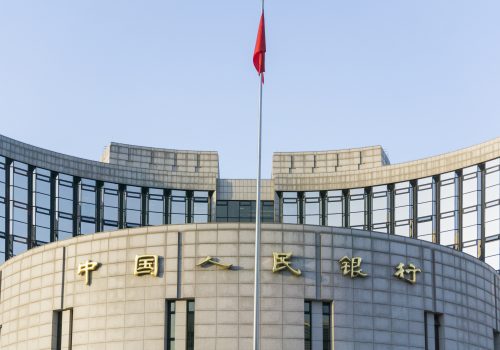
Slow growth exacerbates China’s financial stability risks

By Hung Tran

China’s slowing growth, if left unchecked, will threaten its small- and medium-sized banks. This “Achilles’ heel” of its banking system will be further weakened by spreading problems in the property sector.

China
Economy & Business

Econographics

Jul 14, 2022

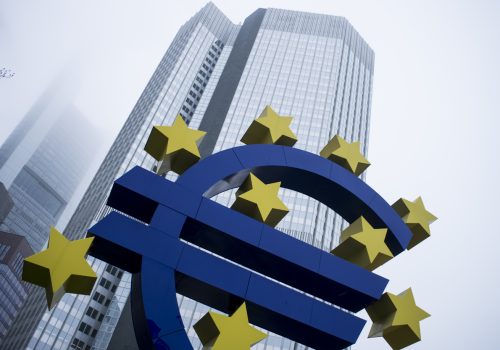
The Euro at parity with the USD: Implications for the global economy

By Hung Tran

The difficult challenges facing the Euro Area and actions taken to calm inflation in the US make it difficult for the EA and other countries to undertake their own policy measures to counter the looming stagflation and recession threats.

Economy & Business
Europe & Eurasia

Econographics

Jul 13, 2022

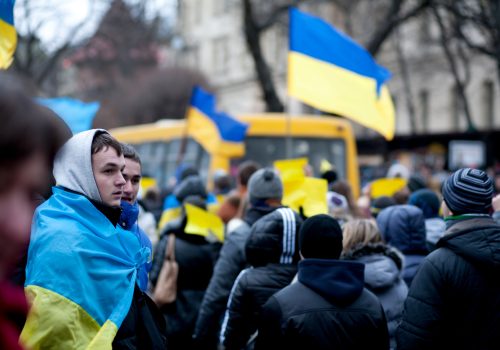
Ukraine needs more international support

By Hung Tran and Charles Dallara

As the war in Ukraine becomes severely protracted, the international community by advancing Ukraine’s proposed roadmap to end the war and clarifying its economic policies in response to Russian aggression.

Economic Sanctions
Economy & Business

Econographics

Jul 13, 2022

Emerging markets need new engines of growth

By Niels Graham

External tailwinds such as trade, interest rates, and commodity prices propelled emerging market growth throughout the 2000s. However, as the global macroeconomic backdrop shifts these conditions are increasingly becoming headwind risks.

Economy & Business
Macroeconomics

Content

EconoGraphics

Feb 6, 2018

Secondary Sanctions: A First Glance

By Ole Moehr

This edition of our EconoGraphic blog explains the difference between primary and secondary sanctions, outlines how secondary sanctions work, and uses a case study to demonstrate how the United States employs secondary sanctions in the real economy.

China
Economic Sanctions

EconoGraphics

Jan 22, 2018

The Irish Border Question

By Ole Moehr

The future of the Irish border is one of the key sticking points in the ongoing Brexit negotiations between the European Union (EU) and the United Kingdom (UK).

Economy & Business
European Union

EconoGraphics

Dec 22, 2017

Parties Supporting Independence Win Slim Majority, But Catalonia’s Complex Stalemate Continues

By Michael Farquharson & Alvaro Morales Salto-Weis

The outcome of yesterday’s regional elections in Catalonia reflects the electorate’s deep polarization on the issue of regional independence.

Economy & Business
Southern & Southeastern Europe

EconoGraphics

Dec 12, 2017

Catalonia: Secession Recession?

By Michael Farquharson & Alvaro Morales Salto-Weis

The region of Catalonia will hold critical elections on December 21. The stakes are high: the region unilaterally declared its independence on October 1 and subsequently saw the rule of its regional government suspended by Madrid’s central government pursuant to Article 155 of the Spanish constitution.

Economy & Business
Southern & Southeastern Europe

EconoGraphics

Nov 27, 2017

Tariff on the Rising Sun

By Michael Farquharson & Ole Moehr

In April of this year, Suniva, a Chinese-owned, US-based solar manufacturer filed a rarely-used Section 201 petition with the US International Trade Commission (ITC), requesting the imposition of minimum prices for solar module imports into the United States. In May, German-based SolarWorld joined Suniva’s petition, and in September, the ITC ruled in favor of the plaintiffs, ultimately recommending up to a 35 percent tariff on imported solar modules.

Economy & Business
Renewables & Advanced Energy

EconoGraphics

Nov 7, 2017

Multilateral Sanctions: Brexit Wrecks-it?

By Michael Farquharson & Ole Moehr

On October 3, 2017, the Atlantic Council hosted a conference with experts from the public and private sector to discuss the impact of Brexit on economic sanctions policymaking. The United Kingdom (UK) currently plays a considerable role crafting and implementing sanctions policy in the European Union (EU). Transatlantic cooperation and sanctions alignment are vital to ensure the effectiveness of this essential foreign policy tool.

Economic Sanctions
Economy & Business

EconoGraphics

Oct 20, 2017

The US Infrastruct-cure

By Michael Farquharson & Ole Moehr

Infrastructure investment stimulates economic growth. According to McKinsey & Company, an increase in infrastructure investment equal to 1 percent of gross domestic product (GDP) would convert into an additional 1.5 million direct and indirect jobs in the United States. America’s infrastructure is in a state of disrepair.

Economy & Business
Europe & Eurasia

EconoGraphics

Sep 25, 2017

Crude Awakening

By Ole Moehr

On August 2, 2017, US President Donald J. Trump signed into law H.R.3364, a new set of economic sanctions aimed primarily on Russia (with additional measures adopted against Iran and North Korea). Essential to the success of any sanctions regime is its alignment.

Economic Sanctions
Economy & Business

EconoGraphics

Jul 25, 2017

The Apprentice

By Samuel Weitzman

On June 15, 2017, US President Donald J. Trump issued Executive Order 13801, which sought “to promote affordable education and rewarding jobs for American workers” by increasing the number of apprenticeship opportunities. Trump’s stated goals are ambitious. With a proposed ApprenticeshipUSA budget of $200 million (roughly double the previous amount), the president wants to increase the number of US apprenticeships from 505,000 in 2016 to 5 million by 2022.

Economy & Business
United States and Canada

EconoGraphics

Jul 6, 2017

The Big Chill(ing effect)

By Samuel Weitzman

In March 2014, the United States and the European Union (EU) issued the first in a series of sanctions against the Russian Federation for its destabilization of Ukraine and annexation of Crimea. These restrictions, which initially focused on senior Russian government officials and private individuals, have expanded to include large corporations, financial institutions, and even entire economic sectors. In retaliation, Russia has adopted counter-sanctions of its own.

Economic Sanctions
Economy & Business